Category: Writing

  • Alternate International Competitions — Gold Medals Aren’t Everything

    Alternate International Competitions — Gold Medals Aren’t Everything

    other national competitions
    Photo by Bill Jelen on Unsplash

    The Tokyo Olympic Games have provided a pastime for many of us recently. We’ve watched with feelings of awe and pride as our nation’s athletes have competed for gold and glory. The hype surrounding this quadrennial event makes it understandable if some of you have become distracted from alternate international competitions. This little piece should help bring you up to speed

    There’s more to international competition than the Olympics

    Dan Rather, former news anchor and author, Tweeted recently that Canada has surpassed Israel as the country with the highest vaccination rates among its eligible population. This achievement is worthy of note. It reveals the care that Canadians obviously feel for one another. All the empathetic Canadians deserve their own gold medals. They have valued social responsibility on par with individual liberty. Israel is running a close second, with its citizens poised to take silver. That competition is not yet concluded.

    Canada’s national accomplishment is at least on par with America’s most recent one. Namely, providing a home country to billionaire private citizens rich enough to slingshot themselves into space for a few minutes riding personal rocket ships—funded at least partly by avoiding taxes. 

    What’s a gold medal, a healthier population, combatting starvation, or providing housing security to fellow humans compared to custom-made Astronaut wings, I ask ya?

    As a result of it’s love affair with monopolists, America is poised for continued success in the billionaire rocket ride competition. Could a dynasty be in the offing? Who cares that we have never performed that well in luge? What’s a sled compare to a hulking rocket? And rockets can be outfitted for paying customers, too—unlike a bobsled.

    Consequently, America’s billionaire class are undoubtedly hard at work spending money to build or do other things no one has ever thought to do. A dubious achievement that used to meet with little fanfare and perhaps even a stint in either a corrections or mental health facility. Who says America isn’t Progressive?

    Where America really shines

    No country is close to surpassing the United States in this epic struggle for national prestige.

    “America, home of the highest number of self-proclaimed Astronauts!”

    (At least we can be #1 in something. It sure won’t be caring for our fellow man.)

    One can, however, argue Canada’s achievement wins on points for total beneficial impact. I could be wrong. 

    Some Americans may feel better from watching the most outrageous display of “I got mine” in the history of humankind. I can’t speak for everyone. If you’re one of them, comment below. Let us all know how your life has improved.

    A proposed new individual event

    I’d like to propose a new event. One that allows betting. I would pit anyone with the social intelligence of the typical junior-high student against our illustrious newest Astronauts — Commanders Branson and Bezos — in one competition (and wager everything I own on the student). 

    The competition I have in mind? It will be called: Reading The Room.

    These first two Tone Deaf Billionaire Bs would not be the only eligible competitors. Anyone who purchases their Astronaut wings (albeit from a very, very expensive box of Cracker Jacks) would automatically qualify for the competition.

    Some of us feel apologetic

    We do owe a national apology to all the other Astronauts in America’s history. In fact, for what it’s worth, I’d like to extend that apology to all genuine Astronauts, everywhere.They became so after an arduous and rigorous process requiring more than the highly refined skill of vacuuming up other people’s money the way a black hole vacuums up light.

    Though I will concede that skill does deserve its own title.

    A medals podium? How about a village stocks instead?

    That these astronauts weren’t immediately arrested upon landing, placed in stocks at the town center and pelted with rotted cabbages and tomatoes for days—says as much about modern, tolerant, demure, money-whipped America as anyone needs to know.

    Come to think of it, that could lead to a whole new event? Hmmm… this has possibilities.

    I hope this quick scan of alternate international competitions has increased your familiarity with these unique pathways to national prestige, inspiring you to the appreciation of truly important greatness when you see it.

  • Writing At The Red-Line — A 140 Day Streak, 200 Posts, and 50 Articles in 30 Days

    Writing At The Red-Line — A 140 Day Streak, 200 Posts, and 50 Articles in 30 Days

    Writing at the red-line
    Shutterstock Image licensed to Author

    I’ve now posted over 200 articles, essays, and stories on both my personal blog and on Medium. I’ve published most of them during the last 140 days, during which I’ve kept alive a streak of posting at least one piece daily. (50 articles being published in a span of just 30 days.) 

    By keeping this streak alive, and publishing this many articles, I’ve been probing for my personal outer limit of maximum productivity. I wanted some answers to a burning question — What kind of results could you get, and what would life as a writer look like if you“red-lined” it all the time?

    You May Throw More Balls Than Strikes

    Those familiar with sports will appreciate the analogy to a baseball pitcher. He may be able to throw 100 mph fastballs—100 mph being his red-line. But while red-lining can he consistently hit the target his catcher sets for him? Or does maximum velocity come at the expense of control?

    If you’re a creator, you will appreciate what I’m saying. At some point, maximum output takes its toll in eroded creativity. Quality suffers and yields more balls than strikes. We may fool ourselves for a time and call it production, because it is a type of production. But if we fool ourselves for long, we risk losing the creative spark along with the discernment to tell the difference. Sure we can “throw” 100, but easing off may help us find the strike zone more consistently.

    Revision Goes On Holiday

    I’m glad for this time I’ve red-lined it and churned out as many stories as I could realistically write. Though I know fully that not each story is my best work. Some may be embryonic. There may be the framework of an idea, but that kind of speed doesn’t allow for much reflection before you take up the next story. Writing means revision. You revise little at the red-line. 

    “I’ve found the best way to revise your own work is to pretend that somebody else wrote it and then to rip the living shit out of it.” 

    Don Roff

    Thankfully, some quality seeped into one of my stories which is sitting at nearly 1000 views and over 500 reads since its publication earlier this month. This may be the norm for many or you, but it isn’t yet for me. Compared to my usual results, the stats for this story are pleasantly shocking.

    I’m encouraged by the number of reads, highlights, comments, and positive feedback this story is garnering. I want my writing to be meaningful. The experience with this story is affirming. It is driving my current statistics causing this month to outpace anything I’ve achieved on Medium as measured by reads and engagement—which equates to more pay.

    Meaning Over Money

    I’ve consistently earned over a hundred grand a year for the last eighteen in the job I’m transitioning from to write full time—but I haven’t touched this many lives in two decades. That feels fantastic. Money is nice. This is better. Both would be, well…

    I’m far, far from real money in my career reboot, and farther still from making a living from writing solely for my Medium audience (which may not be possible at all—at least not for another 4 or 5 years), but there is some attestation that with time and continued hard work, I can make a living writing. 

    There is a nice growth curve happening due to both the productivity of having more articles up, and the instance of one well-performing story. If there’s a formula for success on Medium, it’s likely found in some combination of those two essential ingredients.

    Of course, another thing I’ve learned besides my production limit is that pushing the publish button isn’t the harbinger of personal nuclear destruction I once feared. You may occasionally publish what is mere sophisticated drivel, and it won’t kill you. Critics don’t automatically jump out of the woodwork to cut you to shreds with the cat-o’-nine-tails of derision in an open public forum.

    Besides, if you’re anything like me, you’re your own harshest critic. You know when your stuff is flat. 

    Out-Publish Your Fears

    I out-argued myself for decades into writing nothing at all for public consumption. I was afraid. The fear of failure arising from my belief that I would write nothing good enough to matter kept me from writing anything but journal entries, copious notes, and skeletal drafts of ideas—each of which I abandoned before giving them skin and heart. Publishing stories at my red-line has taken away a lot of the fear of both failure and criticism. Now I’m motivated much more by the hope of success than by those fears.

    You Write What Life Gives You

    Writers know it isn’t as easy as falling off a log. There’s a lot of demon wrestling. If everyone could write well and make money at it, they would. Let’s see your creative work, critic.

    Writing isn’t supposed to be too easy, since good writing is born of life. It has the truth of life in it—and it sows seeds of life from writer to reader. Raise your hand if you think life is easy. But writing should be more emotionally and mentally rewarding than just chasing a buck in a meaningless job. And that means not writing all the time at your highest WPM (words per minute) red-line.

    Take Your Foot Off The Gas — This Isn’t A Drag Race

    I will gradually ease the tachometer of my writing output away from the red-line of imminent engine failure, but I’m hooked on the habit of daily writing now. I realize this isn’t a drag race. There is no shortcut to success that sprinting can achieve. Good writing, like becoming a good writer, is a process. That engagement with the process is the best fruit of the last 140 days. I’m a daily writer — not because I have to be in response to external pressures. I have no contracts to meet, nor a bucket of minimum words to fill at two cents each. 

    No, I’m a daily writer now—because I’m compelled internally. I always marveled at those who said you know you’re a writer when you have to write. I never really understood. Now, I do.

  • The Best Time (Might have been 20 years ago; The Second Best Time is Today)

    The Best Time (Might have been 20 years ago; The Second Best Time is Today)

    The Best Time
    Photo by Mak on Unsplash

    # 38 on my  99 Life Tips–A List is: The best time to pursue your artistic or creative dream is 20 years ago. The second best time is today.

    “1To everything there is a season,

    A time for every purpose under heaven:

    2 A time to be born,

    And a time to die;

    A time to plant,

    And a time to pluck what is planted;

    3 A time to kill,

    And a time to heal;

    A time to break down,

    And a time to build up;

    4 A time to weep,

    And a time to laugh;

    A time to mourn,

    And a time to dance;

    5 A time to cast away stones,

    And a time to gather stones;

    A time to embrace,

    And a time to refrain from embracing;

    6 A time to gain,

    And a time to lose;

    A time to keep,

    And a time to throw away;

    7 A time to tear,

    And a time to sew;

    A time to keep silence,

    And a time to speak;

    8 A time to love,

    And a time to hate;

    A time of war,

    And a time of peace.”

    ~Ecclesiastes 3:1-8, NKJV

    The undeniable theme is there is a best time for everything 

    Borrowing from a phrase I read recently in The Overstory, by Richard Powers, that the “best time to plant a tree is 20 years ago, and the second best time is today,” I am convinced the same is true for artistic, creative pursuits.

    The best time to pursue them is 20 years ago. I wish I could turn back those years and start then, as a younger man, with more time to write more things and potentially reach more people and do more good. But wishing won’t make it so. I have the pleasure of having lived those 20 years and perhaps they have given me more things to write about, so I’m using the second best time… today.

    You should too. You cannot reclaim time lost, but you can prevent losing any more. Stop negotiating against yourself over whether you will pursue your art, your music, your writing, your creative dream, and begin. You won’t regret it. The fear of failure keeping you paralyzed, that seems so big, before you start, evaporates like the morning dew, once you begin. 

    Every creator is afraid. That is the essence of creation. I’m afraid every time I click Publish. To create is to make something never made before. You might fail. People may not like it. 

    So what? 

    If you never try, the people meant to love it, be inspired by it, even be saved by it, won’t be.

    So, since you have today, and since today is still the second best time to start…

    Start.

  • Do You Negotiate Against Yourself?—How Often Do You Win?

    Do You Negotiate Against Yourself?—How Often Do You Win?

    Do you negotiate against yourself a lot? A part of you knows there are things you should or shouldn’t do, but another part bargains against those choices. This may be true for everyone.

    The negotiating you do with yourself determines your results.

    120 days ago my forward-thinking CEO self-negotiated a deal with my lazy, afraid, excuse-making employee self. My CEO got the employee to agree to a 30 in 30 challenge. For those who don’t know what that is, it’s a simple idea in which you write and publish 30 micro-blog posts in 30 days.

    CEO me got unreliable employee me to agree. To be fair, writing as a calling and vocation have been so important to both my CEO and employee selves that the fear of failure made it easier to shelve it, never do it at all, than try it—fail—and suffer irredeemable humiliation. 

    But there was a thick layer of dust on the plan to One Day Maybe become a writer… I’m talking years thick. Covid fallout impacted my usual source of income, freeing time for my CEO self to jolt the procrastinating employee into action. 

    “There’s time, now. That excuse is dead!”

    I found my login credentials for my long dormant blog, started spitting out some drivel that at least got my fingers limbered up and got the ball rolling.

    But it was sporadic. I didn’t get discovered after 3 days of blogging brilliance, and the employee self, doggedly pessimistic in the face of my CEO self’s aggressive optimism, was nearly ready to shut it down again.

    Along came the 30 in 30 challenge

    “Come on, dude. 30 250 word micro stories? Even you can do that. Tell ya what, when you’re finished each day, you can even have a bourbon and pretend you’re Hemingway.”

    “Sold!” agreed my novice-writer self. “You supply the bourbon and I’ll do 30 days.”

    Major negotiation completed, the challenge began that day. There was no more negotiating “IF” I was writing, only when, and about what.

    That was 120 days ago. I haven’t missed a day. Once I’d knocked down the original 30 days, it set the habit. I’m hooked, and I’m a writer now. My CEO self and employee self are nearly always on the same page… terrible pun intended. The employee writer still needs a haircut, but the CEO lets him write in Grateful Dead t-shirts so everything’s chill.

    So, friends with any kind of big negotiations you’ve struggled with for too long—cut a deal! Decide to do it. Take the “IF” part of the bargaining off the table. Get rolling and don’t look back! Oh yeah,… don’t forget the haircut. 

    Subscribe to follow me to see all my posts on Medium. You can also find my writing at gregproffit.com. Check out my 99 Life Tips—A List.

  • The Public Art/Private Artist Dilemma: Which Does The Audience Own?

    The Public Art/Private Artist Dilemma: Which Does The Audience Own?

    This is a story about the Public Art-Private Artist dilemma–defined as the struggle between what an artist creates for public consumption and the private artist who does the creating. The relationship between creative people (famous or not) and their audience raises an observation, and begs a question. The audience consumes the art produced by an artist, but can it claim ownership of either?

    The issue occurred to me a couple days ago when this tweet captured my attention.

    “Will you ever listen to Eric Clapton’s music again, now that you know he’s a Trump supporter?”

    Come Again?

    The tweet stopped me cold. And it’s had me thinking.

    First, I love Eric Clapton’s music. I have many of his albums, listen to them with joy, and I can even play a serviceable Layla on acoustic guitar. 

    Second, prior to the tweet, I knew as much about Clapton’s political views as he knows about mine. 

    Third, I don’t give a damn about his politics. What I care about is the way the music makes me feel. Who he votes for or thinks I should vote for has no bearing.

    When you write, or sing, or paint, or dance, or act, or play your instrument, I am moved by what you create–exclusively. If you move me so much I internalize what you created, it’s mine now. You made it part of me; the greatest success an artist can achieve. You still own the copyright, but you don’t own the effects.

    The best artists speak to us, move us, and shape us despite themselves. Only an artist knows the inner demons they wrestle to create something worth giving away; and the courage it takes to summon the vulnerability to give it. Creating art is an act of faith performed despite fear of failure and struggles with imperfection.

    So I don’t really care about your non-PC views, neuroses, or other hang-ups. I don’t feel compelled to cancel all your unpopular opinions. I promise to stress about your politics only if you write a political piece. Even then, I’m going to evaluate what you’ve created for me by how it makes me feel, and whether I incorporate it into my life, not by who you vote for, and regardless of whether you hold all the right opinions…mine.

    The shared bond between artist and audience is the art. When you make your art public, I own how it makes me feel. But I don’t own you. That’s private. 

  • The Good Opinion Of Some People Is Not Worth Having

    The Good Opinion Of Some People Is Not Worth Having

    Wood block characters with comment clouds over their heads. Everyone has an opinion. The good opinion of some people is not worth having.
    Hey look! Everybody has an opinion. Gee, does that mean I should want the good opinion of everybody? (Adobe Stock image: licensed by author)

    # 54 on my, 99 Life Tips – A List is: The good opinion of some people is not worth having.

    If you followed the advice in Why You Should Stop Caring What Other People Think About You, and stopped caring what other people think about you, shouldn’t you still want everyone’s good opinion? What’s the harm in that? On the surface this seems desirable. Whence then, the assertion, since this is not so much a tip, that some good opinions are not worth having?

    A Matter Of Respect

    This is primarily a matter of respect. The degree of respect you have for the boss or the customer, the friend or the stranger, the critic or the fan, is what gives value to their opinion, or else devalues it.

    And there are at least two things that affect the level of your respect. They are character, and expertise. It is appropriate to give higher weight to the opinions of those with high character or proven expertise in any combination. Likewise, the inverse is true. It is safe and even advisable to discount the opinions of those with low or poor character, and/or zero or limited experience and expertise.

    I’m sure you can think of someone whose opinion of you is less than meaningless. Not only do you not care what they think, you’d be embarrassed if they had a good opinion of you. Their regard would serve as an indictment of your character.

    Is the person you have in mind a scoundrel or criminal? If so, they are probably at the extreme end of your personal scale. As you slide the scale upwards, you’ll reach a point at which opinions begin to have some meaning and value, at least as benchmarks. 

    Desiring Good Opinions Is Natural

    Even if you don’t struggle with receiving your sense of worth from the opinions of others, and even if your sense of who you are is self-determined, and not foisted upon you, none of us are completely immune to feelings that naturally arise when we hear the opinions of others expressed about us or our work. This happens in the workplace. It’s true with the views expressed by those closest to us. And is especially true when you’re a creator. The desire for positive feedback is natural.

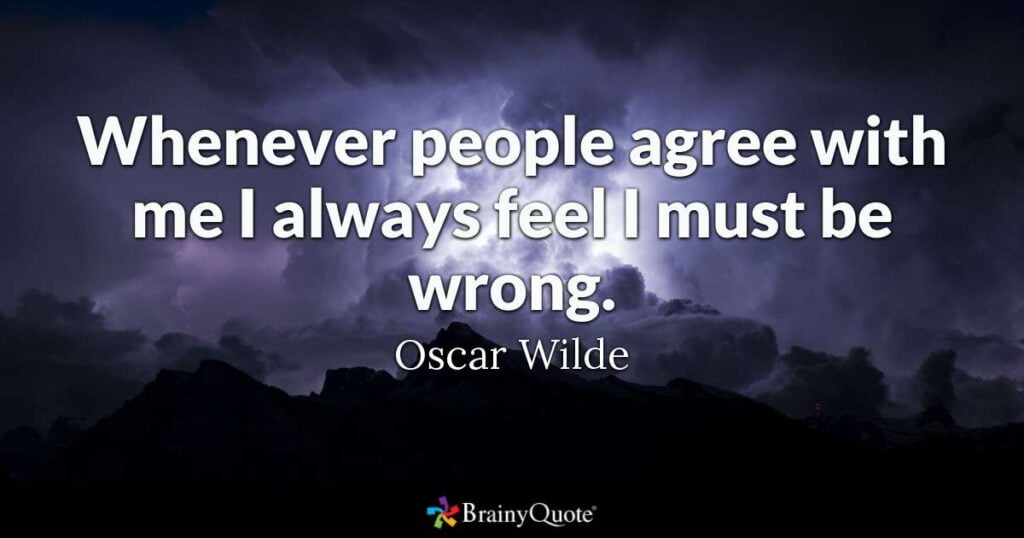
    Putting your work out for public consumption is one of the most vulnerable, and therefore terrifying, things you can do. It leaves many potential creatives paralyzed. Self-doubt erodes confidence. And it leaves many sheltering in place for years, preferring to feel the regret over not trying, rather than face the potential shame and horror of rejection and failure. Believe me, I know. Oscar Wilde shows the possibility of being an author and eventually arriving at a different state of mind. One in which the opposite becomes true. One in which good opinions may even alarm you. He clearly believed the good opinion of some people is not worth having.

    Quote from Oscar Wilde "Whenever people agree with me I always feel I must be wrong from BrainyQuotes - some good opinions are not worth having
    This is an artist comfortable in his own skin and comfortable with his own views (Image from BrainyQuotes)

    All Opinions Are Not Created Equal

    I’m not there. Perhaps few are. Sometimes the only feedback you have is the opinions of others. But all opinions are not created equal. The opinion of readers has value. Although, for a writer, the opinion of readers who are also writers is more valuable than that of non-writers, because familiarity with the difficulties of the craft makes the perspective and opinions of fellow writers more credible. 

    I’ve found thus far on my short journey as a daily writer, that the criticisms and edits suggested in love by my girlfriend, are of more worth to me than any number of accolades by strangers commenting online. It’s not that those good opinions aren’t worth having at all, it’s that they are worth far less than the honest, if pointed, opinion of someone who has seen me at my worst yet still believes in me at my best. 

    I’ll leave you with this final thought. While I believe the good opinion of some people is not worth having, I do think it’s worthwhile to have someone in your life who will push you to be your best, even if they’ve seen you at your worst. I’m aiming to be that kind of writer. Even though I don’t know you, I’m of a mind that there is far too much unrealized good in most people. 

    Therefore, the good opinion of anyone, who, by their assurances and affirmations, causes you to be complacent and contented with either subpar character, or shoddy work, whose approval and acceptance induces you to a lesser version of yourself, is also not worth having. At least that’s my opinion, for what it’s worth.

  • Writing v. Speaking: Writing Is More Artificial…which is not a bad thing

    One of the most satisfying aspects of writing and posting something daily is…you guessed it…writing and posting something daily. Writing is artificial in comparison to speaking. What do I mean? When you speak, it is mostly stream-of-consciousness, with opportunities to course-correct, amend, update, or renounce utterances on the fly. I hope all that makes sense. 

    Both speaking and writing propagate words into the world. But the spoken word is often uttered with less care and painstaking than the words of a careful writer. The impermanent means you can afford to be a little more free-flowing and off the cuff, less careful, less precise, overall. And for some, their emotional state may cause them to say things that will be briefly heard and pass into the ether more quickly than if they were to write the same things for posterity.

    Writing is really, rewriting. That’s what makes writing ”artificial” by comparison, since it is an abstraction from verbal language. Very close, intimate friends and companions will of course engage in “re-speaking” for the sake of clarity. Understanding and being understood are precious to intimates. It is the foundation of intimacy. So often, some “re-speaking” goes a long way to preserve and strengthen it. Of course, both are ”sequential” forms of communication. Each word, whether spoken or written, follows a clear start-to-finish linear progression. The visual arts – painting, dance, video, and certainly the art of music are also “artificial” forms of communication, like writing is, but they do not present information in a strictly linear format.

    That striving for understanding is where speaking and writing share the highest common goal. If you speak to someone and you are careful to read their body language, you can make observations about whether they are hearing you and understanding you. And you have the opportunity for feedback. Not so with writing. Which is another aspect that makes writing artificial in comparison to speaking. 

    If you’re writing, you’re only present in your readers head in the vaguest way. Your words are all you have. No possibility of reading the signs of body language. So, there is a lot of re-writing, re-thinking, restructuring. This ”artifice” is what makes it challenging and rewarding as a skill to be honed. But it has the benefit of helping you to clarify your views, think through an idea, maybe see if from a different angle. That’s a benefit that writing can grant to anyone.

    As I’ve written something for ”public consumption” each day for a couple of months straight, I notice my own thinking is becoming more disciplined and streamlined at the point I attempt to communicate my thoughts. So, I still have a meandering, serendipitous mind when it comes to exploring and indulging my interests, but I’ve gained a structure when it comes time to tell about what I’ve been grokking on. This is a good thing. No one likes endless rabbit trails and non-sequiturs in conversation, and certainly not in decent writing.

    These months of daily immersion have helped to clarify and streamline my thoughts, making me more conscious of what it is I want to say, and hopefully in the neatest, clearest, easiest to understand manner. I have a long way to go, lots of words to cut, and I look forward to getting better.

  • Thoughts on Covid Response — Culture Impacts Results

    The Covid-19 pandemic has been both a global morality play and a world-wide laboratory for observation of social behaviors. For the most part, countries and cultures steeped in cooperation and interdependence have responded better than those based more on individualism. By any metric, western countries, particularly the United States, show far more positive results and deaths when factored for population, than many Eastern, Asian countries. India is the outlier in terms of its rates of infection and deaths. One could hope they share a culture that values life and where the cultural impacts behavior in a positive way, to preserve it. That’s not always the case. Though it is the case that culture impacts results.

    Raw Statistics

    Statistical analyses of raw numbers like the ones linked above measure effects, not causes. There are not likely to be any studies broken down by political party or religious affiliation. If there were, they might prove illuminating. Not that politics or religions create disease. They don’t. They are not the primary cause. But once started, a viral disease spreads, or is mitigated, by the actions of the people where it is present. And people act on what they believe. Persons in the hardest hit countries, with the United States firmly ensconced in the top (bottom) position, either do not believe the virus is serious, or they don’t believe it’s up to them to do anything to help stop it.

    The surest proof of belief is action. If you believe a chair will hold your weight, you demonstrate that belief by sitting on it. All actions (and I include inactions as a type of negative action), are the effects of some type of belief. If I do X, I believe I will achieve Y. Or conversely, if I refrain from doing X, I believe it will prevent Y. Any modifications made to behavior on account of Covid have come from belief in their necessity and efficacy. Those who have not believed it was serious (at least to themselves) have ridiculed the warnings and spurned the recommendations. This has happened to a statistically significant degree in Western countries and cultures contrasted with non-Western.

    Is American Culture A Selfish Killer?

    The Soviet Union collapsed because its brand of Communism failed. What does the unspeakably poor Covid record of the United States say about our culture and government? Is American culture a selfish killer? Or is that an un-Patriotic question? Maybe that is an unfair comparison. Maybe it’s not relevant. But something in the fabric of Western culture (in general), and the United States (in particular) has been the cause of the atrocious global rankings. Some will comfort themselves with the notion that the US shows so poorly because we test so thoroughly. Some will say we are more honest and open with our results. (No one from New York or Florida, though). These views may be accurate. If so, I stand corrected. There is no evidence to suggest these scenarios are true. And it doesn’t negate the fact that many (including many state governors) believe liberty and economics are more valuable than health and life.

    Origination is not as important as Elimination

    To bring this back to my opening, a pandemic starts however and wherever it starts. Knowing how and where this virus started provides zero useful information to stop it. Humans are hard-wired to assign blame, but sometimes fingering the culprit is not as important as limiting the damage. Once started, people are alternately praiseworthy or blameworthy for their actions to limit the spread. Here again, the culture impacts on results.

    The West could have learned from the pandemic. Citizens could have been made aware of shared, mutual dependencies. From the outset, political leaders could have promoted the literally life-altering message of self-sacrifice for the greater good. Instead, it has been the vehicle in an all-out race pitting lunatic-liberty against life. A difficulty for many to embrace these concepts may hinge on their unwillingness to take any responsibility for their role in spreading a virus they don’t feel responsible for starting in the first place. Since they did not personally start it, they absolve themselves of any responsibility to slow its spread. I don’t know if that’s true. I suppose another possibility is that a lot of people in Western civilizations really just don’t give a damn about each other, acting out the belief that people aren’t all that important, except as tools for making money.

  • Labeling

    These are usually meant to be filled in by the wearer, correct? …Thought so.

    People who are all one thing may exist. I cannot prove they don’t. I am not one of them. Those I’ve known beyond the level of acquaintance have all seemed composed of a blend of interests and beliefs, like me. Their bundle of contradictions and idiosyncrasies may be a different size than mine, but I’ve yet to meet the human version of a concrete monolith.

    A feature – or is it a bug? – of Western culture is the inclination to categorize and to classify: Domain, Kingdom, Phylum, Class, Order, Family, Genus, Species. Thank you, Mr. Aristotle. These main categories are fine as far as they go. The broader the category, the more members. Within each main Classification are sub-classes for further sorting and refining. As the concentric circles of inclusion tighten for each subset, the smaller the pool of members. Inclusion in one grouping down the hierarchy happens simultaneously with exclusion and separation from the others.

    The 7 broad brush categories (and their nested sub-categories) are useful for some things, but be honest, prior to reading the category names, how long had it been since you’d thought of them? The classifications aren’t helpful at all in pursuit of self-realization (unless self is broadly defined as that which everything else is not). One doesn’t discover the concept, Species, and cry ”Eureka!, my quest to know myself and my purpose on this planet is over!”, ”I belong to a species!”, ”Glory, Hallelujah!”

    Deeper levels of categorization create problems. ”I’m a homo sapiens,” you declare, satisfied with the sub-division distinguishing yours from other species. Is additional fine-tuning necessary? Knowing your species and behaving as such will answer many questions: who can I successfully mate with? Is this why my body isn’t covered with feathers? So, my brain is larger than a lion’s, but I’m slower, so that means I’m supposed to out-think and not outrun them, right? Seems to be refinement enough, because traverse one level down and you’re at the edge of quicksand.

    There are several subspecies of homo sapiens, of which Homo Erectus is our home base. At this, the Homo Erectus level, we are one big, happy family of Man (pardon, ladies). And now comes the fun. We divide into Sexes. Used to be no biggie, but now we further divide into Gender (and its definitions – including whether or not one is Cis-Gendered) and Sexual Preference (with its accompanying divisions). We divide into Races. Always a biggie because it includes not only the amount of an individual’s melanin, but also National identity as well as historical atrocities and grievances . We divide by Culture. This one makes us feel threatened because of differences of language and art and world view. (Some of us even take shelter within a subculture.) We divide by Religion. Not content to rest in the security we find in our own, we must discredit, disgrace, and disavow all others, as well as belittle and exile those who neither share our preferred Faith, nor claim any Faith at all. We divide by Socio-Economic class. Because Capitalism, Yo! And…we divide by Political ideas, which is not exactly true, is it? We divide over politicized words, the common person having little to no real understanding of what the emotionally charged ”isms” even mean.

    The average person doesn’t know the difference between Communism, Democracy, or Socialism, much less the variants. If pressed to define those terms, could you do so without resorting to a dictionary? Can you confidently say what Conservatism is? Progressivism? What are the rules for inclusion? What you do know is how you feel when you see or hear political labels. You know some people you like, and you want them to like you; and you listen to what they say to believe, and that’s good enough for you. No further thinking required. Peel off the adhesive backing and apply the label.


    But what do you call a guy who spent years as a cross-country, touring DeadHead (and who still loves their music), a former drug addict turned street evangelist and full-time minister (who loves Jesus), a father of seven kids (all birthed at home and subsequently home-schooled), a gun owner and concealed carry permittee (who once even had an AR-15), an entrepreneurial small-business owner of an S-Corp LLC, who hasn’t worked in an office in 18 years, a lifetime Republican voter (until Trump v Clinton forced a decision to vote Libertarian, and then Trump v Biden forced a decision to vote Democrat)? What do you label a guy who would rather read than sleep (and often does), and who has accumulated more mostly useless knowledge on such a wide variety of topics that even he doesn’t know what he’s most interested in, but who could therefore convincingly debate either side of almost any topic, and enjoys doing just that? What do you call someone who has only strong opinions, but who is equally convinced that he could be wrong about any or all of them?

    Go ahead, pigeon-hole me. 

    However, the paragraph above notwithstanding, this essay is not about me. This is about the foolishness of labeling and of dividing over minutiae. I offered my details to illustrate the absurdity of slapping a too-granular, one-word label on another person. If pressed, there is no single label that comes to mind that I would be agreeably comfortable to wear. Your mileage may vary, but is that not also true for you? If yes, then what can we do about it?

    We have two choices. One, we can stop focusing so much on the smallest circle of belonging, and widen our aperture of inclusion to the next circle out, or if that’s still too tight, the next. Unity lives in the big circles. It shares quarters there with Understanding, and Humanity, and Love. I know this sounds like idealistic, utopian, liberal-speak, but it’s true. If it’s not, then our second option is to keep digging smaller and smaller circles for our like-minded tribe until we’re down to a foxhole. That’s a tight fit to be shared with one, and only one, other person. I cannot speak for you, but I would be hard pressed to find anyone with whom I am in agreement on all things, 100% of the time…not even myself. 

    You may need that level of agreement and uniformity of compliance in order to feel good about yourself and your life. For your sake, I hope that’s not the case. That’s a hefty burden of insecurity to lug around. I don’t want any ideas or beliefs that are so fragile that I have to defend them against all opposition lest they die. The more compulsion I feel to defend a position, the less certain I am of its correctness. Truth and Good Ideas far outlive both their proponents and their opponents. Who wants to live in a carefully detailed, perfectly classified, scrubbed, and homogenized world? That seems more like a taxidermist’s shop, or a Nature museum than the messy Real World we’re in.  It’s not that hard to see that each of us is more than a slogan on our bumper stickers. One rung up the classification ladder, we’re a helluva lot more alike than we are different.

  • The Menu

    Today’s selection affects tomorrow’s offerings

    You are born into this world and within a matter of years an invisible but real menu of options is  yours. Your menu is yours and no one else’s, listing things only you can do in your life. Some of the items on your menu are still there. They are still available to you. Other options have disappeared. They are forever off your menu. They may have vanished when you chose one course rather than another, that is, your choice of one thing, negated the other. They may have disappeared because the opportunity window closed.

    When you die, the opportunity window closes forever. I am not trying to depress or frighten you. The best time to have thought of this was fifteen or twenty years ago. The second best time is now. You have fewer items on your menu today than last year on this date. You may have fewer items than last week, or yesterday. The items on the menu shift and disappear. Some of the items on your menu when you were young are as gone as if you were already dead. This is an almost unbearable sadness when you think about it. 

    This is NOT you, but it will be each of us, one day.

    Don’t think too much about what’s gone. If you’re reading this, you still have a menu. But don’t hesitate either. An option available today, could be gone tomorrow. There remains the possibility that you will make a choice today of such import and impact that new items appear. You can create new options for yourself. While some items fade, disappear, and are gone, others will beckon you onwards to a life still to be lived. All the windows aren’t closed yet against the chill of age. What remains on your menu of choices? What will you have today?