# 23 on my 99 Life Tips–A List is: Music bypasses your thoughts to affect your emotions directly. It is unique among art forms for this quality as far as I’ve discovered. Take care then, what you are inviting to stir your emotions.
Music affects emotions and brain responses in emotional centers regardless of lyrical content, or whether the pieces are solely instrumental. There is a body of brain imaging and clinical proof that music bypasses your thoughts to affect your emotions directly.
This topic is worthy of a book or a doctoral thesis on its own. I will limit my commentary to calling your attention to the facts stated. Of note is that one study linked above showed that hearing sad music provoked some people to deeper levels of sadness.
“… the study found that for some people, sad music can cause negative feelings of profound grief.”
~ Memorable Experiences with Sad Music—Reasons, Reactions and Mechanisms of Three Types of Experiences published in Plos One
Emotions usually spring from thoughts
Emotions usually arise as the products of thoughts, and independent of willing them into existence. A person can choose to be happy, but cannot by willing it, make it so directly. One cannot will happiness. One must first think happy thoughts… or listen to happy music. Music affects your emotions directly, not needing the mind to act as conduit.
I am listening to jazz by Art Pepper as I write this. This is the first time I’ve immersed myself in an hour of his playing. I am familiar with him as a jazz musician only because I’ve read references to him in some Barry Eisler books, and I’ve heard snippets of tunes while watching the Bosch detective series derived from Michael Connelly’s novels. (You can stream Bosch on Amazon Prime Video).
Having no familiarity with Pepper’s music, I am enjoying his fluid, sensual, upbeat, even cheerful jazz clarinet and saxophone as the perfect accompaniment to writing. There is nothing melancholy or depressing about it. It is urgent and energetic—sometimes staccato, phrased like well punctuated sentences. He plays woodwinds the way a hummingbird flies, darting here and there—never still for long. There is nothing angry, and certainly no rage. I find myself carried along, fully engaged with the virtuosity of expression, the coolness of style that draws me in like a whisper rather than repelling me like a shout.
Ray Bradbury said the best jazz musicians play as if they don’t believe in death. An hour or so in and I know Pepper is an unbeliever, too. Listening to him I don’t believe in death, either. Rather, I feel smarter, more sophisticated and cosmopolitan—more vibrant and alive. It would be the perfect soundtrack for a dinner party, or an art crawl. Perhaps to serenade a gathering of happy, comfortable friends as they sample wines, cheeses, and chocolates. I like it. It makes me feel good and I will add Pepper’s jazz to my rotation.
You have your favorite music. Ask yourself what it does for you. How does it make you feel? Do you have a “go to” band or song?
Music as mental health medicine
I have a life-rule not included on my 99 Life Tips list, but it would easily be the hundredth tip. Never, ever drink when you’re down. That, too, is a story in its own right. You should, however, have some healthy alternatives for self-medicating your mental health. I find there is nothing better than music. The studies linked above cite the therapeutic value of music as well. Music affects your emotions. Just take care to recognize which emotions you’re inviting yourself to feel when you make your choice of music to listen to.
“Dear Mr. Fantasy, play us a tune
Something to make us all happy
Do anything, take us out of this gloom
Sing a song, play guitar, make it snappy
You are the one who can make us all laugh
But doing that you break out in tears
Please don’t be sad, if it was a straight mind you had,
# 74 on my, 99 Life Tips–A List is: Think less about how you feel and more about what you should do.
The people I know who spend the most time analyzing how they feel consistently feel the worst. I may confuse correlation with causation, a common problem, but the predictability of this outcome led to the tip above.
For consistently better feelings, how you feel matters less than what you do. If you will refocus your attention, you’ll feel better,… and be more productive, to boot.
I’m on a sometimes weight loss (sometimes weight gain) regimen known by its common name as a “diet”. To track progress, I stand on a scale hoping it doesn’t chuckle and say, “One at a time, please.” I can see the number. It is measurable, serving as an indicator of whether I can afford to drink a beer.
There is no empirical scale for emotional states
Seriously though, emotional states don’t work that way. There is no objective, empirical scale.
Asking someone whose emotional states fluctuate dangerously how they feel on a subjective 5-point scale is the equivalent of asking an obviously drunk person if they’re drunk, and what they think they’d blow. Chances are high you will not get an accurate answer.
Maybe I’m different, but whenever asked to pick from three emoticon faces ranging from sad—to neutral—to happy, nine times out of ten, I’m neutral. I seldom think about how I feel.
When I feel good, I just enjoy it. It doesn’t occur to me to stop and evaluate whether I’m at a 3.5 or 4. If I feel bad; I figure out why, what I’m thinking, what it would look like fixed, and what I can do about it. I don’t ponder whether I’m feeling a dismal 1 or perhaps as high as a 2. Degree is irrelevant.
If you get stuck here, analyzing and cataloguing your feelings, you may wish to reconsider. How effective is it? What does your subjective answer about your subjective feelings tell you except in the most general terms?
It is important to know how things make you feel so that you can do something to either recreate them or eliminate them. The action you take is the key thing.
I’ve written about the relationship between emotions and thoughts, so this is where I start when I feel bad. My thinking is the usual culprit. I don’t start by figuring out how bad I feel. I don’t press on my emotions like I do bruises. If I feel bad at all, that’s bad enough to take action.
You most definitely figure out what you’re feeling so you can act accordingly. What you feel and how much you feel are different. Yes, figure out what you’re feeling; think less about how you’re feeling, and figure out what you should do.
Because ultimately, how you feel matters less than what you do.
# 72 on my, 99 Life Tips–A List is: Remember that anxiety is making payments of worry in the present for a future outcome that hasn’t occurred yet. There will be plenty of time to feel bad about that outcome when it arrives. 90% of the time, it won’t.
The temptation when writing about overcoming anxiety is to sermonize Philippians 4:6, which starts with an imperative commandment:
Be anxious for nothing…
While the prohibition against anxiety is as binding as those against murder, adultery, and lying, this one usually gets a pass.
We treat it as an affliction, or disease, more than as a volitional sin. That’s hard to even put in writing. I have such empathy for those in my life who suffer with sometimes debilitating bouts of anxiety.
Nor have I been immune. But my tip above shows how I deal with it and to date, how I’ve successfully prevented succumbing to it.
Recognize what anxiety is. It is present-tense worry about a future outcome. We rarely feel anxious about past events. There may be regret or even depression over some past misfortune or tragedy. Depression seems to occupy the past predominantly. But we rarely worry about events behind us.
Anxiety about the future is the desire for reassurance and certainty that are impossible to give or receive. The uncertainty creates worry universally dominated by things out of your control. Wasting emotional energy on what you cannot control is debilitating.
But you don’t need me to tell you that.
Be Here, Now
You cannot stop how you feel unless you refuse to get into the mental time capsule that keeps playing images for you of events that haven’t happened yet.
It takes a concerted effort to be present to right now.
It is staying present to right now that defeats anxiety. It is the only thing that consistently does.
Focus on the moment and the resources you have on hand to meet it. You don’t need resources for tomorrow yet, or for next week, or next month. When those moments arise, you’ll find the resources you need. Those scenes you fear, the ones playing on the future-projector in your head, may never happen. Leave room in your thinking for the possibility that unforeseen factors and forces may edit them out completely of your future.
One thing about that verse from Philippians; it mentions Thanksgiving, or gratitude. One of the surest, most powerful tools in your arsenal against either anxiety or depression is the practice of present-tense gratitude.
It is impossible to be grateful and anxious, or grateful and depressed, at the same time. Gratitude is key to overcoming anxiety.
Relish with gratitude every simple pleasure and praise-worthy thing in your life that is yours right now. That breath you’re taking might be a good starting point. You got this.
Cam Ward in goal, before giving up 5 and winding up in his own net.(Photo by author)
# 55 on my, 99 Life Tips – A List is: Conflicts are unavoidable. Sometimes the most moral stance possible is to engage.
The first sentence ”Conflicts are unavoidable,” needs no proof. The second requires a book. Perhaps I will write it one day. I’m on my 3rd draft of this essay. I started with Friedrich Nietzsche, and Thrasymachus from Plato’s dialogues. And I went from there to invoke MLK, Jr, then Thoreau and Lincoln, and on to the great social and moral conflicts of the last century and a half. Those drafts outgrew a blog article.
For now, I will attempt to defend the second sentence with a personal anecdote about a night at a hockey game.
I’m a sports fan. Athletic contests involve both skill and luck. I’ve been a fan long enough to experience times when the best team hasn’t won. And other times, the team I’m pulling for just isn’t the best team. But I’ve only jumped in to engage one time as a fan, giving full throat to my righteous indignation…and it was a disaster.
A promising start to a celebratory night
A few years ago, for my birthday, my girlfriend got us tickets to see the Carolina Hurricanes play the defending Stanley Cup champion Pittsburgh Penguins in Raleigh. This was a rare and special treat.
We stayed at a swanky hotel not far from the arena, and took an Uber so we could have some adult beverages at the game.
She got excellent seats maybe three to four rows from the ice. I was decked out in my Hurricanes jersey, and I drained a couple of bourbon’s from the concession stand during warmups, excitedly waiting for the first period puck drop.
Prior to the start, I noticed a lot of gold and black around us, (Pittsburgh’s team colors), and quite a few Malkin and Crosby jerseys. (Pittsburgh’s All-Star players). They had won last year’s Cup, so I was sure there were a lot of bandwagon Penguins fans who had come to watch their team. I was mildly annoyed, since this was a Hurricanes home game, but I thought the rival fans were about to suffer some serious disappointment. No worries.
It was not to be.
By the mid-way point of the game, the ‘Canes were behind 4-0. It could have been a lot worse. The ice was tilted towards whichever end held the Hurricanes goal. The puck and the action stayed in the Hurricanes zone, and four times wound up in the back of their net. On this night the home team was seriously outmatched.
I was dismayed. And I probably could have handled the loss if not for the sea of black and gold clad high-fives around us every time the Penguins notched another goal. The Pittsburgh fans were riotous. And then, they got rude…
The conflict appears, and rapidly escalates
Shortly after the start of the last period, with the outcome of the game clearly decided, the Penguins wanted to rub salt in the wound. They dumped the puck into the Hurricanes zone. The goal was on the end of the ice right in front of our seats, as it had been in the first period.
On this particular play, one of the Pittsburgh players, skating in hard to control the puck away from the flat-footed Carolina defensemen, happened to clip the ‘Canes goalie with his skate, tripping him to the ice. No call from the referees, who let play continue, ignoring what I thought was an obvious tripping penalty. I was livid. And I yelled out my frustration.
Somehow the Hurricanes cleared the puck out of harm’s way as their goalkeeper, Cam Ward, scrambled back to his goal crease, to defend his net.
On the very next play down the ice, one of Pittsburgh’s most notorious players, Patrick Hornqvist, barreled into Ward, knocking him backwards into his own net. The collision happened just as another Pittsburgh player let fly a wrist shot towards the net. Ward went flying ass over tea kettle, even knocking the goal off its moorings, but not before the puck had crossed the goal line, making the score 5-0.
To me, this was an obvious case of goaltender interference. The goal should have been disallowed, and the Hurricanes should have gone on the power play with a man advantage.
But no. Not only was there no penalty. The goal was allowed and the Pittsburgh fans began to mock and jeer and laugh at Ward and the pathetic, disheartened Hurricane players. They were jumping up and down and high-fiving each other, and pointing at the overhead scoreboard in obvious glee.
Excuse me while I make a fool of myself
I popped. This time when I stood to yell, I was screaming at all of Pittsburgh. I yelled profanities at the referees, at the players, and to my girlfriend’s horror, to the fans seated in front of and around us. I was a complete ass. But I was standing up for my team, by God!
Typically, a hockey team, when seeing one of its players physically maligned by an illegal or particularly aggressive hit, will defend their teammate and ”police” the action by fighting for him. Especially so, when it is their goalie.
Not on this night. Not these players. The Hurricanes skated around meekly with their tails tucked between their legs where their testosterone ought to have been. I’ve seen Olympic ice dancers with more fortitude.
I idiotically acted like I could make up for it, and defend the weak with my embarrassing tirade. It’s a small miracle that I didn’t start a fight myself, one that could have put me in the hospital.
In an athletic contest, with no moral or social ramifications whatsoever, I engaged. I engaged even though I was just a fan, with zero power to affect the outcome. I was just there to watch and enjoy the experience with my girlfriend, regardless of the outcome. At least, I should have been there for that alone. To my everlasting shame, I let my emotions and allegiances dictate my behavior.
This story illustrates what my tip means. In reverse.
Hey look! Everybody has an opinion. Gee, does that mean I should want the good opinion of everybody? (Adobe Stock image: licensed by author)
# 54 on my, 99 Life Tips – A List is: The good opinion of some people is not worth having.
If you followed the advice in Why You Should Stop Caring What Other People Think About You, and stopped caring what other people think about you, shouldn’t you still want everyone’s good opinion? What’s the harm in that? On the surface this seems desirable. Whence then, the assertion, since this is not so much a tip, that some good opinions are not worth having?
A Matter Of Respect
This is primarily a matter of respect. The degree of respect you have for the boss or the customer, the friend or the stranger, the critic or the fan, is what gives value to their opinion, or else devalues it.
And there are at least two things that affect the level of your respect. They are character, and expertise. It is appropriate to give higher weight to the opinions of those with high character or proven expertise in any combination. Likewise, the inverse is true. It is safe and even advisable to discount the opinions of those with low or poor character, and/or zero or limited experience and expertise.
I’m sure you can think of someone whose opinion of you is less than meaningless. Not only do you not care what they think, you’d be embarrassed if they had a good opinion of you. Their regard would serve as an indictment of your character.
Is the person you have in mind a scoundrel or criminal? If so, they are probably at the extreme end of your personal scale. As you slide the scale upwards, you’ll reach a point at which opinions begin to have some meaning and value, at least as benchmarks.
Desiring Good Opinions Is Natural
Even if you don’t struggle with receiving your sense of worth from the opinions of others, and even if your sense of who you are is self-determined, and not foisted upon you, none of us are completely immune to feelings that naturally arise when we hear the opinions of others expressed about us or our work. This happens in the workplace. It’s true with the views expressed by those closest to us. And is especially true when you’re a creator. The desire for positive feedback is natural.
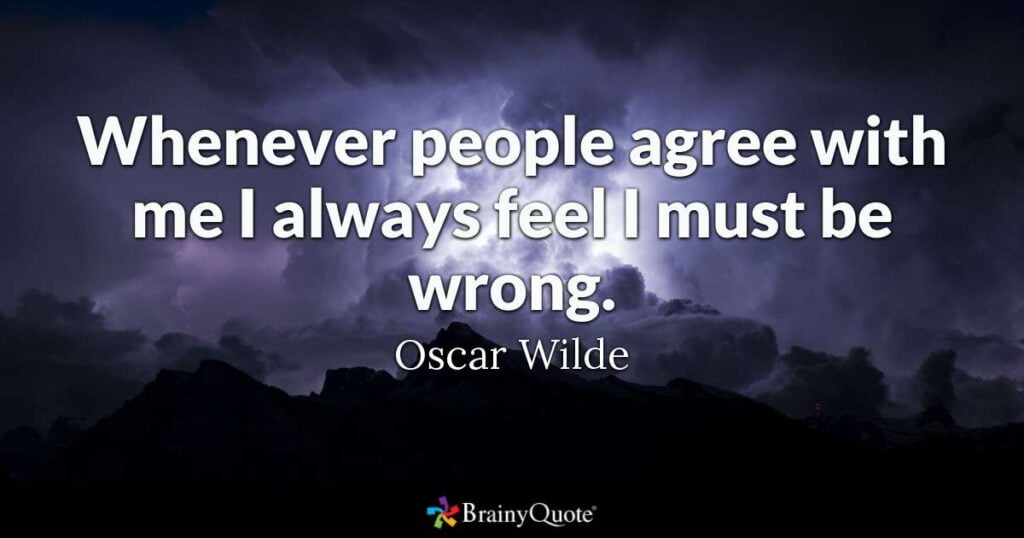
Putting your work out for public consumption is one of the most vulnerable, and therefore terrifying, things you can do. It leaves many potential creatives paralyzed. Self-doubt erodes confidence. And it leaves many sheltering in place for years, preferring to feel the regret over not trying, rather than face the potential shame and horror of rejection and failure. Believe me, I know. Oscar Wilde shows the possibility of being an author and eventually arriving at a different state of mind. One in which the opposite becomes true. One in which good opinions may even alarm you. He clearly believed the good opinion of some people is not worth having.
This is an artist comfortable in his own skin and comfortable with his own views (Image from BrainyQuotes)
All Opinions Are Not Created Equal
I’m not there. Perhaps few are. Sometimes the only feedback you have is the opinions of others. But all opinions are not created equal. The opinion of readers has value. Although, for a writer, the opinion of readers who are also writers is more valuable than that of non-writers, because familiarity with the difficulties of the craft makes the perspective and opinions of fellow writers more credible.
I’ve found thus far on my short journey as a daily writer, that the criticisms and edits suggested in love by my girlfriend, are of more worth to me than any number of accolades by strangers commenting online. It’s not that those good opinions aren’t worth having at all, it’s that they are worth far less than the honest, if pointed, opinion of someone who has seen me at my worst yet still believes in me at my best.
I’ll leave you with this final thought. While I believe the good opinion of some people is not worth having, I do think it’s worthwhile to have someone in your life who will push you to be your best, even if they’ve seen you at your worst. I’m aiming to be that kind of writer. Even though I don’t know you, I’m of a mind that there is far too much unrealized good in most people.
Therefore, the good opinion of anyone, who, by their assurances and affirmations, causes you to be complacent and contented with either subpar character, or shoddy work, whose approval and acceptance induces you to a lesser version of yourself, is also not worth having. At least that’s my opinion, for what it’s worth.
Thoughts yield Emotions, Emotions come from Thoughts. However you think of it, you cannot will emotions into, or out of, existence (Image by author)
# 48 on my, 99 Life Tips – A List is: Emotions cannot be directly controlled by the will. Try to be scared now. You have to first think of something scary, right? All emotions are this way. They are the fruit of your thoughts.
You Will Never Un-See This Truth
There are some truths that, once presented to the mind, become irrefutable. The truth that emotion cannot be directly controlled by the will belongs to this class. Try it. As demonstrated in the example above, feelings don’t respond to your will. Your mind and thoughts must play an intermediate role. This role is indispensable. Your will cannot control your emotions. It cannot produce fear on its own initiative.
If you try now to be joyful, say, as an act of will, you will encounter the same obstacle. You must think of something joyous first. Once you do, the emotion is easy to produce. In fact, it is impossible to feel any other way for as long as you keep the joyous thought in your mind.
My life has been full of terrible misfortunes, most of which never happened.
~Michel de Montaigne
If you cannot make yourself feel a certain way by willing the feeling into existence, neither can you will the feeling out of existence, once you’re feeling it.
While I am a staunch advocate of controlling everything you can. The linked discoveries that my will cannot control my emotions, rather, that my emotions come from my thinking (which I can control), has proved of incalculable worth to me. I hope you will find the same benefit.
Exactly How Does This Help You?
Knowing the general rule of where your emotions come from, allows you to know how to change them. And it will keep you from wasting time and energy listening to bad advice like, ”Don’t be (angry, afraid, anxious,)”
Your will doesn’t control your feelings. So you can safely stop trying.
Sometimes, knowing what not to do is an important step in discovering what to do.
Now, you realize the following:
Your will does not produce your emotions, instead;
Emotions are the products of your thoughts, and;
Thoughts can be controlled by a conscious, willful choice (in the absence of mental illness of neurological pathology), therefore;
Saying this woman feels “bad” doesn’t reveal much about what she’s really feeling. We would have to go granular to find out. (Adobe Stock Image: licensed by author)
# 45 on my, 99 Life Tips – A List is: In the face of negative emotions, go as granular as you can to analyze and identify exactly what it is you’re feeling. Generalities like, ”I’m just sad,” won’t work.
No matter your optimism, positive-mindedness, or mental toughness, there will be times when you feel bad. Unfortunately, this fact besieges and ensnares us all. Even those whose practice is to deny negative emotions, for a moment feel bad enough to trigger their denial response. It is neither a crime, nor a sin, to feel bad. In the physical world, pain is a signal that something is damaged or injured and needs protective care. Ignoring physical pain can lead to permanent damage.
This is also true of emotional pain. Ignoring or denying mental and emotional pain is not an effective strategy if mental and emotional health is the goal. Neither are generalizations a good remedy. Telling yourself, or others, ”I’m just down today,” or, ”I just feel bad,” doesn’t give any clues either to what it is you’re really feeling, or to the cause. Think of the last time someone mouthed this to you. Did their, ”I just feel bad,” provide enough useful information to offer a solution or ease their suffering?
Sometimes, we guard our privacy by deflecting unwanted attention away from our down times. Uttering a generic, ”I’m just a little down,” can be a defensive, avoidance technique. However, it’s not healthy to do this to yourself. One practice that is helpful is to probe deeper than these surface generalities to unmask exactly, precisely what you’re feeling.
Emotional Nuance Is More Than Semantics
There is a difference between ”sadness,” and depression, and between depression, and anxiety. Likewise, are you ”upset,” or frustrated? ”Angry,” or just annoyed? Do you feel ”hurt,” or ashamed? Are you simply ”bothered,” or do you feel overlooked and invisible? These nuances of emotional intensity and precision are more than mere semantics.
Going ”granular” yields analysis of your feelings with specificity. And the process of ferreting out precisely what you’re feeling, will often reveal why you’re feeling it. Oftentimes, this discovery is the insight you need to change the way you feel. Sometimes this happens instantly. Other times, you’ll come away with a hard-won lesson that can bring beauty and wisdom from the pain. At minimum, you will have a diagnostic tool revealing the root causes of the matter.
The next time you feel bad, go as granular as you can. Dive deeply to discover exactly what you’re feeling. You’ll likely also uncover the ”why” of your negative emotions, and this awareness will equip you to address the roots, and not just the bad, surface fruits, represented by those generic ”bad” feelings.
Emotional Intelligence starts with the recognition that All Emotions Are Valid
# 44 on my, 99 Life Tips – A List is: Allow everyone in your life to feel how they feel, they’re going to anyway. If you tell them they shouldn’t feel a certain way, you’re alienating yourself by your own emotional ignorance.
To start, I want to acknowledge and thank John Gottman, author of multiple books, relationship and marriage therapist par excellence, and founder of the John Gottman Institute, where many fine people continue his work on relationships and emotional maturity. Many of the things I will touch on in this article I learned from reading his books and watching his videos and Ted Talks (like this one with over a million views).
I’ll also be linking to several articles for further reading. I promise I’m not intentionally plagiarizing any specific comment, phrase, or idea, but after 16 years of assimilation, I’ve adopted a lot of the language as my own.
Wow. Where do I start with this one? It is regrettable that I discovered the truth that all feelings are valid, far too late in my life. 40 years old, married, and the father of 7 kids, I was an emotional idiot, alternately over or under reacting to the negative emotions of the people around me. I even became a full-time minister. Nevertheless, I possessed zero, ZERO emotional intelligence. Why? Mostly because of how I was raised, and consequently conditioned, to deal with negative emotions.
Before proceeding, it must be noted that emotions, typically thought of as feelings, are not just feelings. They are behaviors, too. The feeling of anger can give rise to an outburst (behavior). Negative emotions form patterned responses (including associated behaviors) from a young age.
Four Parenting Styles
Gottman identifies four distinct parenting styles that influence the development of these patterned reactions. These styles imprint children for dealing with negative emotions as they grow into adulthood. I’ve linked an article outlining each of the styles. Only one of them can develop emotionally stable kids who grow up to be emotionally intelligent and emotionally mature adults. That style is the ”Emotion Coach”.
Emotion Coach parents recognize the validity of a child’s negative feelings, and help their child work out appropriate responses. This is the crux of the matter if you ever hope to become emotionally intelligent, benefitting both yourself and the people with whom you are in relationship. All emotions are valid, even if all responses are not.
I wasn’t raised by an Emotion Coach. I was raised to deny negative emotions, to ignore them, and to distract myself from them. My mom was a bi-polar, suicidal alcoholic who took her own emotional medicine. When she felt bad, which was often, she wrote bad checks, or passed out drunk, or slept with inappropriately aged young men, or sometimes…took handfuls of pills.
Whenever I felt bad it was, ”Here honey, you don’t need to feel that way, have a drink.” And when I got angry, she’d get just as angry, or worse, apparently believing the way to exorcise anger was to blow it out of your system. We could be angry together. It was us against the stupid world.
Being A Christian Doesn’t Impart Emotional Intelligence
So, of course, my life followed the stereotypical pattern. I didn’t like to feel bad. I had learned that I shouldn’t have to feel along with many ways to make myself feel better. Sex, and cocaine, and weed were great ways to avoid, ignore, or distance myself from negative emotions.
This wasn’t going to end well, but it was definitely going to end.
At 21, I became a serious Christian. I mean really serious. But reading and memorizing large swaths of the Bible didn’t make me emotionally intelligent. In some ways, my poor understanding of Jesus and Christianity made me less so. If a Christian feels bad, it’s their fault, right? God doesn’t feel bad. Jesus doesn’t. If you feel bad, you must be doing something wrong that more prayer, or listening to more teaching tapes on Faith, or attending more meetings on Sundays and Wednesday nights can fix.
In short, I grew up believing that feeling bad is not okay. Feeling bad when you’re a Christian is REALLY not ok. I mean, what’s the point?
Maybe you grew up in a lion’s den, too. Maybe you were taught to deny your negative feelings because it is not acceptable to feel bad. I want to say however you feel right now is valid. It is how you feel. You don’t have to rationalize those feelings or justify them to anyone. They are yours, and you are entitled to them. I’m sure if we could all see inside your life and your head, we’d understand a lot better why you feel as you do. And if we couldn’t, that’s our problem, not yours.
Having said that, all of your responses to your feelings are not appropriate. I’ll explain shortly.
Even as an ardent Christian, I went years in a state of emotional detachment to people. Growing up with a mom who routinely attempted suicide, and even more regularly threatened it, doesn’t exactly make one trust and value long-term relationships. I had seen her be gut-wrenchingly depressive so often, with nothing ever coming of it, that I completely detached if anyone around me ever cried or got upset. My mom’s drunken, cryee-faced, suicide routine had taught me that kind of drama wasn’t real, and not something to get too alarmed about.
Inappropriate Responses
For years, I was happy, rarely depressed, not a substance abuser, had a wife and kids, friends, and at 26, became a full-time minister.
Then, 12 years ago, after 22 and a half years of marriage, I found out my wife was cheating on me with an old high school ”friend” she had reconnected with on Facebook. I was so emotionally oblivious that it went on for 6 months before I discovered her treachery. But then, according to pattern, I was devastated and angry. Murderously angry.
Those feelings, given my situation, were completely valid. (I even had a licensed Christian marriage counselor tell me so). Feeling betrayed, I wanted to kill. That’s understandable. But actually killing either of them would have been horribly inappropriate. It wouldn’t have erased the adultery, it would have just put me in jail for murder.
That’s an extreme example, but it is my story, and I’m sticking with it.
I’m also ashamed to admit, that sometimes after my girls became teenagers, struggling with typical teenage girl problems, they would cry themselves to sleep at night, and I was emotionally unavailable. Sometimes I would make it worse by telling them to pray. I didn’t want them to feel bad. I offered many reasons why they shouldn’t…usually heavily laced with what I thought were uplifting scriptures. But my attempts were born out of a stupidity about the nature of emotions and emotional connection.
It seemed the more they cried and hurt, the more shut down and aloof I became.
This all changed one night when I picked up my 15 year old second daughter from a party with friends. I knew she had a crush on a boy at the party and on the way home I asked her about him. She became upset and teary as she explained that he had hardly paid any attention to her. Crying, she told me he had been obsessed with another girl. Then she told me how bad this made her feel about herself, and how she would never have a boyfriend.
It was the perfect opportunity for me to be a good, loving, understanding father to a teen-age daughter who just needed me to be there for her. It was a chance to hear her, validate her feelings, and relate to her that I had been rejected and ignored at her age too, and I understood how bad that could feel. I wish I had been that father.
Instead, I told her how silly it was to be upset. I explained that at her age nothing was going to come of this crush. And I told her that the boy was probably not ”godly” anyway and that she was much better off not getting any more involved with him. I told her to be thankful and to feel good that that was over. I can vaguely remember her looking at me incredulously with a tear-streaked face in the dark car. And I thought I had done so well trying to make her feel better.
The Turning Point
When we got home, I went about my normal routine and thought nothing more about it. After a while, I overheard her talking with her mom. She was crying and clearly upset. I got up and came into the kitchen where they were. My daughter was sitting on a barstool, her face in her hands. More teen-aged female drama, I thought. Hadn’t I already dealt with this and helped her get over it on the way home?
I said, ”You didn’t feel this way on the way home, and we get home and you fall to pieces?”
”I cried all the way home, Dad,” she said.
”What? Now, you’re just lying.” I said in return.
She jerked her head up, tears streaming, and I had the flashback of her face in the dark car. My emotional blindness astonished and floored me. After apologizing profusely to her, I retreated into my mind to try to understand how I had tuned out her emotions and her crying on the way home.
Though I had failed at getting her to ignore her bad feelings, I had succeeded in ignoring them myself. My patterned response to her crying had been to erase it from reality. So much that, to me, it didn’t even exist. I had marched into that kitchen in righteous indignation, clouded by emotional self-delusion, as if she was making up the whole dramatic scene just to curry compassion from her mother. I was stunned…in the best possible way.
Emotional Connection
The next day, I searched for the words ”Emotional Connection” and discovered John Gottman.
Do yourself a favor and watch a video, or read a book. Don’t be like me. Er, don’t be like I was!
I’m not that same detached, emotionally unavailable man anymore. It has taken work. Some of the time it has felt very artificial because my ingrained tendencies to deny, deflect, and distract were so deep. I’m no longer afraid to feel bad, quite the contrary. And I have the distinct pleasure and honor of hearing my girlfriend tell that I’m the most emotionally intelligent person she’s ever known.
I have the unspeakable satisfaction to be there for my kids when things are bad, knowing that now, I’m in it with them. I’m able to relate to their emotions, and validate them, and they know it. I’m much more the Emotion Coach now, even to my adult children. I teach and model for them that all emotions are valid, even if all responses are not. I’ve stopped telling them how to feel, or how they shouldn’t feel. I let them feel how they feel. They were always going to anyway.
And I have the chance to share these things with you, dear Reader. I hope you’ll find how affirming and strengthening it is when you allow the people in your life to feel how they feel without judging them, or trying to change their feelings, or ”make them feel better.”
One of life’s greatest gifts is a kind soul who will help us shoulder the burdens of times when we feel down. A friend and partner with whom we can share our hurts without fear of judgement. One who will hear us, hold us, be there through it with us, allowing us the space to feel all we need to feel, and who will help us respond appropriately. You can be that gift.
PS–
There are times you’ll be in a position to validate and affirm someone’s emotions, when you believe the reasons for their emotional state may not be sound. That can happen. When it does, I encourage you to connect emotionally. Tell the person you understand how they feel. You may even say something like, ”It’s understandable you feel that way since that’s how you see ____________.” The time to discuss the reasons for the feelings will come after you affirm the existence of the feelings.
Learn to listen so well you can tell the speaker how they feel
# 43 on my, 99 Life Tips – A List is: Learn to listen,…no, really listen. You want to be able to summarize not just a list of facts the speaker is relaying, but how the person feels about those facts.
Most advice about listening well, while fine and helpful, focuses on techniques and tools more than on the proper mindset. We are told learning to listen well starts with paying attention. This is true. But where does undistracted attention start? What can our first experiences with listening tell us about being good listeners as adults? Here’s my theory.
No one is born knowing how to listen well. Though newborns dorecognize their own mother’s voices. It is believed they respond to the emotions expressed in ”baby-talk”, and begin to associate speech with the communication of emotion. This happens well before abstract meaning is understood.
This 2017 article in Time magazine shows what happens in mom’s brains when they hear their babies cry. The emotional and verbal centers fire in preparation for an emotionally attuned response. These neural changes don’t happen for non-mothers. Mothers of newborns listen well. Impressively well. They know how their baby feels just by the timbre of the cry. The interesting take away is the clear emotional component involved.
If you hope to listen well, you will also need to recognize how the speaker feels.
This article from the National Institutes of Health cites studies indicating that by ten months, a baby differentiates sounds of her native language from a non-native tongue, and soon thereafter begins losing the innate ability to form sounds not found in the ”mother” tongue.
This baby’s mom knows who it is and probably knows what it wants…just by listening
What does this have to do with learning to listen?
It seems that newborns and their parents are able to both hear and communicate with emotional fluency. That is, there is an unconscious, but underlying and foundational emotional bond when listening for, and speaking to newborns. And the newborn is attuned to the emotional conveyance of the babbling and cooings directed his way. Newborns and their parents intuitively know that verbal sounds carry emotion.
Newborns lose the ability to form words they don’t hear in their native language at about the same time they become more proficient in forming and trying out the words they do hear. This is what makes it difficult to gain linguistic fluency of foreign languages as we age. We will likely never sound like native speakers of languages not our own. We were born with the ability to trill ”R” sounds, but if we don’t hear that sound as infants, we’ll likely lose the ability. Just as it is difficult for a Japanese person learning to speak English who doesn’t grow up hearing the hard ”L” sound since it does’t exist in Japanese.
Babies learn to form sounds, and learn meaning by listening. Sadly, somewhere along the developmental arc, babies learning to speak, and learning new vocabulary, ”outgrow” the initial importance of the emotional impartation of language, in exchange for the mechanical and comprehension components. They stop listening for the emotion and begin listening for the mechanics and the meaning. And parents don’t emphasize the transference of emotion as much as their children age, either.
Paying attention is easy when you care, Impossible if you don’t
To be a good listener means going back, as silly as that might seem. New parents can hear the sound of their own baby because they care. As mother’s listen, their brains change, preparing for an emotional response to the perceived needs of the baby. They know that the emanation of sound is the expression of emotion. Their baby’s…and their own. Even if they are unaware of the psychology behind it, and would never say it just that way.
As this New York Times article points out, good listeners are similarly empathetic, listening from a sense of caring. Responding not just to the words spoken, or the recitation of facts, but also to the emotional frequency. The more you care to apprehend the speaker’s feelings, the easier it is to pay attention. Can you tell the speaker how they are feeling? A good listener can. The better you become at this, the more you will hear and retain. You’ll be listening and connecting beyond mere sound and meaning.
Emotional moment: man sitting holding face in hands, stressed, sad, feeling bad, depressed, disappointed. We’ve all been here.
# 11 on my, 99 Life Tips – A List is: Do not be afraid of feeling bad. There are things to feel bad about, and the contrast is a wonderful reminder of why gratitude is so important.
This is one of the most important Life Tips. It also swims upstream against the prevailing American cultural and social ethic. We are a country terrified of feeling bad. So, we medicate. We pre-medicate prophylactically to prevent even the chance we might feel bad. We’re so afraid to feel bad, we self-medicate. But you do not to be afraid of feeling bad. If you don’t know both how to, and when to, feel bad; if you make yourself artificially numb to negative feelings, then neither will you experience the full heights of feeling good.
This one has been difficult to learn. Obviously, one doesn’t learn to feel bad by being gifted a million bucks. I heard a preacher once say that if you pray and ask God to take away your bitterness, He won’t do it by giving you a Cadillac. The point being, we all learn to feel bad by hard practice. But face it, this life deals everyone some hard, hard blows eventually. Not to be morbid, depressing, or nihilistic, but everyone you love is going to die some day. And you will join them if not precede them. This unavoidable truth doesn’t exactly feel like Disney World.
But what do we do with that truth? I say, let’s wring all the pleasure and joy and love out of this short ride on the merry-go-round that we possibly can. And, let’s do so in the knowledge that being human is the experience of the full gamut of emotion: from heart-crushing grief to soul-enriching joy. We will face the things in life that feel bad and become more resilient, more capable of experiencing appropriate emotional responses, and more grateful.
And here is the most important point. You will feel the worst over the loss of something you loved the most. They are two sides of the same coin. It is impossible to feel bad over something you couldn’t care less about. Bad feelings are the result when something that made us feel good goes missing, or is lost to us in some way.
If you are afraid of feeling bad, my advice is never, NEVER, let yourself attach to anything that makes you feel good.
It is important that we allow ourselves to put on the sweater of our bad feelings as Morrie would remind us in Mitch Albom’s excellent book Tuesdays with Morrie. There are things that will always bring some measure of hurt, pain, or sadness when we reflect on them. This is as it should be. Some things in life just hurt. This is the way of life. How dare we try to escape that by numbing out? To do so is to deny the very thing that makes us human. That sweater of pain will always feel bad whenever we choose to put it on. But we can also take it off and not wear it all day, every day.
No friends, Do not be afraid of feeling bad. We are the species that loves, and marries, and feasts, and dances in the face of future imminent death. There is an undercurrent of sadness that accompanies our reality. You can accept that fact, face it, and choose to live as full of gratitude for the myriad good things that come your way in a world where nothing lasts forever, or you can numb out in the effort to escape it. Just be aware that if you are afraid of feeling bad, you’ll disqualify yourself from feeling good, really good.
NOTE:I am not negating the fact of clinical depression, or crippling anxiety. Nor am I either vilifying or castigating those who suffer from these medical conditions. These conditions supersede mere emotional states. However, as this article from February, 2021 suggests, the over-prescription of psychiatric drugs is not without serious drawbacks, especially when many cases of depression and anxiety are contextual, non-pharmacological, and would respond better to psychotherapy than to dependence on medications.
As a final thought on this topic, let me leave you with this beautiful song, from Rich Mullins, who was tragically killed way too young on his way back from a free benefit concert for Native Americans. A horribly sad thing indeed: