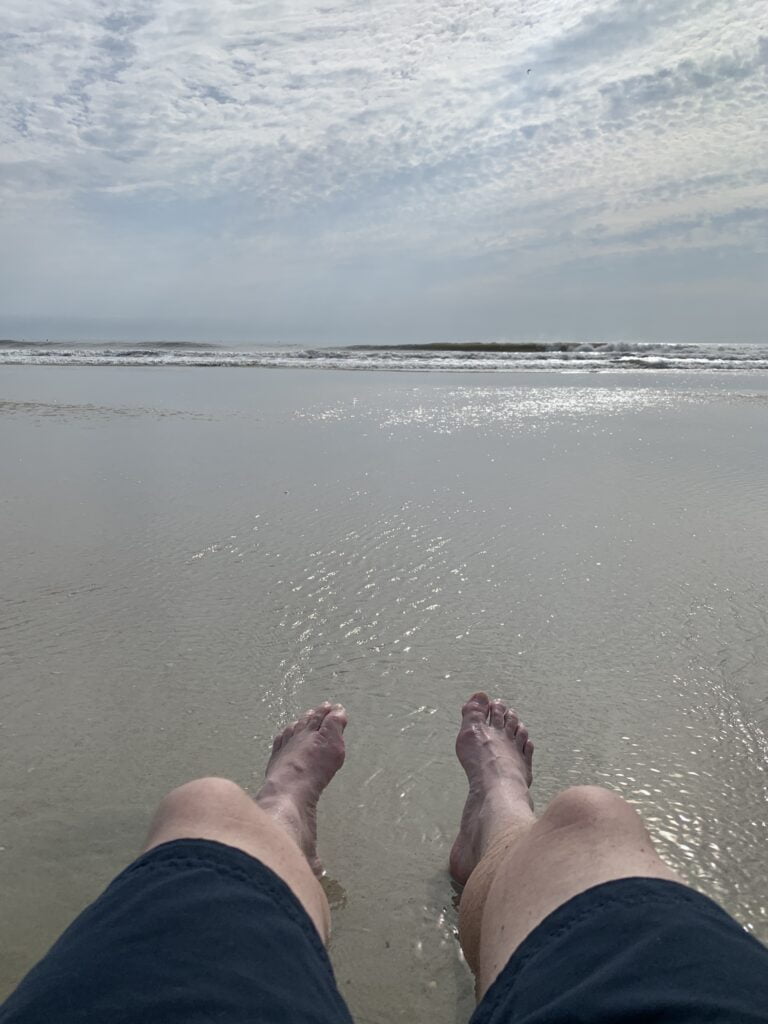
When you stretch out your feet to the incoming tide, lazily reclined in a beach chair, and the sun is a hand’s width above the water on the horizon, and the wavelets are chasing each other up the sand, and the egrets and sandpipers skitter nervously away as if they’ll melt if the water touches them, your mind isn’t occupied with what’snext..
You soak in the moment as you soak in the sun. This…this is the reason you’re here. It’s what you came for. It’s the end sought.
For most of us, ends as idyllic as that described above are rarities. They are valuable in proportion to their scarcity. Beach folk may no longer hear the murmur-Roar of the waves tumbling in. They may take these marvels of sight and sound for granted, because they’re no longer novel. And familiarity breeds contempt.
But what can we do, regardless of where we pass our lives, to extract the sublime from the familiar, eliminate the contempt, and cease taking anything for granted?
In that light, find small “mini-ends” throughout your day. Identify the ends in themselves. Look for them every time you drink a cup of coffee or tea. Savor every conversation with a loved one. Similarly, let each meal exemplify the opportunity to reflect on more than transience. Sure, you’ve had many meals. You anticipate others. But, stop to appreciate that by some miracle you’re having this one, right now. It’s the only time you’ll partake of this meal. That’s a worthy end in itself.
That mindset and it’s objective is what we cultivate by the practice of awareness, or “mindfulness”. To do so is to fill the mind with what is right in front of it. Extract the precious by appreciation of the obvious. Discover what is too often disguised by plain sight, and realize that if you’re still conscious of being conscious, things could always be a whole lot worse.
Findthese moments hidden in plain sight
Acquaint yourself with moments from which you want nothing else. Recognize and log in your awareness each time you recognize a moment to which you would add nothing to make it better, or sweeter, or richer. The more these inner promptings bring you into the present, the better you will come to know your true self.
You’ll see that the good life isn’t about waiting for the big, rare thing to come along. Rather, it’s seeing and appreciating the good already present in the so-called mundane grind of life. And when you can maximize happiness from the everyday, you’re living a rare life indeed
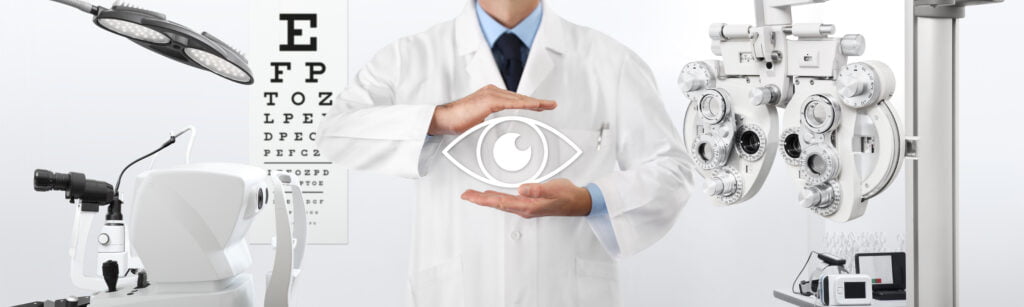
Eye vision test with sight chart – the chart is what it is
# 21 on my, 99 Life Tips – A List is: Accept life as it shows you it is, not as you wish it was, or as you want it to be. The same goes for people.
It’s possible some will read that tip, shrug, and think, ”No duh!” While others, myself included, will see that we resemble the remark, and try to act on it. While it is undoubtedly normal to put the best spin on life, some of us invest too much in the spin. If this is you, then let this be a reminder to accept life as it shows you it is. And also, accept people the way they show you they are, not as you want them to be.
Rather than try to enumerate all of the psychological reasons some people have difficulty with this, let’s stipulate that some simply do. You may be among that number. Assuming that’s the case, consider the following questions:
Is your experience of life the result of how you think life is; or do you think about life based on how life has shown itself to be to you?
Perception Is Reality
Few would admit they belong in the first camp. And yet, to some degree, we cannot experience anything differently than how we think prior to the actual experience. You bring your way of thinking about life to every life experience. This is commonly referred to as paradigm, which is nearly synonymous with perspective. The difference being that paradigm refers to the big picture ”model” of reality we mentally construct, while perspective refers to the small picture, individual, subjective point of view from which we observe the model and form beliefs about it. Together, these influence our perception of the world. And our perception is our functional reality. How could it be otherwise?
In this way we experience life like a person who perpetually wears sunglasses. The sunglasses filter everything. The filter modifies the reality of what is being looked at. Remove the sunglasses, and everything looks a little different. Change the filter and change the world.
This optician, with his charts and machines can help you see things in the physical world the way they are. You’ll have to do that for yourself in your mental world.
A patient in need of eyeglasses looks at a chart, or at images though a machine. The images are blurred. An adjustment is made. The images get worse. Another adjustment, and the images get better. They appear sharp, crisp, and in focus. In this scenario, do the actual images change at all? No…they are what they are. The patient would be foolish to see blurred images, wish they were clear, and declare them to be so because he wants them to be.
Reality Cataracts
A few years ago, I had cataract surgery for both eyes. Prior to the surgery, vision in my right eye had become so occluded that if I tilted my head a certain way, objects would disappear. I could make street signs, cars, and people disappear just by closing my left eye and tilting my head. Some people try to live this way. They try to make problems disappear by an inner tilting of their mind. But guess what? Just because you cannot or will not see something doesn’t mean it’s not there.
If your own paradigm, perspective, personality, perception, or personal hang-ups make it difficult to accept life as it shows you it is, then, like a person in need of an optometrist for corrective lenses, you probably need a new prescription. Or, like me you need an ophthalmologist for your eyes and your life. Tilting your head and pretending is not a long term solution.
And friends, not to be too heavy handed with the analogy, that’s us. Life and people are images on a chart. The chart does not change. The way you see the chart changes. Better to see the chart, and life as it shows you it is, not the way you wish it was.
Awareness Of The Susceptibility Helps You Look Twice
I wish there was a magic cure. If there is one, I haven’t found it. Knowing that I’m wearing my own sunglasses of perception, and that I cannot take them off, helps me to realize that I could be wrong. Knowing that I’ve had a past history of mistaking my glossed over version of reality from what was really on the chart, makes me wary. It makes me look twice. I don’t tilt my mind and hope the evidence will change. This healthy skepticism at least gives me the awareness that my own uncorrected filter tends to skew life towards the way I prefer it to be, not necessarily the way it is. This is an imperfection that I will likely always carry with me. So, my tip to accept life as it shows you it is…definitely applies to me. If it applies to you, get those eyes checked.
Slow down, savor, appreciate, enjoy. Now, Gratitude is. (Adobe Stock Image licensed to Author)
# 12 on my, 99 Life Tips – A List is: Gratitude works its magic in the moment you become aware of something for which to be thankful. The more aware you become, the more the magic of gratitude will follow you throughout your day. It doesn’t work the same when practiced as a generalized, “I’m thankful for my life.” No, gratitude works best and strongest within the context of contemporaneous specificity.
By word count, this is my longest tip. Still, if I was limited to only one tip, this would be it. This one has the most potential to produce positive, repeatable results. As stated, gratitude works best and strongest within the context of contemporaneous specificity. While correct, the gist can be summed up with: Now, Gratitude is.
But allow me to try for more clarity. Gratitude works most deeply, and its effects are experienced most fully, in specific, definable, instantaneous and momentary awarenesses of appreciation. Hmmm…that’s worse. Try this: Gratitude is the sense of appreciation, wonder, and thankfulness for a single, specific thing, at a single specific moment in time. Yes, that’s closer to it. Now, Gratitude is.
Many believe they are grateful who ”count their blessings”, and can recite instances of good fortune for which they undoubtedly feel thankful as they remember them. But this type of gratitude is a lame imposter compared to the practice of gratitude I’m trying to capture with feeble words. Now, Gratitude is.
When Does Gratitude Happen?Now…
The first words of Hebrews 11:1 say, ”Now, Faith Is…”. I could meditate, write, and preach on this segment of a verse forever. Briefly, it declares the season in which faith can be exercised. That season is ”Now”. I submit, true gratitude is the same. Now, Gratitude is. Either Gratitude happens right now, this moment, at the exact instant when the pleasure for which gratitude is the deepest and only appropriate response, or it doesn’t happen at all.
True gratitude is the antithesis, and therefore the antidote, to depression and anxiety. It is not a backward looking remembrance. Nor, is it a journal chronicling pleasant things past. Rather, It is the present tense inhalation of appreciation for the present tense experience of the simplest pleasure. It is the pause to savor that stops time and transforms a right now moment of pleasure into an eternity. Gratitude is the observant mind grasping what makes pleasure pleasurable. And it is the satisfied inner accountant who says, “this is enough.” This awareness is one of profound appreciation and thanksgiving for the experience. And it is a sense of incredible awe at being capable of enjoying such an experience. No, true gratitude and depression cannot coexist. Now, Gratitude is.
Thus, gratitude is to be found in the first savored sip of freshly brewed, creamy coffee. Likewise, it is present at the first light of dawn. Similarly, for the grateful observer, it is the glimpse of Orion in the night sky, or the faintest outline of the crescent moon against a pale blue morning. Gratitude feels the smile on a baby’s face. And, it also invests the good-morning kiss of your love with all the the courage and fortitude you need to face the entire day. Gratitude is the warm coat you pull on against a chill wind. And can also be the childlike glee of a soft spring rain against your upturned face. Are you beginning to see? Now, Gratitude is.
Practiced this way, as a sort of “appreciation radar,” gratitude becomes a bulwark against almost every mental ailment, while enriching and elevating everything in its scope. And friends, there are as many different opportunities to practice it as moments in a day. For,…Now Gratitude is.
Be grateful therefore, and live. Now, Gratitude is.
This scene shows context, situation, and negative emotion…a recipe for disaster
# 6 on my, 99 Life Tips – A List is: Know your imperfections – You won’t get over them or get past them, you’ll drag them with you through life. You must learn where they live and what brings them out of the dark.
TF does this mean, you may be asking yourself? Lemme explain. I often hear people struggling to overcome some negative trait or other, say they are hoping, ”to get over it”. There exists a belief, or maybe a wish, that it is possible to outgrow or forever overcome character flaws. Yet, the contrary is true. We rarely, if ever, get over, or get past, our imperfections. The imperfections are ours. They lurk beneath the surface (hopefully), but provided the right (wrong) context and a trigger, the imperfection(s) will bust out. This makes it imperative to know your imperfections, and also to be able to identify the conditions for their display, before they erupt.
To me, it is helpful to think of my most egregious character deficiencies as susceptibilities. It is helpful to me to realize that I am capable of all the acts and words that live in my life’s junk drawer of shame. I’ve already proven my ability to do each of them, after all. Thus, I have stopped making promises about whether or not one of them may fall out of the drawer into a life scene, ready for public consumption. I believe in the reality of toxic behavioral patterns. To short circuit the behavior, I have to spot the pattern that triggers it.
Think with me. Humans are capable of committing personal atrocities on an almost unimaginably vast scale, from drunkenness to adultery to drug abuse to 9-11. You and I may have never committed the most gruesome or detrimental deeds, but whatever disgraceful and disturbing commissions you have personally produced could come back at any time the conditions are ripe and your inner awareness and security system is lax.
BecauseWe All Have A Past…And We Want To Leave It There
I have done a lot of bad stuff in earlier chapters of my life. And I live with the knowledge that the context and the opportunity I found myself in at those earlier times created the perfect recipe for their manifestations. Should the same conditions and opportunities arise, I would be foolish to think I couldn’t do the same things again, or worse. Of course I could.
And so could you. Especially so in the face of negative emotions. Each of us develops patterned responses to negative emotions. We build defense mechanisms. Some will have a pattern of attack, others a pattern of run away. The attackers group may become angry, abusive, hateful, and aggressive, The runners may drink, drug, or distract themselves with other potentially harmful efforts to feel something other than the negative feelings they are dealing with. The runners may end up in someone else’s arms for instance, or overdraft their checking accounts. The attackers may end up in jail on assault charges.
These examples illustrate extremes to a purpose. Which is, your patterns of response are unique to you. They are deeply ingrained. You will likely never, ”get past them”. The important thing is to know your imperfections, realize and know you won’t get over them, and become acutely aware of the first sign of the emotional signals that if unattended, might provide a trigger for your worst self to burst forth.
This form of internal situational awareness will be far more effective and therefore more beneficial to you than any efforts spent deluding yourself that you can overcome those deeply ingrained patterns. Better to realize that there is a ferocious attack dog lurking inside you. Be ready with the leash at the first sign of stirring.
We’re all capable of every bad thing you can think of given the opportunity and the context. Be watchful therefore, and aware of the particular context (both emotional and situational) that wakes up your inner demons. This is what it means to know your imperfections.
In my post Look What’s In Your Hand, I encourage the reader to acknowledge the simple fact of having made it through every day right up to the present. That is not a simple feat. Nor is it one that deserves to be shrugged off and taken for granted. It is not a throw-away piece of knowledge. It is a simple exercise to show that we miss truths we’re not looking for.
One way to think of life is as a daily search for clues revealing how we should feel about things. But life rigged the search. It will reveal the evidence you’re looking for. It will confirm your biases, whether good or bad. What you look for determines what you see. Optimists don’t need rose colored glasses. They are looking for things to feel good about, and they see them. Pessimists look for evidence to confirm their frustrations, disappointments, and skepticism, and they find the evidence. Problems are incredibly easy to spot. A child can do it.
A wiser man than I once said, ”You don’t see the world the way it is, you see it the way you are.”
Unknown…
To see a different world requires a different you.
Do not despair, this is not an impossibility. However, seeing the good in the world around you is an acquired skill. It takes a commitment to look for the good and to recognize it when you see it. It doesn’t take any particular skill or talent to see all the problems in the world. Mastering the ability to see the good all around you is one of the most worthwhile pursuits of life. It is indispensable to a good life because a prerequisite for having one is the ability to see what is good about it.
No one who is habitually focused on the problems and deficits of their circumstances, or of the world in general, is living a good life, no matter how much money they make, what car they drive, or any other external factor.
Every person chooses whether to be happy or not. The decision is made alongside the determination to look for and see the good, or not. Some make the choice on the front-end and evaluate their circumstances based on that choice. They know that what you look for will determine what you see. For these, even when bad things happen, they haven’t neglected to also spot the good, the recognition of which acts as a defensive buffer for their mind and emotions.
Others make the happiness choice on the back end, allowing circumstances to dictate the choice for whether they will be happy or not. And people waiting for circumstances to be exactly as they want them to be before they can be happy never are.
What a beauty. Listen closely, you can hear it’s trying to say something. (Adobe Stock Image: licensed to Author)
It occurred to me this morning that you cannot lie to a tree. Please allow me the attempt to explain.
Since beginning The Overstory, by Richard Powers, trees have become my heroes among creation. I know that seems strange, but my fascination has only grown as I marvel at their presence on this planet and I ponder what they are up to. As one of the characters in the book might say, ”What they do?”
The more I learn about them, and even as I try to share what I’m learning, the more I realize that my learning is taking me backwards so that I can properly start at zero. My preconceptions have to be shattered and laid aside. They are obstacles. I am like a guitar student coming to a Master. ”I’d like to learn to play guitar,” I say. ”Show me what you can do,” says he. I begin to strum through chords I’ve learned, pleased to show off a few rudimentary elements. ”Stop!” he shouts, before I complete 4 bars. ”This is not guitar! We will need to unlearn these mistakes before we can begin.”
This is how it is with trees. To borrow a concept once more from the book,
”You can’t see what you don’t understand. But what you think you already understand, you’ll fail to notice.”
The Overstory, p. 439. From Adam Appich, a character who is a psych professor.
Thinking you understand trees, you don’t see them. I mean, you see the shapes, but you don’t see them. It’s the same with the people you race each morning to get to work. You see them just enough to avoid hitting their cars when you change lanes. But you don’t have time to see the people. You don’t have time to look. You understand them. They are going to work just like you are. Knowing that tidbit is enough to stop the quest for any deeper enlightenment.
You see trees about as much as you see people in these cars. (Adobe Stock Image: licensed to Author)
A weird thought that just wouldn’t go away
I was thinking on these things when I realized that you cannot lie to a tree. I know, that’s a weird thought to have. But you cannot lie to a tree in the same way that you cannot lie to God. Lies will not impact either one. They will remain unmoved, unbent, unbowed, unswayed. The wind will move a tree more than your lies will. Go ahead and try to prove me wrong.
Which of your lies will either impact or impress a tree? (Adobe Stock Image: licensed to Author)
I find that so satisfactory to contemplate. You can senselessly cut down a tree. Or you can treat it like a cash crop. You can scorch it with acid rain and blight. You can foolishly clear out the undergrowth that makes up its nutrient bed. But you cannot lie to a tree. In every conceivable way, a tree is above you. It is unmoved. It is unflappable. A tree is nothing but living, breathing, branching, spreading, sharing truth. No liars need apply.
Juxtapose that with what we call civilization. On the one hand, a forest is a collection of beings so willing to give and receive truth from one another that they become one thing. A Douglas Fir cannot fool an Aspen that it is something else. The Aspen does not pretend to be a Maple. The Oak has leaves that sample and absorb the off-gassed, chemical condensates of its neighbors, and shares with them in turn. Every tree in the wood shares carbon with every other tree underground through the mycelia of their root structures, assisted by fungi, the most un-heralded, unseen, world-class mediators and facilitators of the planet. The network of sharing is so complete, so entwined, that the forest becomes an organism in its own right. Trees have nothing to gain from pretentious self-centeredness. They have everything to gain from being exactly what they are.
This collection of varieties alone proves the social superiority of trees to humans. There is no murder, no isms, no inequality…makes ya think. (Adobe Stock Image: licensed to Author)
The veneer of civilization and culture is sophisticated fabrication
By contrast, human civilization is hardly anything but lies. Lies that appear in facebook posts, instagram stories, and snaps. Tweeted lies. Spoken lies. Documented lies. How rare to find someone not trying to be more than they are, or not trying to be someone else – or wishing they were. We drive cars we can’t afford to pretend we have more money. We mortgage our lives to dwell in houses that are shoddily and hastily built; they have no architectural finesse, or aesthetic beauty, or soul whatsoever. They do fit neatly on the 3rd of an acre lot sandwiched between two neighbors you smile and wave at, but whose names you do not know. But for God’s sake can they just please keep their lawn mowed?
No, human culture is a polished veneer of appearances. Its strength is not deep connection, but deep deception. You are more deeply committed to your favorite celebrity (who you will never meet) than to your neighbor. We cannot share life the way trees do because we cannot be trusted to share equally. I wish I had the talent to paint in words the absurdity of the tree-equivalent of Elon Musk, or Marc Zuckerburg, or any one of the despicable Kardashians.
This? This is the height of human civilization? Please! Give me a forest! (Adobe Stock Image: licensed to Author)
Here’s a thought: If you picture the canopy of trees in a forest having an average height that represents their individual net worth, the average height would be 88* feet tall. The Elon Musk tree would tower 23,525,920** feet above the average height of the forest. That’s a large number. Correction. It’s an obscene number. It is twenty-three million, five-hundred twenty-five thousand, nine-hundred twenty-three feet above the eighty-eight foot ceiling of the forest average. In other words 800 Mt. Everests stacked on one another, or 800 times higher than the cruising altitude of a commercial jet.
See anything sticking 23 million feet above this? No? Didn’t think so. (Adobe Stock Image: licensed to Author)
That Elon tree aberration is 4455.66 miles above the average tree. That’s a mutation! (That is farther than the distance from New York, New York to Anchorage, Alaska). The Bezos, Zuckerburg, and Buffett trees would also tower way above the ”average height” canopy. Can you even imagine what that would look like from space?
[This deserves a WaitButWhy illustration from Tim Urban. Like the ones in this excellent piece on AI. (C’mon Tim, discover trees!)]
Trees aren’t greedy – They’re more honorable than people
No tree would be so ashamedly greedy. Humans have no such limitations on either shame or greed. Trees are way more honorable than people. Trees exist to scrub poison out of the atmosphere, turn it into biomass and energy, and give it back in the form of life to everything else on the planet. The immorally rich exist to squeeze life out of everyone ”beneath” them, use them for their own ends, and excrete the poison of selfishness with its envy, lust, and competition, all while being loved and praised and enamored for doing so. Talk about insanity writ large…
You will live your entire life and maybe know one or at most two other people. I mean really know them. But you will be coldly calculating to make sure you get as much as you give in every transaction with everyone else. You will cultivate a persona for work, for your kids, for your spouse. Then you will put on a face for the public at large. You will go to church and put on a religious face for the members, and for God. While there, you will have the uneasy feeling that God sees through your piety. He sees beneath the veneer. The degree to which you allow Him to see, will be the degree to which you experience the unfathomable bliss of love undeserved.
A classroom for a better way
Go to the woods. The trees will release pheromones to bribe you into carrying pollen for them, or maybe just to get you to stand nearby and breathe for a while. But go there and tell them your stories, and show them your curated life with its glamorous photos of the vacation that will take you ten times longer to pay for than the time you spent enjoying it. Show them your checkbook register, or your stock portfolio.
I’m just here to learn. I have a feeling there’s so much you can teach me. I hope I’m not too late; for your kind, or for mine. (Adobe Stock Image: licensed to Author)
Go to the woods and look. See if you can spot a tree trying to seduce its neighbor. See if you find one trying to impress. Find one that is hustling its neighbor, or conning it. Especially, look for the trees trying to oppress and exploit and abuse and use their surrounding, neighbor trees. You know, the ”hard-working” trees just trying to climb the ladder and get ahead.
You won’t find any. No, they just stand still, wave in the breeze, reach and stretch, and branch, and take in what’s there, and give back to everything around them, and practice being invisible.
The Takeaway: I learned these truths by reading fiction
You cannot lie to a tree. But you can lie to yourself and to others. You can tell yourself there’s nothing to learn here. Trees aren’t people, you say. No, thank God, they’re not. I learned all these things about trees, their essential truths, their fundamental importance, and the dire emergency they truly face, by reading a work of fiction. That’s the power that fiction has to reveal truth and change lives!
NOTE:
*The dataset for tree heights found the average height was 87.6 feet (88′).
** Elon Musk’s net worth is approx. $185B, the average American net worth is the whopping, $692K (which seems very high). 185B/692K=267,341 (this is how many times more Musk’s net worth is than the avg. If $692K = 88’, then $185B = 88 x 267,341 = 23,526,008’ (the height of the Musk tree) 23,526,008 – 88 = 23,525,920’ (The height in feet of Musk’s tree above the canopy average height)
“I was blind all the time I was learning to see” ~ Grateful Dead, Help On The Way
I’m listening to the Audible version of The Overstory during my daily walks. Yesterday, I heard the Bullhorn of Truth in the dialogue of two characters on page 430:
”What keeps us from seeing the obvious?”
Douglas puts his hand to the brass bull’s horn. ”And? What does?”
”Mostly other people.”
[Before proceeding with my remarks. Here is a fun tidbit. I just pulled a bookmark randomly from a pack I received from Amazon a couple days ago. Each has a quote from a famous person. The one I selected (without peeking) to mark the passage I quoted above, says:
”Don’t let the noise of other’s opinions drown out your own inner voice.” ~ Steve Jobs]
These aren’t exactly the same ideas, but are next of kin. Other people influence what we pay attention to, and therefore what we see and hear. Their opinions hold the power to silence and shelve our own opinions.
I could spend a month searching the psychological literature to find supports for those sentences above. I’m not going to do that. They are self-evident to me. I’m sold. I just wanted to package it up for your consideration.
To look below the surface, you have to know there’s more to see
None of us can see everything. We have to be selective. And we are constructed in a way that we cannot simultaneously see what is in front of, and behind, us. Unlike an owl, which can spin its head around, or a fly, with eyes that allow 360° vision, we can look in only one direction at a time. And often, we don’t really know what we’re looking at. To truly see a thing requires some idea of how much there is to look for, does it not? Who decides where we look? Who tells us how long to look, or much to look for? Who tells us what to pay attention to? Where do these impulses come from, if not other people?
(For God’s sake do not get me started about the algorithms Facebook, Twitter, and other social media platforms use to restrict what you see and hear about in order to capture your attention for sale to advertisers. The truth asserted above is the basis of their business models, by virtue of which, they are the richest companies in the history of the world.)
Who have you permitted to determine what you get to see? And who decides what you get to say about it? There is more going on friend, than the carefully curated world that has been pulled over your eyes to blind you to the truth. (with my tip of the cap to Morpheus’ quote in The Matrix.)
Yesterday’s post posed the question: would you accept a salary that would meet all of your needs for the rest of your life? I then discussed some pitfalls pursuant to chasing wants.
My morning ritual involves coffee, a quick run-through of automated reminders about bills due, and a quick check of banking software to assure the resources are available for the bills, lest I should need to move funds.
I start each day making sure that I have the financial resources on hand for that day’s financial needs.
But what other resources do I need for today? And can they be stored up? Can they be transferred from account to account?
I’ll need breaths. Lots of them. Even more if I can squeeze in a walk or bike ride. I dare not try to store them up.
He’s gonna need a much larger bag, no?
I’ll need Grace. Lots of it! That can’t be stored either. Grace is deposited via the conduit of Faith on an as-needed basis and must be spent immediately.
I’ll need my heart to keep beating. I don’t have any way to put the needed beats in an account that I can withdraw from if I start to run low.
I need all the neurons and axons and dendrites in my neural cortex to fire correctly all day long. No neural storage banks either…
Anyway…made me think.
The most valuable things I’ll need for today, I’ll have to receive moment-by-moment as the need arises. Like the manna of old, I’ll have to gather only what I can use today. Attempting to store more than a day’s worth will spoil and breed worms.
I think maybe that’s what Jesus meant when he said, ”Take no thought for tomorrow, for tomorrow will worry about its own things. Sufficient for the day is its own trouble.”
The things we take for granted, like breaths, and heartbeats, and mental processes are where the really important things reside. While we spend our energy and our time chasing and storing up, ”bread that does not satisfy.”
Have a nice day! It’s the only March 29th, Two Thousand and Twenty-One that you’re ever gonna get.