Thoughts yield Emotions, Emotions come from Thoughts. However you think of it, you cannot will emotions into, or out of, existence (Image by author)
# 48 on my, 99 Life Tips – A List is: Emotions cannot be directly controlled by the will. Try to be scared now. You have to first think of something scary, right? All emotions are this way. They are the fruit of your thoughts.
You Will Never Un-See This Truth
There are some truths that, once presented to the mind, become irrefutable. The truth that emotion cannot be directly controlled by the will belongs to this class. Try it. As demonstrated in the example above, feelings don’t respond to your will. Your mind and thoughts must play an intermediate role. This role is indispensable. Your will cannot control your emotions. It cannot produce fear on its own initiative.
If you try now to be joyful, say, as an act of will, you will encounter the same obstacle. You must think of something joyous first. Once you do, the emotion is easy to produce. In fact, it is impossible to feel any other way for as long as you keep the joyous thought in your mind.
My life has been full of terrible misfortunes, most of which never happened.
~Michel de Montaigne
If you cannot make yourself feel a certain way by willing the feeling into existence, neither can you will the feeling out of existence, once you’re feeling it.
While I am a staunch advocate of controlling everything you can. The linked discoveries that my will cannot control my emotions, rather, that my emotions come from my thinking (which I can control), has proved of incalculable worth to me. I hope you will find the same benefit.
Exactly How Does This Help You?
Knowing the general rule of where your emotions come from, allows you to know how to change them. And it will keep you from wasting time and energy listening to bad advice like, ”Don’t be (angry, afraid, anxious,)”
Your will doesn’t control your feelings. So you can safely stop trying.
Sometimes, knowing what not to do is an important step in discovering what to do.
Now, you realize the following:
Your will does not produce your emotions, instead;
Emotions are the products of your thoughts, and;
Thoughts can be controlled by a conscious, willful choice (in the absence of mental illness of neurological pathology), therefore;
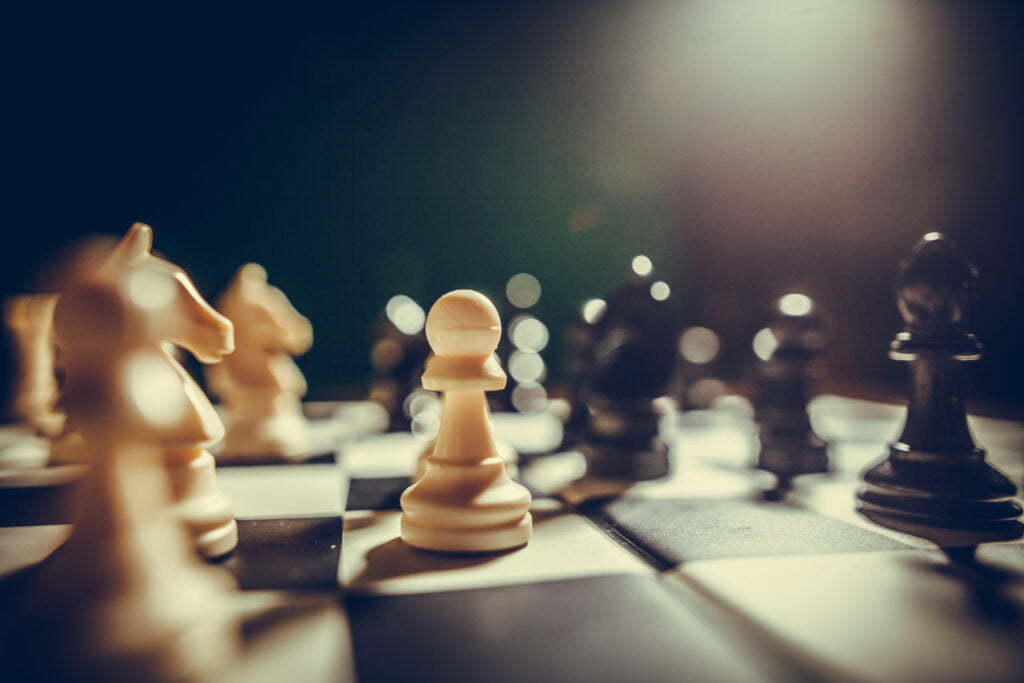
You only get 16 pieces to play with, all of one color. That’s it. Not your opponent, or his pieces, or the board, or the table, or anything else…Your move.
At the end of my failed marriage, now 12 years behind me, my cheating spouse often accused me of being a “control freak”. That became her go-to excuse for her extra-marital dalliances. You know, because…Control. I submit, that if I was indeed a control freak, I was a damn poor one. The evidence showing that I was unable to control even my own wife. I offer this sad chapter to illustrate a point. Which is; there are very few things in your life over which you exercise direct, complete control. It is best practice, as soon as possible, to identify your handful of pieces, and then control them with all the concentration, attention to detail, and purposeful action that you can bring to bear.
However, on several counts, my ex was right about my attempts to control her behavior. First, her actions were hurting me. Second, I wanted the hurt to stop. Third, I saw her as the source of the pain and tried all I could think of to get her to stop. Alas, shame didn’t work. Prayer didn’t work. Bombarding her with scripture didn’t work. Threatening to kill her lover didn’t work. Threatening to kill myself didn’t work. Telling her family didn’t work. Telling our friends didn’t work. Despite my efforts, neither appeal, nor persuasion, nor kindness, nor anger worked. I simply could not control her, no matter which handle I grasped at.
Regardless of what I tried, all my efforts to control her were futile and fruitless. I had hitched all of my emotional well-being (sorry for the pun) to a person who’d become utterly devoid of care for my well being. For that matter, she refused to consider the well-being of our children either. That was also something my attempts to persuade her and turn her failed to accomplish. I had made myself dependent upon her behavior for my own happiness. Being unhappy, I saw her and her behavior as the culprit, and for far too long, attempted to change both.
Waking up to the hard truth
Far too late into this nightmare of hurt and betrayal, and then frustration and near murderous despair, I realized the the truth: the only one I could control in the whole sordid affair (no pun intended) was me. The nightmare ended when I decided to wake up. Waking up entailed taking control of me, owning my own responses to the hurt I was feeling, and then making thoughtful responses to eliminate my exposure.
This episode, painful though it was, taught me some valuable lessons, and opened the door to the happiest twelve year stretch of my life. The lesson forever etched into my psyche is: you cannot control anyone else. Period. You will do damn well in life to control yourself. That will be enough to keep you occupied. But also, it will serve you well to identify the small number of things in your life over which you exercise direct, complete control, and make purposeful decisions about them.
As I sit to type this, I can control everything within reach on my desk and beside it. That is, I am the one pressing the keys on the keyboard, I am the one who poured the cup of coffee (and sips from it), I put the mail in that far corner, and placed the iPad on the near one. I have a guitar within reach, that I will pick up to play at some point today. If I need to print something, I know how to control the printer. If I need to reference something in one of the books on my shelves, I also control those.
What I put in my body in terms of food and calories is my decision alone. Likewise, what I do to exercise my body. Spending or saving money is directly under my control. I control where my internet browsing takes me. And, I alone determine how much I will work at those things I do purely for money.
A distinction between internal and external control
To be clear, I am making a distinction here between the concept of self-control, and control by the self. The foregoing are related, but distinct. Self-control focuses on controlling internal responses, with particular attention to impulse and temptation. This is valuable in its own right, and is foundational to behavioral therapies in general. On the other hand, control-by-self focuses on controlling things external. Its focus is on which pieces on the chess board of life are mine to move and which are not. Which leads to the knowledge that I cannot control my opponent (to follow the chess analogy further), nor the hardness of my chair, nor the temperature in the room, etc. Likewise, I cannot change the board or the rules of the game. I can only pick up and move my own pieces within the limitations set by the rules.
There is no need to bore you with my complete list of moveable, controllable ”pieces”, but I assure you I’ve typed out 90% of it. Those things are what I control and almost nothing else. Once I stopped depending on people and things I could not control for my happiness and well-being, I was on the way to emotional independence. In my world, that is at least as valuable as financial independence.
I observe people all the time negatively impacted by precisely the things they could control, if they chose to. They may have become fat and unhealthy, yet have no idea what they put in their bodies on a day to day basis. They do not track caloric intake. But they can tell you what is trending on Twitter. They have zero control over the people, things, and events that dominate their attention and emotions. These poor people will be upset over a politician, or over a sports result, or over China, or Russia. Their emotional state is dependent on and dictated by things far beyond their control.
Some want you to share their outrage at a protest march all the way across the country. But in their unhappiness, they habitually spend money they don’t have on things they don’t need. They are trying to buy something that cannot be purchased. They are aghast hearing threats to decrease police funding in Seattle. Still, they cannot tell you where every dollar of their last paycheck went.
Or perhaps they remain connected to toxic friends and relationships. Attached out of habit and familiarity, they waste effort alternately trying to change or appease their friends and trying to fix up their ”project” partner. These people over which they have no control, slowly grind them down, eroding their happiness day after day. Yet in areas of their lives they could control, they are obliviously unconscious about their daily choices. These are the truly important things, yet they act without awareness or purpose, exercising little control at all.
This you? Think of all the emotional disturbance created by things you cannot exercise direct, complete control
For the majority of people, the true impact to their lives comes from things they could control, but don’t because of inattention. Instead, they give their attention and energy to things and events they cannot control. This emotional dependence leaves them dominated and drained by things they have no power to change. Because they have never taken the time or recognized the few things in life over which they exercise direct control, they act as if their happiness derives from some magical place far outside their own dominion. But they won’t clean their own room (which they control completely) and enjoy the benefit and peace of mind cultivated by an uncluttered space.
I advocate for becoming an absolute control freak over every. single. thing. you. can. control. That is what intelligence is for. Use it to determine what you can actually control, then control the hell out of it. And don’t apologize. Why would anyone not do that?
As an exercise, observe yourself and the people around you today. Pay careful attention to any negative emotions you become aware of. What is their source? Things you or they can control? Or things you or they cannot? I will bet you a cup of coffee, 95% of the distress you observe in yourself and others arises from things you or they cannot control anyway. Unless you’ve already realized these truths, and are already on the path to emotional independence.
Independence does not mean Detachment
Do not confuse emotional independence with emotional detachment. Far from it. Above, I stated that waking up from my nightmare opened the door to the happiest 12 year stretch of my life. That’s true because of the wonderful woman I share life with. She is also my best friend. But, I am not trying to control her, nor is she trying to control me. The best part of a great relationship, built on friendship and mutual respect, is that we don’t have to manipulate and control each other. We don’t have to bribe and cajole.
We are a good fit precisely because we want to make each other happy. Being in control of myself, and where I direct my attentions and affections, I choose her. I increase the happiness of us both with each successive choice. Would I miss her if she wasn’t in my life? Terribly beyond words…but my happiness isn’t her job. That’s my job, and it’s based on things I control.
To close, I want to encourage you to really think about the things in your life over which you exercise direct, complete control. Write them down if that helps you. Realize that this is the sphere that will determine 99% of your emotional life. If you are like most people, you’ve allowed things over which you have no direct control to dominate that 99%. But if you will focus your concentration, attend to every detail, and take purposeful action over those things you can control: your eating, your spending, your exercise, your choice of friends, your role in your relationships, your choice of what to read, or watch, or listen to, you will do well.
Note: If you really are a ”control freak”, trying to change things and people that you really don’t have the right or permission to change, here’s a helpful article. Just try to remember, there are very few things in your life over which you exercise direct, complete control.
My favorite athlete to watch in an individual sport is Rafael Nadal. He is currently second behind only Roger Federer in number of Grand Slam tennis titles won. If you don’t know who he is, you can look him up.
I like him because he is the rare combination of innate talent with an unmatched, ferocious work ethic. He is also humble in victory.
He is known for his relentless, never give up, never-quit-on-a-point effort. That, and his weird OCD including a ritual of pre-serve tics, and precision water and juice bottle placement. It’s fascinating to watch him place his juice down and give it an eighth of a twist to get the label pointing in just the right direction. As if that will matter.
Rafa never argues calls that go against him. He never complains about points he loses. He just moves on to the next point. When asked about the apparent discrepancy of being meticulous about juice bottles and yet not arguing even questionable calls, he said, ”I don’t waste emotional energy on things I cannot control.”
That.
In a life with finite energy available. It’s better to spend it twisting a bottle you can control, than to argue with a referee you cannot. It’s very important to recognize the difference.
You and I will never be Nadal. It’s rarified air to reach the summit of your field or profession, so that’s likely out of reach, too. But we can learn from him where not to waste our emotional energy.