Tag: goals

  • Wisdom Is The Choice of The Best End and The Best Means for Achieving It…to be continued

    Wisdom Is The Choice of The Best End and The Best Means for Achieving It…to be continued

    Wisdom is the choice of the best end — here is a nice one, Antigua, Mamora Bay at sunset
    Antigua, Mamora Bay Sunset (Photo by Author)

    # 78 on my 99 Life Tips–A List is: Wisdom is also the application of the best means for the most valuable ends. See # 77 above for initial thoughts regarding wisdom.

    In keeping with the string of tips and stories about intelligence, truth, and wisdom, this is the reader’s digest summation. Wisdom chooses the best end, then achieves it by the best methods.

    Easier said than done.

    Getting lost in the weeds of esoteric ideas is no benefit if you want to be wise (and who doesn’t want to be?). Simple answers and concepts are the most helpful to get you and keep you on track. 

    The Best End

    You may wish to grab a Venti-sized latté while you ponder what this means to you. It will take a while. 

    What is the mainspring of your life? What is your ultimate reason, purpose, goal? Why do you do what you do? What is it you’re hoping for?

    The ultimate end of a person’s life dictates their life, morality, their praiseworthiness or guilt. It is the motive behind every decision. It is the mission statement, even if unspoken, deeply buried in the unconscious.

    Wisdom is the choice of the best (most valuable) end.

    Which is what exactly? What is the correct answer?

    America’s founding documents declare it to be, “the pursuit of happiness”—but is the pursuit, or the happiness—the end?

    If happiness; is that the most valuable end? Is your happiness more valuable than mine? It may be to you, but when weighed on a universal scale? Are they not equal?

    And if that has you scratching your head, assuming a belief in God, is your happiness more valuable than God’s? And are you more deserving of happiness than God is?

    That will keep the mental wheels spinning a while.

    Lest we digress too much, a repetition is in order. Wisdom is the choice of the best end.

    Oh, that’s easy, you say. Lots of money is the best, most valuable end. But is it? Is money more valuable than time? What is an extra hour at the end of your life going for on the open market nowadays? A day? A year? Pretty pricey if you can find a vendor.

    Well, ok then, time is more valuable, you agree. But is time more valuable than health, or peace of mind? Would any reader wish to live for eternity with a tormented mind? Or with a debilitating illness?

    No? Didn’t think so.

    This explains why philosopher types are so vilified. So damn many questions!

    Still, you must choose a worthy end of your own if you hope to be wise. Your choice of end shows your wisdom—or lack thereof. A hint: You’ve already chosen an end regardless of whether you know what it is. We all have. But you can move off the default choice, which is to live entirely with regard for your own momentary pleasures as fully as possible, to some more valuable and well-considered purpose.

    The Best Way To Get There

    This is going to have to wait for another treatment of its own. You’ve got plenty to work on.

  • The Relation of Plans to Goals, Do You Know How To Get Where You Want To Go?

    The Relation of Plans to Goals, Do You Know How To Get Where You Want To Go?

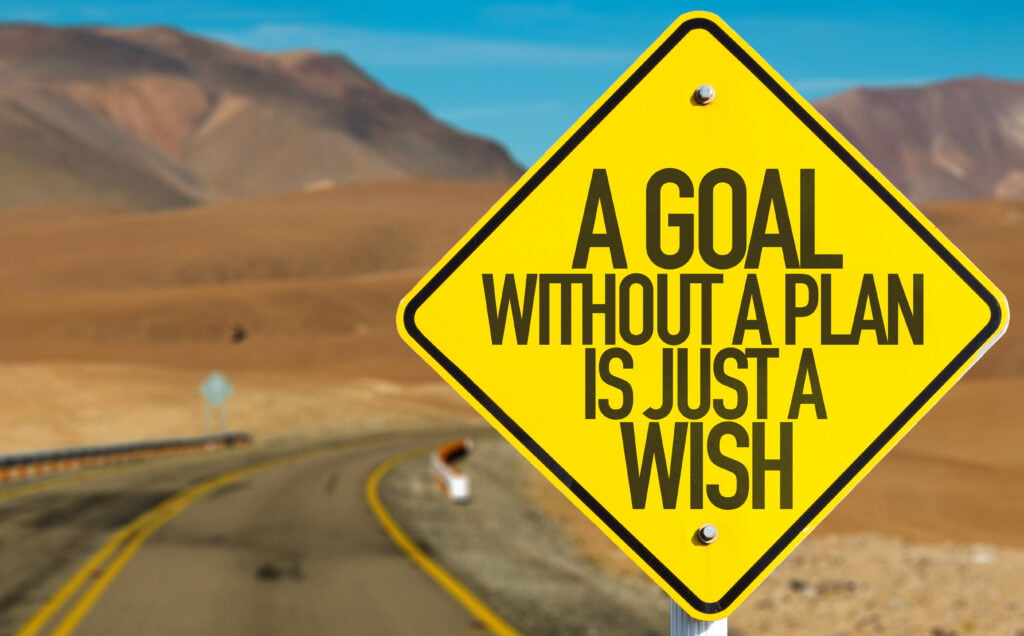
    Road sign says a goal without a plan is just a wish
    It would be nice to have these reminders pop up like road signs from time to time

    I’ve written about goals and goal setting in a previous post. It was tongue-in-cheek. My intention was to spark thought about the right questions to ask when setting a goal. But an ongoing conversation with my 17-r-old, college freshman, son has me thinking more about the topic of goals and the relation of plans to goals. 

    A Plan Is Not Busy Work, It Is Essential

    My son is required to complete an Academic Plan for a class. He is on the bubble about what he wants to major in and so is dragging his heels about drafting a plan. He thinks there is no point in working on a plan, and putting it in writing, if it’s likely to change. So, he is thinking of this assignment as busy work. I am encouraging him to create the plan, finish the assignment, and realize that it is not carved in stone. My reasoning is this:

    1- A goal represents an end that you have in mind.

    2- A plan represents the means for achieving that end.

    Unless a goal can be achieved with a single action, setting a goal and having no plan is the equivalent of not setting a goal. It may be a dream, or a wish, or perhaps a hope, but it’s not a proper goal. 

    A goal is something tangible, measurable, achievable (at least potentially), and exists during a window of opportunity (there is a timetable, or deadline for reaching it). A plan maps out how that is going to be done. What are the steps? What are the necessary resources? Are there pre-requisites, or contingencies I should be aware of?

    One of the most important things to grasp in life, as young as possible, is the relation of plans to goals. That is to say, knowing the difference between means and ends. It is a rare person who keeps this concept in mind as the basic metric for decision making of all types.

    Everyone Is Living For Some End

    Everyone is living for some end. Even if they are unaware. Most people haven’t clearly defined it to themselves. This causes many to live very passively,  in a state of hopeful disappointment (so as to not plagiarize Thoreau’s ”quiet desperation”, though they are functionally the same). People hope their lives will magically get better. Whatever better means. But they are living out a series of steps that feel predestined for them without much thought of their own. Succumbing to social and economic pressures, they live and act as if their own agency doesn’t have a lot to do with their own lives. To many, life is a lottery game, or a roulette wheel, and some people get lucky. They hope to be among the lucky.

    But without a specific end in mine, clearly defined, and pursued for the value it represents, most are passively adrift. Their favorite words are ”If only…”. This even affects purchases. Or maybe it especially affects economic decisions of all sorts. People seem to be very confused about their relationship with money, thinking it is an end, when it is quite literally a means, and only a means. The result is they are either trying to accumulate money as an end in itself, or spending it for some feeling it cannot buy

    The Antidote to Passivity And Its Soul-Crushing Effects

    The antidote to this hopeful disappointment or quiet desperation is to spend time thinking about what you really want. Identify your desired end. What ultimate goal do you have in mind? What would make life worth the effort to stay or get healthy, or the effort to establish better habits? Is there any worthwhile payoff for the hard work? What would make your life one you actually want to be living? Unless you define this ”most valuable end” and then live as if that end really is as valuable as you say it is, you’re cheating yourself. And you’re definitely not being authentic. And you’re forgetting how short this ride on the merry-go-round is.

    Maybe you haven’t worked out your lifetime ”most valuable end”, supreme goal yet, but it certainly helps to start there and work backwards when planning. For now, you can start small to learn how to think of means and ends, and to plan sequentially so that you take the steps necessary to achieve the desired end, by taking action in the right order. 

    Today’s Academic Plan Yields Tomorrow’s Dream Life

    I pointed out to my son that he is in an intermediate phase of life. He is wisely in a local community college that is cheap. In it, he can get all of his general college credits out of the way, keeping an open mind about a major. He will be ready to transfer those credits and his enrollment once he’s decided on a solid major. His immediate goal is 60 transferable credit hours in required courses. That’s it. 

    That intermediate goal is actually a means to a larger goal…a 4-yr degree at a university. And that, too, is an intermediate goal to the larger goal of a good, high-paying job. Which is also an intermediate goal to the ultimate goal of a life he wants to be living….to success defined in his own terms. I think I’ve helped him to see the relation of the academic plan he drafts today to the ultimate goal of his dream life.

    Talking with him over the last couple of days made me want to share the conversation and hopefully the insights with you. This framework of setting a clear goal, then making a plan on how to arrive, works in every part of life. It even makes life more fun, even if a little more challenging. It’s better to be proactive and work a plan towards a goal you actually want. The relation of plans to goals is what turns a dream into a possibility, and can transform it from a wish to reality. Certainly better to be armed with a plan towards a clear goal than to be a leaf on a stream, hoping things will magically get better, while passively floating towards what might just turn out to be a waste treatment plant. 

  • Setting Goals: A How-To Guide in 5 Easy Steps, and A Conversation

    Be careful setting goals. If you don’t ask the right questions, you won’t end up with the right answers. Success achieving wrong answers, is not success worth succeeding at. It just means not enough care was taken in setting the goal. To that end here is a how-to guide in 5 easy steps.

    The guide:

    Step 1- Ask lots of questions.

    Step 2- Keep asking “why” to set the best goals.

    Step 3- Don’t stop until you run out of questions.

    Step 4- When you’ve asked all the questions you can think of, and provided yourself satisfactory answers, proceed.

    Step 5- If at any time more questions occur, stop and repeat steps 1-4 before proceeding.

    And, as promised, a conversation:

    You say, “I want to lose weight.”

    “Why?” I ask. 

    ”I don’t like the way I look,” you say.

    ”Oh, you spend a lot of time looking at yourself?” I ask.

    ”No, it’s just, I want to look better.” you say.

    ”Has someone told you you don’t look good?” I ask.

    ”No, but I would feel better and be healthier if I lost some.” You say.

    ”Sure,” I say, ”those are good reasons. Why do you want to feel better?”

    ”Doesn’t everybody?” you ask me.

    I pause and say, ”I guess everybody thinks they do, but not everybody acts like it.”

    ”Well, I’d be healthier then.” you offer.

    ”Right, and why is that important?” I ask.

    ”C’mon, that’s obvious!” you snort.

    ”Is it?” I ask.

    ”Sure,” you say, ”everybody wants to be healthy.”

    ”Do they? Even if no cheeseburgers? Or beer? Or coffee?” I ask.

    ”I see your point,” you concede.

    “Is there a certain weight that will make you healthy?” I ask.

    ”No, not just a weight,” you tell me, ”I guess there’s more to it than just a number on my scale.”

    ”Probably so,” I agree.

    ”So what you’re saying is it might take more than hitting a number to be healthy?” I ask.

    ”Right,” you agree.

    ”Ok. Let’s say you’re healthy. Presto! You’re healthy! Now what?” I ask.

    ”What do you mean, now what? That’s just it, I’d be healthy,” you reply.

    ”I mean, what do you do with your health?” I ask.

    ”I enjoy it!, you say.

    ”Yeah? How?” I ask, ”Doing what?”

    ”I don’t know,” you say, ”Guess I haven’t thought that far.”

    ”Isn’t that the point?” I ask.

    ”I guess it is.” You say.

    ”Maybe figure that out,” I say, ”that’ll keep you motivated.”

    ”True,” you agree.

    ”Once you’re more fit, and healthy, and you look better, will you be happy?” I ask.

    ”Happier!” you say.

    ”But there’s more to it than that?” I ask.

    ”Maybe?” you concede.

    ”Like what?” I ask.

    ”Well, I need to pay off some debt, too.” you say.

    ”Why?” I ask.

    ”Isn’t that obvious?” You ask me.

    ”Well, there are some good reasons for sure, but I’m asking you,” I counter, ”if your debts were gone, then you’d be happy?”

    ”I don’t know,” you say.

    ”That wouldn’t do it?” I ask.

    ”Prolly not,” you say, ”I’d still want more money.”

    ”How much more?” I ask.

    ”Much as I can get,” you say.

    ”Why?” I ask.

    ”Don’t know,” you admit, ”so I can get some things I want.”

    ”Why?” I ask, ”then you’d be happy?”

    ”I see where you’re going with this,” you say.

    ”Good, ” I say.