Tag: humanity

  • Do Not Be Afraid Of Feeling Bad – It’s Good For You

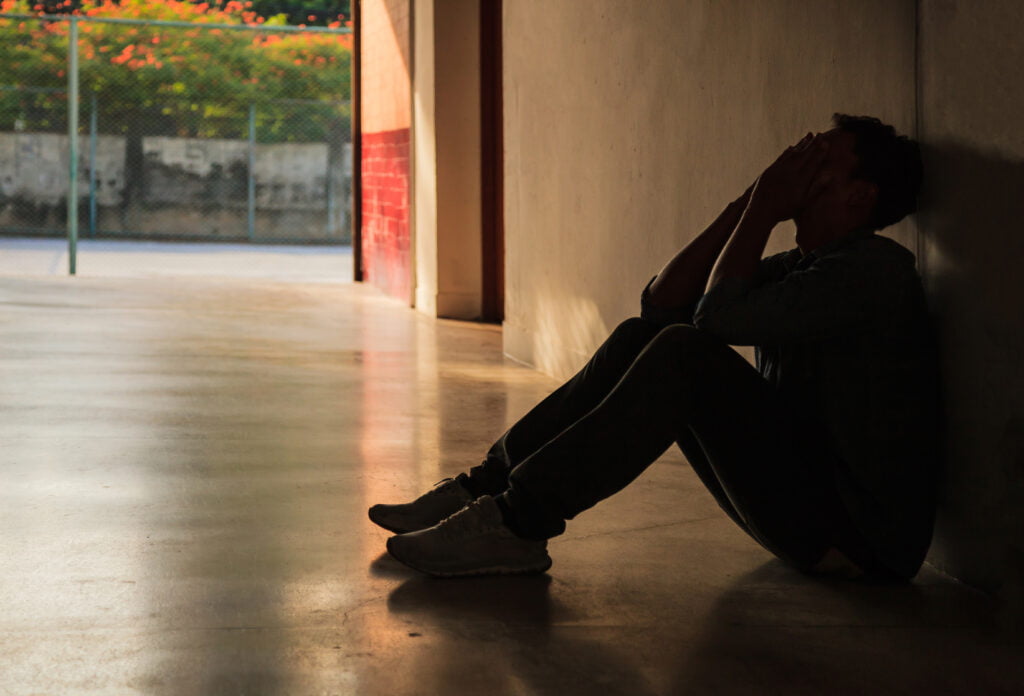
    young man slumped against a wall in a dark hallway feeling bad
    Emotional moment: man sitting holding face in hands, stressed, sad, feeling bad, depressed, disappointed. We’ve all been here.

    # 11 on my, 99 Life Tips – A List is: Do not be afraid of feeling bad. There are things to feel bad about, and the contrast is a wonderful reminder of why gratitude is so important.

    This is one of the most important Life Tips. It also swims upstream against the prevailing American cultural and social ethic. We are a country terrified of feeling bad. So, we medicate. We pre-medicate prophylactically to prevent even the chance we might feel bad. We’re so afraid to feel bad, we self-medicate. But you do not to be afraid of feeling bad. If you don’t know both how to, and when to, feel bad; if you make yourself artificially numb to negative feelings, then neither will you experience the full heights of feeling good.

    This one has been difficult to learn. Obviously, one doesn’t learn to feel bad by being gifted a million bucks. I heard a preacher once say that if you pray and ask God to take away your bitterness, He won’t do it by giving you a Cadillac. The point being, we all learn to feel bad by hard practice. But face it, this life deals everyone some hard, hard blows eventually. Not to be morbid, depressing, or nihilistic, but everyone you love is going to die some day. And you will join them if not precede them. This unavoidable truth doesn’t exactly feel like Disney World.

    But what do we do with that truth? I say, let’s wring all the pleasure and joy and love out of this short ride on the merry-go-round that we possibly can. And, let’s do so in the knowledge that being human is the experience of the full gamut of emotion: from heart-crushing grief to soul-enriching joy. We will face the things in life that feel bad and become more resilient, more capable of experiencing appropriate emotional responses, and more grateful.

    And here is the most important point. You will feel the worst over the loss of something you loved the most. They are two sides of the same coin. It is impossible to feel bad over something you couldn’t care less about. Bad feelings are the result when something that made us feel good goes missing, or is lost to us in some way.

    If you are afraid of feeling bad, my advice is never, NEVER, let yourself attach to anything that makes you feel good. 

    ”It all rolls into One.

    And nothing comes for free.

    There’s nothing you can hold

    for very long.”

    ~ Grateful Dead: Stella Blue

    It is important that we allow ourselves to put on the sweater of our bad feelings as Morrie would remind us in Mitch Albom’s excellent book Tuesdays with Morrie. There are things that will always bring some measure of hurt, pain, or sadness when we reflect on them. This is as it should be. Some things in life just hurt. This is the way of life. How dare we try to escape that by numbing out? To do so is to deny the very thing that makes us human. That sweater of pain will always feel bad whenever we choose to put it on. But we can also take it off and not wear it all day, every day.

    No friends, Do not be afraid of feeling bad. We are the species that loves, and marries, and feasts, and dances in the face of future imminent death. There is an undercurrent of sadness that accompanies our reality. You can accept that fact, face it, and choose to live as full of gratitude for the myriad good things that come your way in a world where nothing lasts forever, or you can numb out in the effort to escape it. Just be aware that if you are afraid of feeling bad, you’ll disqualify yourself from feeling good, really good.


    NOTE: I am not negating the fact of clinical depression, or crippling anxiety. Nor am I either vilifying or castigating those who suffer from these medical conditions. These conditions supersede mere emotional states. However, as this article from February, 2021 suggests, the over-prescription of psychiatric drugs is not without serious drawbacks, especially when many cases of depression and anxiety are contextual, non-pharmacological, and would respond better to psychotherapy than to dependence on medications.


    As a final thought on this topic, let me leave you with this beautiful song, from Rich Mullins, who was tragically killed way too young on his way back from a free benefit concert for Native Americans. A horribly sad thing indeed:

    “There’s bound to come some trouble to your life

    But that ain’t nothing to be afraid of

    There’s bound to come some trouble to your life

    But that ain’t no reason to fear”

    ~ Rich Mullins: Bound to Come Some Trouble
  • Authenticity

    Authenticity.

    There is a fine word. And with much urging telling us to find and be true to our authentic selves, I thought I’d take a crack at it. To get there, let’s think on a few things.

    How many people have inputs into your outputs?

    Asked another way, how many people do you feel beholden to act, or speak, or dress, or function in a certain way for?

    Put in the negative, how many elicit constraints upon you, causing you to refrain from acting, speaking, dressing, or functioning in ways you may privately prefer?

    Or this, to whom do you feel obligated to make these accommodations?

    And to whom is this obligation legitimately owed?

    When people live and work in close proximity to one another, they modify themselves accordingly.

    A couple remains a couple so long as they conform themselves the one to the other.

    ’Tis true, the best relationships require the least remodeling to achieve conformity, but all require some. And in the best relationships, the conforming of partner to partner is what gives each the greatest pleasure and fulfillment.

    Families sharing the same dwelling and utilizing the same resources find an equilibrium conferring membership privileges to those who are least able to provide for the resources needed for the family’s well being. Parents and siblings reconfigure their lives outwardly and inwardly to conform to the needs of a new baby. They continue to do so as the child advances in years, feeling themselves obligated to conform the patterns of their own existences to provide the necessities of smaller, shorter, younger persons, unable yet to secure the necessaries of life for themselves. Good parents do this for some eighteen years, not of compulsion, but voluntarily. 

    And is it not true that at all stages of a baby’s life, save in the first mewling months, that child is shaped, and taught, and fashioned to learn to temper the authenticity of its innocent selfishness to the needs and desires of others? Meaning; as soon as is practicable in most households, training begins to teach and shape the baby for accommodation to the needs of the people on whom it depends for survival. Bed time and nap times are employed. An interval of feeding is established. A rhythm develops. A pattern emerges. Some kind of symbiosis evolves that allows the caretaking parents and older siblings to meet the baby’s needs and appetites without killing themselves in the effort. 

    It is only during infancy, and quite early infancy at that, that the person is authentic in his unconcern for conforming to the needs of those around him. (The possible exception of this is the extreme advance of old-age.) Unaware of, and unconcerned for, others except as means to his own satisfaction, the infant is a living consumer of the attentions, energies, and efforts of those positioned to give him what he wants and needs. This is tolerably cute at one month, but is a veritable nightmare by age two.

    So, when we speak of adults rediscovering their authentic selves, and assign any connotation of selfish indulgence as that, and only that, which is truly genuine, we are speaking of that phase of our lives which existed for perhaps three to six months at most, then vanished, as it should have.

    Why then, the desire for authenticity? Especially that described as adhering to one’s true self? 

    No human, save Adam, was created as a reclusive hermit to live out his days consulting only his own whims and wishes. 

    If cooperation and adaptability are the hallmarks of enlightened humanity, it is no surprise that Eve was formed out of Adam’s rib. She has no being apart from Adam. And it had already been determined by God Himself, and not Adam, that it was not good for man to be alone. Therefore, he lay down and slept, voluntarily giving, quite literally, of his own substance, to provide the materiel necessary for a life other than his own, he having no being worth having apart from her.

    And thus, from the earliest story of our race, we can learn that it is others, and our relationships and adaptability to them that gives rise to our lives. And is therefore that which gives both meaning and richness to our lives. If this is not authenticity, what is?

    No one is required to yield to the childish, selfish demands of those who have aged out of infancy and who therefore ought to know better. The law of love is naught but an appeal and reminder to humans to love others As we love ourselves. 

    The interests of every other person are as important and valuable to them as yours are to you. They are not greater in value and have no greater claim. One may voluntarily choose to love another More than oneself, or act in another’s interests, more than one’s own, but if that person is of similar age and situation in life, it is not obligatory, and it is no part of human authenticity requiring that degree of conformity and accommodation. 

    But let’s consider that it is the very nature of authentic, genuine human-ness to adapt our lives to those around us. Had not our mothers literally accommodated us in their own bodies, we’d have no selves at all, authentic, or otherwise, right? It is accepting, yielding, and adapting to the life of another that makes life possible at all.

    This is a dance in which we sometimes lead and sometimes follow. We sometimes give and sometimes receive, This is human authenticity. He who practices these adaptations best is most authentic and most human.