Tag: reality

  • Selective Attention–You Cannot Trust Your Eyes For All That Is Real

    Selective Attention–You Cannot Trust Your Eyes For All That Is Real

    # 65 on my, 99 Life Tips–A List is: You cannot trust your eyes for all that is real.

    “So I give you my eyes, and all of their lies

    Please help them to learn as well as to see”

    ~ Grateful Dead: Black-Throated Wind

    One of the best examples of this truth is this video, known as the Monkey Business Illusion.

    How did you do?

    Selective Attention is a thing

    We have eyes only on the fronts of our heads. This means in order to see something, we must face it. You can only see in the direction you’re looking. Does this mean that nothing exists in outside your field of vision? Of course not, but it means you must look for and look at something in order to see it.

    Add to this the fact that it is not the eyes that see. It is your brain. Neuroscientists know that the brain create and feeds an image of the world into our conscious perception of reality. It generates a moment-by-moment hallucination. How weird is that? The ramification is that we’re always playing catch up to the present, and that what our brains show us via the openings in front of our heads is the best-case prediction of what the next millisecond ought to look like.

    And even within your field of vision, as the video linked above shows, about 50% of viewers don’t see something even if it happens in the direction they’re looking. I didn’t the first time I watched the video, which my children could have easily predicted. They’ve known for years the easiest way to hide something from me is to hide it in plain sight. We won’t see what we aren’t paying attention to, or if we are distracted by giving attention to something else. For me, that’s often a book (which means I can’t hear, either).

    But I’ve had the belief for as long as I can remember that there is more going on in reality than meets the eyes. Of course, we know that to be true scientifically. The fact that you cannot see in the infrared spectrum doesn’t mean bees cannot. They do in fact. And they see well into the ultraviolet spectrum, well beyond human visual capability.  It’s speculated that venomous snakes see infrared as heat signatures as well, so be careful out there.

    The point of my tip is that our eyes are not the final determinants as to what is real. Without a long harangue about metaphysics and the nature of consciousness and reality in general, suffice it to say that, while you can trust your eyes for the tasks they’re well suited for, you cannot trust your eyes for all that is real. 

  • Alternate Facts, Weapons Of Misinformation, And The Battle For Your Mind

    Alternate Facts, Weapons Of Misinformation, And The Battle For Your Mind

    Jars of poison labeled as Misinformation
    Misinformation Is A Toxic Poison – And Its Being Used As A Weapon

    There are unwritten norms that in the past have governed and united us as Americans. But, these have proven too weak for the job in the face of modern stresses, and given the existence of weapons of mass misinformation (WMM’s). Especially since it is so easy to present alternate ”facts” using these channels, and do so with impunity. Sadly, the most basic assumptions we once shared about reality itself, and our agreed upon notions of it, are no longer a “given”. Even empirical, mathematical facts are not able to withstand politicized assaults in highly-charged racially or socially coded language, specifically intended to divide us into alternate worlds, with alternate facts, and alternate versions of ”reality”.

    Destroy Consensus and Kill Consensus Reality

    Consensus reality is that which is generally agreed to be reality, based on a consensus view. If so, is there a doctor in the house? This piece from Post Carbon Institute claims 2020 is the year that our shared reality finally cracked. We don’t seem to have any shared objective reality anymore. Nor, it seems, do we any longer enjoy a shared cultural reality. Seth Godin’s treatment of this concept is brilliant.

    The consensus reality defining America and what it means to be an American may already be dead. Ironically, a reality-TV con man killed it. While ironic, I guess it is fitting. Give the devil his due. Modern American politics in the age of Twitter and Facebook is more like fake tv than we knew. Reality television, even though it is not real, doesn’t work, generate enough profit to stay on the air, and provide entertainment value unless enough people believe it’s real. Consensus reality doesn’t work without a consensus. It evaporates when enough people believe a different narrative. Destroy consensus with incendiary and divisive language, and kill the shared reality that was the by-product of that consensus. Done and done. Facts be damned. 

    Social Contract Theory

    In some respects, it is miraculous that it has taken this long for the fabric of the country to fray and tear. Social Contract Theory has been around a long, long time. It arose in a time before printing presses and certainly before the internet or social media platforms. This entry at the Internet Encyclopedia of Philosophy suggests the idea has been around as long as philosophy itself. Check it out if you’re not familiar with the idea.

    This is a short article on social contract theory from the University of Texas school of business. Members of society live together under certain pre-arranged and agreed upon rules of engagement. These ideas are deeply interwoven into social, economic, and political life. So much so that we have been able to assume their strength and take them for granted. Democratic, Representative governments, exist both as the result of, and for the protection of, this bedrock social contract. As such, they operate best behind the scenes of everyday, normal civic life.

    I wrote this essay back in January in remembrance of the days when our government was virtually invisible except for rare, highly unusual, high visibility occurrences. Reliable assumptions about the underlying, invisible social contract are the foundation of a national reality. In combination with shared language and art, the result is stable, flourishing culture and civilization.

    Who Wields Weaponized Misinformation?

    To destabilize a society, attack the shared ideas that bond the members together in a mutually beneficial reality. Nothing does this more effectively than weaponized misinformation. Historically, only totalitarian, dictatorial governments (whether right-wing fascists, or left-wing communists), have turned their citizens against one another by means of misinformation and propaganda. Russia, or China, or fill-in-the-blank state actors have wanted to undermine the US with these tactics for half a century, having used them with success against their own citizens.

    Now an ex-President and the political party he controls do the job for them. Only an autocrat wishing to use you for his own power willfully, repeatedly misinforms you to think of your neighbor and fellow citizen as an enemy. And to base that belief on some factor like race, or religion, or sexual orientation, or in the past year, misinformation about mask wearing, or getting a vaccine.

    Obviously, the fissures in American society didn’t start overnight. They didn’t start with a dangerous, deranged, anti-democratic demagogue. In some ways, there have been two or three different Americas from the nation’s inception. Your version of America depended upon which race and economic class you were born into. But a large portion of the country has been unwilling or unable to see a clownish buffoon for what he was and is. Failing this, they have joined him and his puppets in the effort to turn us against one another, denying even basic human decency, medical science, the rule of law, and the democratic process. These are enough combined straws to break the back of the national consensus reality camel. 

    Misinformation Has Created A Separate World With Its Own Reality

    Didn’t we used to be better than this? We used to have cherished words, national words, that we treasured for their inspiration. They urged us towards a common, shared vision of a more perfect union and a general welfare. But words are not reality. They are mere approximations of reality. And the same language that had the power to unite us in agreement and solidarity, has been used to foment hate, mistrust, and derision. Powerful, pervasive platforms of language dissemination have been used to craft alternate, disparate, separate versions of reality. Versions of reality believed in regardless of the presence of objective facts. 

    So, there are people in this country, and maybe you are one reading this, who believe things they’ve been told, or they saw on unsocial-media like Facebook, or Twitter, or maybe on FOX, or OANN such as: the election was stolen, and Joe Biden is not the legitimate President, the vaccines will make you sterile, the vaccines will alter your DNA, covid isn’t dangerous, masks are an infringement of liberty and unconstitutional, there is a deep-state cabal of satanic, cannibalistic pedophiles, and sex-traffickers running the country, January 6th was not an insurrection, but was just normal tourists visiting the capitol, etc.

    The Only World That Exists Is The One In Your Mind

    In short, purveyors of malignant, malicious fiction have broadcast descriptions of an alternate reality in which many believe. I cannot argue against the truth that the only world that exists is the one that is in your mind as far as you are concerned. But, unless there is some return to consensus reality, based on verifiable, objective facts, and unless we hold those who traffic in lies and disinformation as culpable, dangerous criminals, this American experiment will soon be over. 

    Fake or fact concept with turning cubes with letters
    Being discriminating is not a bad thing. It’s the only way to decide which world you’re going to live in

    I appreciate fiction as much as the next person. I love that Stephen King, or Ernest Hemingway, or Daniel Silva can create world’s from words. To your mind, these elaborate worlds that are real and engaging.

    In like manner, the world you woke up in today, and interact with from the driver’s seat of your own perspective, while not quite as fictitious as the one’s constructed so skillfully by a great author, is still fundamentally a fiction. It is also created with words. Yours. The ones you tell yourself, and the ones you listen to. It is fiction because it is limited and relative to your experience of life alone. It is however, very real to you. You don’t live in my head, nor I in yours, so our realities are unique to us. But if you’re reading this, you’ve given me, sitting here, at a particular juncture in space and time, access to your mind. And my words are shaping it. 

    Never in American history, have the unscrupulous, power-hungry, selfishly motivated, or willfully and negligently ignorant had so much access to such powerful tools to shape our minds with the fiction of misinformation. They do so via social and mainstream media platforms, wielding them as weapons of mass misinformation. The fact that they have gained such an allegiance among the non-discriminating is astonishing. And, that they have successfully created a completely different world with its own ”reality” is equally shocking. Perhaps, in the final analysis, we only have ourselves to blame.

    Obviously, things like microscopic airborne viruses don’t give a damn what kind of lies you believe in. The truth will always prevail in the end. But for some, it will be too late. It may be too late already for the country. The disparate, divided realities may never reach consensus again. 

  • Accept Life As It Is, Not The Way You Wish It Was; or The Sunglasses of Perception

    Accept Life As It Is, Not The Way You Wish It Was; or The Sunglasses of Perception

    Eye vision test with sight chart
    Eye vision test with sight chart – the chart is what it is

    # 21 on my, 99 Life Tips – A List is: Accept life as it shows you it is, not as you wish it was, or as you want it to be. The same goes for people.

    It’s possible some will read that tip, shrug, and think, ”No duh!” While others, myself included, will see that we resemble the remark, and try to act on it. While it is undoubtedly normal to put the best spin on life, some of us invest too much in the spin. If this is you, then let this be a reminder to accept life as it shows you it is. And also, accept people the way they show you they are, not as you want them to be.

    Rather than try to enumerate all of the psychological reasons some people have difficulty with this, let’s stipulate that some simply do. You may be among that number. Assuming that’s the case, consider the following questions:

    Is your experience of life the result of how you think life is; or do you think about life based on how life has shown itself to be to you?

    Perception Is Reality

    Few would admit they belong in the first camp. And yet, to some degree, we cannot experience anything differently than how we think prior to the actual experience. You bring your way of thinking about life to every life experience. This is commonly referred to as paradigm, which is nearly synonymous with perspective. The difference being that paradigm refers to the big picture ”model” of reality we mentally construct, while perspective refers to the small picture, individual, subjective point of view from which we observe the model and form beliefs about it. Together, these influence our perception of the world. And our perception is our functional reality. How could it be otherwise?

    In this way we experience life like a person who perpetually wears sunglasses. The sunglasses filter everything. The filter modifies the reality of what is being looked at. Remove the sunglasses, and everything looks a little different. Change the filter and change the world.

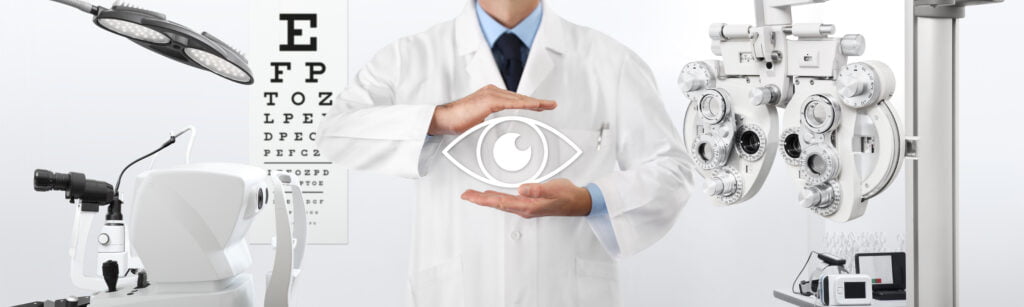
    image of optician in office with charts and diagnostic machines
    This optician, with his charts and machines can help you see things in the physical world the way they are. You’ll have to do that for yourself in your mental world.

    A patient in need of eyeglasses looks at a chart, or at images though a machine. The images are blurred. An adjustment is made. The images get worse. Another adjustment, and the images get better. They appear sharp, crisp, and in focus. In this scenario, do the actual images change at all? No…they are what they are. The patient would be foolish to see blurred images, wish they were clear, and declare them to be so because he wants them to be. 

    Reality Cataracts

    A few years ago, I had cataract surgery for both eyes. Prior to the surgery, vision in my right eye had become so occluded that if I tilted my head a certain way, objects would disappear. I could make street signs, cars, and people disappear just by closing my left eye and tilting my head. Some people try to live this way. They try to make problems disappear by an inner tilting of their mind. But guess what? Just because you cannot or will not see something doesn’t mean it’s not there.

    If your own paradigm, perspective, personality, perception, or personal hang-ups make it difficult to accept life as it shows you it is, then, like a person in need of an optometrist for corrective lenses, you probably need a new prescription. Or, like me you need an ophthalmologist for your eyes and your life. Tilting your head and pretending is not a long term solution.

    And friends, not to be too heavy handed with the analogy, that’s us. Life and people are images on a chart. The chart does not change. The way you see the chart changes. Better to see the chart, and life as it shows you it is, not the way you wish it was. 

    Awareness Of The Susceptibility Helps You Look Twice

    I wish there was a magic cure. If there is one, I haven’t found it. Knowing that I’m wearing my own sunglasses of perception, and that I cannot take them off, helps me to realize that I could be wrong. Knowing that I’ve had a past history of mistaking my glossed over version of reality from what was really on the chart, makes me wary. It makes me look twice. I don’t tilt my mind and hope the evidence will change. This healthy skepticism at least gives me the awareness that my own uncorrected filter tends to skew life towards the way I prefer it to be, not necessarily the way it is. This is an imperfection that I will likely always carry with me. So, my tip to accept life as it shows you it is…definitely applies to me. If it applies to you, get those eyes checked.

  • Reality Can Be Limited By Perspective

    One of my favorite lines in a Grateful Dead song comes from the tune, Scarlet Begonias.

    “Once in a while you can get shown the light,

    In the strangest of places if you look at it right.”

    This has been true for me. All that it sometimes takes to see a previously hidden truth is my own willingness to look at the subject a different way. 

    This act of taking another look at something is what is colloquially referred to as ”open-mindedness”. I find a lot of people are afraid of this term. I find they are afraid of it because they misunderstand it. Being ”open-minded” doesn’t mean abandoning anchors of belief, or intellectual boundaries, putting you in danger that your brain will fall out. It means accepting the possibility that there may be more than one valid viewpoint to a particular issue.

    Ideally, this would be a universally applied truth. But, before any truth can be applied, it must first be known. Here then, is my attempt to say, 

    ”Hey, here’s something cool. There’s more than one way to see a lot of issues. Have you tried looking at it from another perspective? Have you tried putting yourself in the other guy’s shoes, for instance?”

    A few months ago, I was sitting on the front porch with my seventeen year old. We were discussing a problem he was facing. His ability to solve the problem was limited by two things. One, he had only seventeen years of experience to draw from. Two, this lack of experience forced him in to a very narrow perspective, which blew the problem out of all proportion.

    I was sitting in my normal spot on the front porch. It is wide enough to accommodate my frame. He was sitting in a chair to my left. A cloud moved in the sky, the sun peered from behind it, illuminating a perfectly crafted and quite large spider web just as I glanced up to notice it. The web had been there the whole time we had been talking, but I couldn’t see it against the gray overcast. It took the light hitting it just right for it to come into view. What had been real the whole morning, was now real to me.

    I asked my son, sitting to my left at the end of the porch and at an acute angle to the web, if he could see it. He shook his head. Interesting, I thought. Nature has provided the perfect metaphor. 

    ”Come look at this,” I said.

    He got up, came over a few steps and looked up at the intricate web. 

    ”Wow!” he said. He was amazed by both the intricacy of the web, and that something so large had been completely hidden from view.

    All he had to do was look at it right.

  • Truth is Reality

    Get ready Dorothy, this ain’t gonna look like Kansas anymore…

    ”You will know the Truth and the Truth will make you free.” ~ John 8:32

    I’ve been thinking about this verse a lot. My life was turned around nearly 35 years ago when I bumped into the Truth. I found out that Truth is a Person. I had erroneously thought that truth was an accumulation of facts and knowledge, but it is so much more than that.

    The NT was written in Greek. In this language, the word truth is the same as the word reality. I am fascinated by this. I try to think of truth and reality and the person Jesus as equivalents. 

    The verse above indicates that knowing truth can set one free. 

    But just what can it set you free from?

    Only from a lie, right?

    The interesting thing about being enslaved by a lie is this. If it is clever enough, subtle enough, and deeply imbedded enough, you won’t even know you’re enslaved by it. That was me. Think of Keanu Reeves character Neo in the Matrix before Lawrence’s Fishburne’s Morpheus gives him that red pill and he takes it.

    The verse implies that a person desires to be freed from enslaving lies. It implies an implicit value of truth over lies. It implies that truth should be loved, and sought, and applied, specifically for its power to make one free.

    I am not afraid of truth. Even the most uncomfortable ones. Like Neo, I’d rather eat gruel in reality, than eat steak in an illusory fantasy of my own creation.

  • Filtering

    I’ve always been curious about reality. I can accept that I am sitting in my office chair, my own hands stretched in front of me, touching hard plastic keys on a bluetooth keyboard, each touch producing a change that adds or removes squiggly marks on the screen in front of me, carefully engineered to look like a sheet of white paper suspended in portrait view. Because I’m not using full-screen mode, I can see my background wallpaper on what is called my ”desktop”. Of course, I know it’s not an actual desktop because my keyboard and my coffee cup are sitting on my ”real” desktop. If I tried to place them on the one in front of me, they’d slide off in a crash because the one with the squiggles is 90° perpendicular to my actual desktop, the wooden one that is parallel to the floor. The flat one in front of me, in 5K-retina-display-glass-and-electricity, also has some fancy hard drive icons on it. These represent physical hard drives, but they are not the ”real” hard drives, just graphical user interface (GUI – pronounced ”gooey”) representations of the ”real things.

    I’m beginning to think that the ”real world” is probably a bunch of gooey icons too. See if you catch my drift.

    The virtual desktop has a ”wallpaper” of nice colors on it, except I know for a fact those colors don’t really exist anywhere except in my own brain. Light is getting in through the specialized openings in my head called ”eyes”, and that light has a variety of wavelengths (all part of a spectrum called ”white light” that is human friendly) that gets interpreted in some fancy way by another part of my brain that is doing the actual ”seeing” (Eyes don’t really ”see” anything at all). Anyway, the seeing part of my brain allows me to perceive the variety of colors, and it fools me into believing the colors are happening on the screen and not in my head. This same deception also happens when I look out the window and see  ”blackness”. (It will happen when the sky changes into vanilla cotton candy in about an hour too, unless it’s foggy, then I’ll get deceived into believing there is such a thing as ”gray” out there.)

    I had to take a break and walk to the master bathroom for a moment to say good morning to my girlfriend. The tile was very cool on my feet. I remained upright without tilting or leaning. On the way back to my office chair, I felt the brush of my cotton pajama pants against my thigh. Sitting here now, I can’t feel these pants at all. (I am still wearing them) I can’t feel the waistband of my boxer shorts. With a little focused attention, I just made myself become aware of the soft collar of my Life Is Good long-sleeved tee shirt. I can feel the luxuriously soft cotton lying soft as a feather against my shoulders, and the barely noticeable cuffs tickling the hair on my arms at my wrists while I type. As soon as I stop trying to notice it, those sensations will go away.

    I just became vaguely aware of some yellow-white and red lights moving slowly from left to right outside the window in front of me, accompanied by a vague whoosh of sound and a slight low ”grrrr”. ”Car,” says my brain. And, I’m just now noticing the muffled white noise of what has to be the shower running in the bathroom, which is on the other side of the foyer wall to my right. In another minute, I’ll be oblivious to it again. 

    Reality is different than my perception of it, or your perception of it. It’s probably as different as your computer file icons are from the gibberish of ones and zeroes that make up the actual files. Philosophers debate this stuff. There is a school of them that suggests there is no matter at all, only ideas presented to our brains giving us the illusion of matter. I dunno, that’s a bit of a stretch, but I digress.

    You know the way you cannot ignore the sound of waves rhythmically crashing when you first climb out of your car at the beach, only to be completely deaf to the sound within minutes? The waves don’t disappear. The sound is still being generated because the force of water is vibrating air at a specific frequency that is still vibrating the cilia inside your ear canal, which tickles your ear drums to begin the transmission of signals along dendrites and neurons to reach the sound processing part of your brain for some info on what those vibrations mean. 

    ”Ahhh,” says your sound engineer., ”That’s waves…we can safely ignore that. Unless you just want to pay attention, then I can also flip a switch to let you hear those gulls that have been circling overhead the last five minutes you’ve also been deaf to. And for good measure, here’s the sounds of some children laughing.” 

    (Sidenote: It is said that people living in proximity to Niagara Falls do not hear it.)

    That’s the way our brain handles everything, all the time. We may think our conscious selves are being presented with all the information that’s available in our sphere of awareness, but in truth, the normally functioning human brain is a gigantic stimulus gatekeeper. It filters out way, way more than it allows to knock on the door of awareness. It only lets through what it determines is really essential for whatever it guesses you’re most likely to need to navigate the next microsecond successfully. It does this so quickly, that many neurophysiologists believe that most of what we perceive as ”real” is actually the brain’s moment-by-moment predictions of what is ”real”.

    Like your computer icons, the predictions represent reality sufficiently for you to interact without having to sort through the messiness of what’s being kept from you in DOS or UNIX world. Meaning, the perceptions we have of reality are our brain’s predictions (icons) about what the next moment holds in store, which means we are all caught in a milli-second lag and never quite able to…catch…the…present…moment. 

    Sidenote2: (This is what makes improvisational Jazz, or the creativity of a Grateful Dead jam so much fun…they are sonic efforts to catch up to the elusive NOW of things. And the effort is happening between the band members, and between the band and the audience.)

    The brain captures and catalogues all incoming stimuli, maps it, creates a baseline, stamps ”reality” on it, feeds it to the interpreter part of us that needs to know where the edge of the bed is in a dark room, and then starts filtering out extraneous info while feeding the predicted-hallucination-labeled-as-reality back to the interpreter part. The brain is very, very good at picking up on subtle shifts in the catalogued stimuli, but it acts with equal speed to quickly put new information into the existing ”reality hallucination” unless the new stimuli is so disruptive that it requires the generation and presentation of a new hallucination, such as the refrigerator suddenly making ice and the brain has to feed you a reality that tells you:

    1. the fridge is making ice, or 
    2. Someone is breaking into the kitchen through the door leading to the garage.

    OK. Enough of that. You get the general picture, right?

    The gist is, there’s just too much information to pay attention to all of it at the same time. Our brains, somewhere along the line, determined that all the sensory info doesn’t have the same level of importance, so it creates a hierarchy to give the part of us that pays attention a break, since it’s a known fact that dude in charge of paying attention cannot focus on one thing for very long. 

    This is a GOOD THING, because we cannot give equal attention to all things simultaneously for very long and remain what is commonly referred to as ”sane”. 

    So…the brain filters. It predicts. It predicts based on what I guess is a learned history (possibly an innate pre-wired assumption) of the spectrum of ”normal”. From this baseline, it follows that the picture of reality shown to the owner should not be changed very often, and should not be changed very abruptly, or dramatically, unless such measures are unquestionably called for. 

    The other day, I was on a walk. I wasn’t consciously paying attention to the landscape I’ve walked through a hundred times, caught up instead in listening to an audiobook, when I glanced into the empty field with the dead tree beside the sidewalk I was casually descending, and for a hair-raising moment I saw a knee-high tall coyote standing about 20 yards away. Its tail was up, its head was swung in my direction, eyeing me. I had that brief explosion of of WTF adrenaline…you know that explosion? Then, in the next instant, the coyote vanished and became a perfectly aligned clump of dried brown grasses and a scraggly shrub that had been the coyote’s bushy tail only a second before. 

    This was funny. And it was revealing. I’m willing to bet you’ve had the same thing happen before. Maybe you walked into a room and there were some clothes thrown over a chair in a way that for an instant startles you into believing a person is sitting there, and you have that momentary panic. The brain filters out most data that reaches our conscious ”pay attention to this” ops center, but it has no qualms throwing out a hallucination of a coyote (or an unexpected person sitting in a chair) to protect you if needed. And every time your head shifts, whatever new information comes into your visual field has to be scanned, categorized, assessed for threats, assembled into a new hallucinatory reality puzzle, labeled ”real” and ”ok” and fed to the ops center. 

    I’ve jacked with this whole system and this whole process quite a few times in my life. Not too recently, but I can remember. Oh boy, can I remember…

    But think with me, even if you’ve never done acid, or mushrooms, I bet you’ve been sitting in your car stopped at a traffic signal when all of a sudden you have the distinct feeling of moving when the tractor trailer beside you rolls forward. Right? You haven’t budged, but your brain interpreted the new stimulus of the moving trailer as YOU moving, and gave you all the accompanying physical sensations just to complete the hallucination for you. It’s so ”real” you press hard on the brake to stop your unmoving car from ”moving”. Tell me that’s never happened to you.

    That same brain that can make you feel like you’re moving, is making you feel like you’re sitting still, or standing, or whatever right now. And that’s cool. It’s ok, but it is very, very subjective. 

    Your filter, is not my filter. I cannot feel your clothes. I do not see the same sky you’re seeing. I do not hear the same sounds. Studies have shown that even people who look at say the color ”blue” will perceive variations in hue, tone, intensity, depth when asked about ”blueness” on a more granular level. So…the conclusion is we don’t all see the same blue. That’s because there is no blue OUT THERE…your blue lives in your head and my blue lives in mine. 

    I know, weird stuff, right? But, I’ve always grokked out on this kinda stuff. And let me tell you…it has IMPLICATIONS. But…that’s probably enough for today.