# 63 on my, 99 Life Tips–A List is: Learn to preface statements with, “I could be wrong,” as needed. Recognize how true this is.
I’ve written previous pieces on preference and on being right in your own eyes exploring the idea expressed in this piece. Yes, you choose what you prefer. You also feel right in your own eyes when you do so. But… you could be wrong.
This truth about the potential for error applies not solely to actions, but applies to opinions and beliefs as well. It is important to keep open the possibility that you could be wrong.
I count as among my most helpful moments in life, two disasters when, to my horror and shame, I was wrong about everything. I don’t know if there is a sage adage that you learn more from failure than from success, but if there isn’t, there should be.
The first such moment was learning how wrong I was—living independently from God.
That was a Big one.
The second was learning how wrong I was to build a life around an unfaithful woman in the naïve belief that it would last forever because we’d stood in front of the aforementioned God, and a bunch of people, declaring that it would.
Never trust anyone without a limp
Both these instances pulled the rug out from under me in the most marvelous way. And they’ve left me with a limp. Remind me sometime to tell you my story about Jacob wrestling with the Angel.
That limp is internal. It’s the constant reminder to be vigilant not to put confidence in myself as an accurate predictor of my accuracy.
And let me just say here in my piece about the need to admit to yourself that you could be wrong… I could be wrong.
I don’t feel any need to set myself up as a guru or ultimate authority, even on matters I know a lot about. That flies in the face of conventional wisdom, especially for writers like me who produce lots of so-called “life advice” stuff. We’re supposed to own our niche, and position ourselves as THE VOICE, or the expert, or some other non-sense. Hmmm… I wonder if GregTheOracle dot com is available???
When I read someone like that, I discount 95% of it, and laugh at the other 5%. Seriously.
Look, confidence is great to have. If you need some, be confident in this. You could be wrong.
Woman shamed by the accusations of others. Her feelings about herself shaped by their opinions about her. (Adobe Stock image: licensed by author)
# 53 on my, 99 Life Tips – A List is: It is a trap to care too much what other people think about you. There are only 2 or 3 people who matter, and one of them is you.
Consider the following sources
Mark Manson, in his excellent book, The Subtle Art of Not Giving A F*ck, tackles this one head on. The whole book is dedicated to the proposition that you should stop caring what other people think about you.
2650 years ago, around 625 B.C., another writer with a surly attitude, Jeremiah, said this:
”This is what the LORD says: “Cursed is the man who trusts in mankind And makes flesh his strength, And whose heart turns away from the LORD.”
He flat out called it a curse to trust in the opinions of others. He said this amounted to a heart that ”departed from the Lord.”
These sources may not be convincing enough. So, if this malady has you trapped, here are ten great quotes to ponder for further encouragement to freedom from other’s opinions.
I’ve read Manson’s book. And, I’ve also read Jeremiah. I have profound appreciation for the weeping prophet, who warned Israel of the consequences of their apostasy, and then stood and wept as the consequences unfolded. He didn’t gloat and say, “I told you so.” And, I also like all ten quotes I linked. But my all time favorite is:
”Woe to you when all the people speak well of you…”
Granted, you may place no stock whatsoever in Biblical, or scriptural authority. I do not fault you for that. But consider, if all people spoke well of you, and none thought badly, that would mean you are satisfactory to even the most despicable. No? That being the case, what exactly have you gained that is so precious?
Johnny Cash had it this way:
”It is good to know who hates you, and it is good to be hated by the right people.”
I could cite sources indefinitely. But if you struggle with this, it is real to you. I sympathize. Really. My girlfriend worries what complete strangers think of her when they are driving the car behind her and she is a little slow to move when a traffic light changes from red to green. She is kind and does not want to be an imposition. This inherent kindness is at least somewhat commendable.
But we’re talking about those whose identity and sense of self worth comes from the hoped for good opinion of others. There is nothing commendable about that. That is a trap, a curse, an undesirable end (even if attained), and not a good achievement at all. The trap is a mindset that makes your worth conditional upon your performance and its perception by others. To escape this trap, you must stop caring what other people think about you. You must see your worth as a person is more than a perfect, impeccable performance, or the meeting of expectations others have imposed upon you.
Brené Brown writes about the dynamics of all this, including how to develop what she calls, ”shame resilience,” in her excellent book, The Gifts of Imperfection. I highly recommend it for her in-depth analysis born of her years studying and analyzing shame and our responses to it.
Examples to consider
But, to pursue the topic further here, let me ask you, is it more important to be honest, or for someone to think you’re honest? If you are an honest person, you are honest regardless of who believes it, right? And vice versa, if you are dishonest, you remain so regardless of your ability to coax a good opinion from others. Truth, especially truth about character, is unswayed by belief.
Let me also ask, have you ever changed your mind and opinion about anyone in your life? Isn’t it possible you felt one way about them, learned something new, and now you feel a different way? This happens to me so often, I just assume it happens to most people. This predisposition to change notions is enough to make me look for emotional stability elsewhere than the opinions of others.
And finally, when considering practical examples, do you suppose those whose good opinion you crave have no flaws and imperfections of their own? Are you the only person beset by occasional errors? If other people have faults, weaknesses, and flaws, their opinions will also be faulty, weak, and flawed, just as yours are at times. This is universally true for each of us. You may want to treat this fact as a fact, and in so doing, devalue those oft flawed opinions accordingly.
Self Esteem is the Approval You Give Yourself – It does not come from Others
Self-esteem by definition is the esteem you give to yourself. It is the respect, regard, admiration, and approbation you account to your own credit. Many, especially those who suffer from the topic of this article, are confused as to its nature and are actually searching for Other-Esteem. This would be the esteem granted by those outside your self. Self-esteem is born of good character. It is strengthened each time you do the right thing. If you want to build yours, simply do the next right thing you know to do. Keep doing this. Soon, you’ll know yourself to be the kind of person who can know what is right to do and do it. It is the most highly subjective, relative, and individualized of all the emotions.
Life is too short to knowingly live wrong. I enjoy the challenge of being and becoming the kind of person I can respect. I personally refuse to live with a bad conscience. If I have wronged someone, I make it right at any expense. By the same token, I refuse to let someone else’s opinion of me intrude into that inner sanctum. I refuse to allow another’s bad opinion or me, give me an undeserving bad or bothered conscience. I stopped caring what other people think about me a long time ago.
Whose Opinion Should You Care About?
I care what I think about me. The degree of care I have for anyone else’s opinion is based entirely upon whether they have, by proven demonstration, shown that they consistently and ardently want the best for me, for my own sake, and not for what they stand to gain. There is about 1 other person in my life currently who fits that description and meets that criterion. Possibly 2, but that fluctuates, and if their opinion about me changed, I would be sad, but not crushed. It has changed before and changed back again. Which is to say, no one’s opinions are guaranteed to remain stable indefinitely.
And I care what God thinks. Not because I believe I can behave well enough to get him to love me more. I cannot. Neither can I behave badly enough to get him to stop loving. But, I care what He thinks because He’s proven that He wants what is best for me, and that I am too shortsighted and ignorant to know what that is at all times.
Opinions Can Encourage You Without Owning You
The one caveat that I will admit to is this. I know that I am my own worst critic. While I generally like myself, and as I’ve stated, I endeavor to keep a clear conscience, I am hard on my creative products. Without the encouragement of friends, and even strangers, I might be too discouraged to continue the attempt to create content that may provide value to some. So, I allow room for the encouragement to continue those efforts.
But let me be plain. I may care what people think about what I do, or what I say, or what I write. But I could not, in general, care any less about what people think of who I am. This works for me, it keeps me from being trapped by the opinions of others. I don’t seek esteem from that quarter. And since I don’t seek it there, I’m never disappointed not to receive it from there. Your mileage may vary, but I highly encourage you to stop caring what other people think about you. You’ll thank me. You’ll appreciate me. But I won’t really care if you do or not.
#3 on my, 99 Life Tips – A List is: Own it when you’re wrong. Accepting fault that is yours is the hallmark of character, maturity, and humanity.
”Well I ain’t often right, but I’ve never been wrong.Seldom turns out the way it does in the song.”
~ Grateful Dead: Scarlet Begonias
Why is it that some people have such a difficult time with this one? One of the most widely available avenues to personal growth and character development is simply to admit fault. As this article points out, it is one of the surest paths to both self respect and the respect of others. Own it when you’re wrong! Admit your mistakes. Own it as quickly as you can. Pride goeth before a fall, as the book says. A person who is always right (in their own eyes) has nowhere to go but down.
Is there anyone in your life who cannot admit fault? Do you know anyone who will not say, ”I’m sorry,” ”I was wrong,” ”that one is on me”, or any of the other variants?
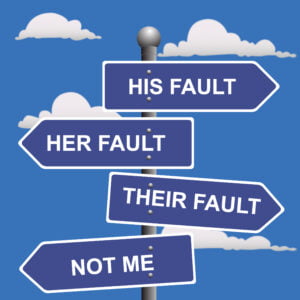
God, I despise a blame-shifter. That’s nothing but chasing one mistake with a worse one. This excellent article goes so far as to say it is a form of emotional abuse.
It’s not enough to simply raise your hand and mumble, ”my bad”, when you’re in the wrong. Own that ish… Take responsibility for what you did wrong and for the repercussions. You will forever prove to yourself that you are the kind of person who can. Character doesn’t come from never being in the wrong. Character comes from being in the wrong, owning it, and learning from it. So, own it when you’re wrong.
Why? Because you’re human, and fallible, and like all of us, you make mistakes. When you step up and own your mistakes, that act says much more about you than the mistake does. It defines you as the kind of person who can acknowledge fault, lay down their ego and pride, and accept responsibility for your contribution to a problem. It makes you trustworthy, approachable, accountable, ethical, and real. In other words, a high-quality person, mistakes notwithstanding.
People who think so highly of themselves that they never say, ”I’m sorry”, never accept blame, never take responsibility for things going sideways, are pathetic. They are insecure, immature, and willfully blind to their own shortcomings. Quick to find fault in others, they never let the finger of blame swing around and point at themselves. They are hell-bent on protecting the reputation of an error-free self, non-existent in the real world.
And we know that’s not you. Naw, you own it when you’re wrong.