Blog

  • The Magic of Ritual & Why You Should Buy A Burr Coffee Grinder—With a Childhood Story Added to Boot

    The Magic of Ritual & Why You Should Buy A Burr Coffee Grinder—With a Childhood Story Added to Boot

    buy a burr coffee grinder
    KitchenAid burr grinder like mine. (Image from KitchenAid website)

    # 15 on my 99 Life Tips–A List is: Buy yourself a good burr coffee grinder when you can afford one. This is the one I’ve used for 20+ years. Use whole beans. You’re welcome.

    My first encounter with coffee

    I’ve been a coffee drinker since I was little—maybe 4 years old. I remember being at a family gathering at my maternal grandfather’s brother’s home in Podunk, SC. The name of the town is 96. Which has always seemed odd to me. It is nearby North, South Carolina, and even closer to Ware Shoals, which the locals pronounce as War Shoals, so I was scared to visit there as a youngster, not knowing when a battle might break out.

    Anyway, at this reunion of sorts, my grandfather’s brother, who I called Uncle James, and who was an old-school, handsaw carpenter with forearms like Popeye’s, was serving coffee. I don’t mean to give the impression he was carrying around a pot and refilling cups like a waitress at Waffle House. Just that coffee was available for self-serve all day. All. Day.

    At 4, I liked sugar, but my mom limited me to one piece of cake or pie. To my amazement, there was no limit on coffee. And there, right beside the coffeepot, sat a large cardboard tube of Dixie Crystals sugar with its own pour spout. All. Day. I probably had 8 or 10 cups of coffee-flavored syrup during the hours we spent listening to our relatives speak slow. (My mom was born in SC, near this gathering place, but she grew up and went to school in the Midwest where I was born, in Davenport, Iowa. So we spoke differently) By late afternoon, the combination of caffeine and sugar made me a nuisance, and my mom turned me outdoors to race and wrestle the dogs out back.

    But this is about burr coffee grinders isn’t it? It’s not about Southern Drawls.

    My love affair with coffee matures

    To the point. Coffee is ritualistic. It is good food. Sure. To my mind, it is the breakfast of champions. But there is something about making coffee, similar to making a cup of tea, that invites the coffee lover into the magic of ritual.

    When I was a younger man, I used to spoon Taster’s Choice or Folger’s into a cup, pour in boiling water, add milk (I stopped with the sugar), and think I was drinking coffee. That was fine on those mornings I when I’d gotten little to no sleep and the boss was in his pickup blowing the horn for me to come out and go to work. Speed was of the essence. A jar of pre-ground black dust in a jar was fast, if nothing else.

    Later, I discovered the finer things. First, I got a blade grinder and started buying whole beans. It was cheap and plastic, except for the thin metal blade that spun around to dice the beans. I learned somewhere, probably from my habitual reading and accumulation of unrelated facts, that coffee was better if you ground the beans just before brewing. I did this a while, but it wasn’t until I met a real coffee-man, a barista in a fancy coffee shop in the local mall, that I learned about burr grinders. His knowledge inspired me to buy a burr coffee grinder. I’m paying it forward.

    Burr beats blades

    Burr grinders use opposing, spinning pinwheels of ridges to crush and grind whole beans. Whereas a blade grinder will heat the beans, enough to change their composition—tainting their flavor, burr grinders don’t. Blade grinders also chop and dice uneven shapes. The grind is not consistent. Burr grinders are the slow and gentle approach to coffee bean perfection. There is a dial-in setting on burr grinders to match the grind to your coffee maker and taste preference. The grounds are uniform and perfectly alike.

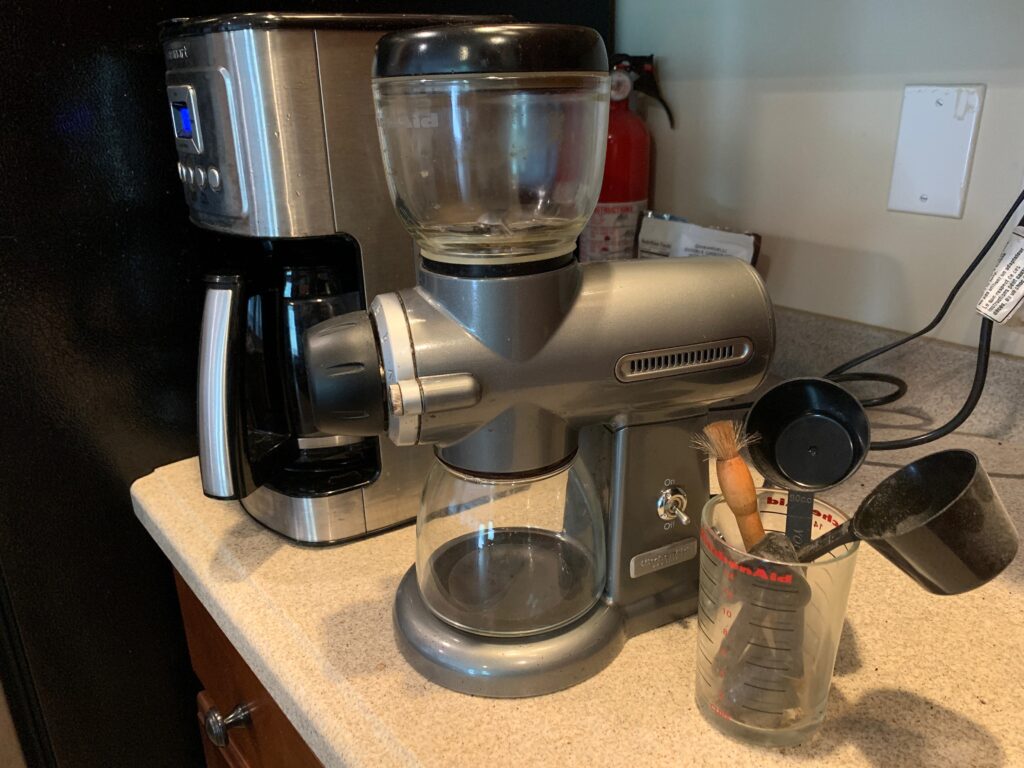
    I have had the same Kitchen Aid grinder for at least 30 years. A workhorse, it has outlived 5 computers and as many televisions. It sits on my counter beside my Cuisinart coffee maker. My grinder is integral to my morning ritual.

    The Magic of Ritual

    Each morning, I empty the prior days grounds from the Cuisinart into the trash (I’m not currently composting, though I have in the past). I fill the tank with water, then I reach down my tub of beans and one Melita bamboo, unbleached #4 filter from the box I’ve cut open to expose the filters in the cupboard. Using a scoop I keep in with the beans, I shovel 7 scoops into the top of my grinder. 

    My kids recently pointed out that I use a peculiar cadence when scooping—it’s quick scoop, slow pour… quick scoop, slow pour… If they’ve been awake, they’ve heard me do this every morning for their entire lives. My grinder is older than all but 1 of my kids. So they know the peculiar rhythm of my coffee ritual.

    After the 7 scoops, I flip the toggle switch and hear the satisfying churn of the grinder. It is deep and resonant, not like the high-speed whine of a blade grinder. Those sound more like a smoothie maker or blender. My grinder is more like a throaty wood chipper. I watch the heap of grounds slowly disappear into the grinder’s maw. I assist with a tiny pastry brush, sweeping the reluctant beans into the hopper to disappear. The aroma is fresh, instant, and intoxicating.

    buy a burr coffee grinder
    My burr grinder at the center of my morning ritual. (Photo by Author)

    The ritual is peaceful, serene, almost hypnotic. It is half-mindful-half-autonomic magic. I could do it asleep, but I remain aware of every step of the process. I know every quick-slow scoop matters to the outcome, so I pay attention with a much deeper part of me than normal thinking. Like I said, it’s magic. And my burr grinder is at the center of it all.

    So, buy a burr coffee grinder. It is a fantastic investment in excellent coffee, healthy ritual, and the beauty of single-purpose, well-engineered tools. Which means it is a fantastic investment in yourself. Win-Win-Win.

  • Take It From A Snob—You Should Drink Coffee Fresh

    Take It From A Snob—You Should Drink Coffee Fresh

    Drink Coffee Fresh
    Ocrakoke Coffee at Cape Hatteras. Yes, I bought a mug. (Photo by Author)

    # 14 on my 99 Life Tips–A List is: Drink coffee fresh. Preferably within 20 minutes after brewing. A brewmaster once told me that after 20 minutes, coffee’s chemistry changes, turning it into something else. As an addendum to this tip: don’t serve old coffee to a guest in your home. Make a fresh pot, or offer them something else.

    I suppose I should have started this tip with the simpler imperative, “Drink coffee.” But then I’d be forced to make an exception for my girlfriend who in all other ways seems remarkably well-balanced and stable, but who does not drink coffee, so I’m certain there is some latent problem yet to be revealed.

    I jest. But not about drinking coffee fresh. And not about making it fresh for company.

    My tip stands on its own with sufficient explanation. You can google the details if you doubt the veracity. Here is a good site with decent information for the home barista.

    One addendum: Buy whole beans, store them properly in an air-tight opaque container and grind them fresh with a burr grinder (not a blade grinder). I will be adding a story about this.

    Is it more trouble to drink coffee fresh? Yes. Is it worth it? Yes. Am I a coffee snob? Yes.

    Drink Coffee Fresh
    Beachie Bean’s Coffee Shop in NSB, FL (Photo by Author)

    To sample the local pace, support locally owned coffee shops

    While on the topic, allow me to plug the idea of finding good local coffee shops to support whenever you travel. I know the ubiquity of large chains like Starbucks make them easier to find for their numbers, but there is something uniquely satisfying about a cup of fresh coffee enjoyed just after dawn in a locally owned shop. 

    Part of the allure is that traveling well, and by that I mean getting the most of the experience, involves at least sampling the local pace of life, if not outright melding into it. Where better to sample the local pace than at a locally owned, locally supported coffee shop?

    Just remember to drink coffee fresh. You’re welcome. Oh, and never use non-dairy creamers and continue to call yourself a coffee drinker. I’m not sure what that chemically processed stuff is. So, that’s it. You’re doubly welcome.

    Drink Coffee Fresh
    This coffee shop on the NC Outer Banks even has a lending library. How cool is that? (Photo by Author)

    PS- I’m not a coffee shop owner, just an opinionated coffee lover who happens to be right about this. Enjoy! 😉

  • If You Want To Dance, You Have To Pay The Piper—And Other Sacred Verses Of My Youth

    If You Want To Dance, You Have To Pay The Piper—And Other Sacred Verses Of My Youth

    # 93 on my 99 Life Tips–A List is: If you want to dance, you have to pay the piper.

    This advice is from my Uncle. He said it so often that it is now enshrined in my life’s accepted canon. 

    This sacred tidbit is 1 Kurt 1:1.

    It stands beside other canonized wisdom I received as a kid from those more wise than I.

    My Granddaddy, Leo, used to say things like, “The faint heart never won the fair maiden.” 

    And, “Look before you leap.” 

    And “Nothing good ever happens after midnight.” 

    (Much later I would tell him he had never been out with me after midnight except to go flounder gigging).

    He said these things so-matter-of-factly and with such conviction he also has a book in the canon—First Leo.

    It is filled with priceless treasures, sometimes mixed with half-scriptures, like “the wages of sin is death.” Sometimes he elevated his extra-biblical quips to Divine status by asserting things like, “You know the Good Book says one in the hand is worth two in the bush.”

    A melting pot of wisdom

    I would shake my head and roll my eyes. But I didn’t dare try to dissuade him from mingling those aphorisms from Poor Richard’s Almanac and other dubious sources into a melting pot of wisdom. After all, I wasn’t “old enough for my wants to hurt me.”

    But, the one from my Uncle stands out, both for its succinct truth, and for its unfailing accuracy. 

    If you want to dance, you have to pay the piper.

    Other memorable verses from my Uncle include the timeless, “Let’s put her in the wind.” 

    He always said this at the end of a long workday when the power saws had screamed their last, the smell of fresh cut pine was hanging in the air, the tools were all gathered and put away, the job site was prepped for tomorrow, and power cords collected, coiled and looped like lassos. 

    That magical phrase signaled quitting time. It conjured sailing away towards a better shore, or riding off into the sunset, or exiting the stage into an evening of rest, relaxation, and recuperation, usually accompanied by a cold beer. Hearing it,  just as remembering it now, induces a Pavlovian response. Your face parts in an involuntary smile, and you’re ready to tap a reserve of strength to pack up and go—away from work and towards play.

    My Uncle and Granddad shared a common desire that propelled their energies. They wanted to play! So they worked hard to fully enjoy the play of not working in the interim. Neither one ever uttered something so mundane as “Work Hard, Play Hard.” But they lived it. And it rubbed off on me.

    I do want to dance. Both literally (sometimes), and figuratively (daily). To dance is to play. In my mind, I hear my uncle, and dance becomes representative of play. To do so, I work, cause you have to pay the piper, as it says in First Kurt chapter one. So, you too, remember this advice, if you want to dance, you have to pay the piper.

  • R-E-S-P-E-C-T: It’s Multi-Faceted Meanings & How Knowing The Variations Can Save Your Life

    R-E-S-P-E-C-T: It’s Multi-Faceted Meanings & How Knowing The Variations Can Save Your Life


    # 92 on my 99 Life Tips–A List is: You should, respect a person (or not) based on 1- who they show themselves to be. But, you should respect authorities based on 2- what they can do to you. None can require you to respect the person in the uniform or office, refer to “1” for that.


    I could not write this essay about respect without hearing Aretha belt out the spelling in that inimitable, soulful way of hers. I hope you’ll enjoy that earworm. If you belong to my generation, you will. If not, you’re already thinking, “huh?”

    This is an essay about respect; its various meanings, its contextual application, and how knowing how to show respect appropriately can save your life.

    Words are idea containers 

    We need to think for a minute about what respect is and what it isn’t. Like Aretha, we spell it only one way. But we use it to mean many things. I won’t bore you with definitions except to say this about words: Words are idea containers.

    When my firstborn was young — precocious, verbal child that she was — if she saw something she didn’t have the vocabulary for, she used a catch-all container, the word “pumen” (rhymes with lumen). Her word box contained everything from blackberries to motorcycles, from horses to Santa Claus. It was a large container. We grew used to her pointing at something and asking, “What’s that pumen?”

    “Respect” tries too hard to contain too much

    My story has a point. Which is that some words contain ideas so numerous and varied the containment stretches and tests the adequacy of the word to hold and convey them all.

    The word “love” is a prime example. We use it to describe our feeling for bananas, baseball, and best friends.

    With words such as love, like, hate, we come to understand that context plays a role helping the hearer or reader infer the speaker or writer’s intent. There is a broad range of meaning in these “over packed” words.

    Respect is such a word. It is an over-packed, “try-hard” of a word attempting to do overmuch. It is the “pumen” of social lubricants and niceties. This gives it a wide spectrum of meaning. But not all the meanings are apropos for every usage. 

    A variety of meanings to fit the contextual and cultural pendulum

    There is a contextual and cultural pendulum when selecting the applicable meaning of respect. In my lifetime, the meaning of respect has swung from — “to acknowledge the right of,” or, “to regard” — to the current meaning (as used by my kid’s generation) in which it reflects an amalgamation of “esteem, high regard, acceptance, and approbation” (though my kids never use that actual word). So, the meaning of respect is rapidly accelerating to its farthest and highest meaning which is “deep admiration” and “the highest regard”.

    And in some cultures respect has always meant “deep veneration” and “honor”, such as that respect shown to one’s elders, something we’ve never been good at in the U.S..

    We see then, that the single word respect conveys a variety of meanings. It doesn’t mean the same thing to all people, even to those who speak the same language and share the same cultural heritage.


    The Advice Reframed

    I laid that groundwork in an essay about respect to serve as a footing upon which to discuss the advice I offered at the outset. 

    When you read it again, notice how the meaning shifts. The ideas contained in the word respect change as the context changes.

    Below, for clarity’s sake, I’ve reframed the advice offered in my tip.

    Respect a person (or don’t respect them) based on:

    1- Who they are in words and deeds.

    2- The power they have (because of the office or job they fill) to mess with or take your life.

    As stated, Respect is an interesting idea-container of a word. It includes variations of meanings which have shifted in one generation. In my youth, showing respect was simply to act with the deference of courtesy and politeness. It was akin to good manners. Respect had little to do with agreement or acceptance or esteem, except at the very highest levels where only the most deserving received it. In such cases, we substituted a better, more specialized word, more descriptive of feelings of esteem, admiration, and acclaim.

    For example, I’ve never heard a fan say, “I really respect Jerry Garcia’s soloing.” Or, “I respect Mark Twain as a writer of short stories.” And no one would say, “I respect the way Mother Teresa cared for Calcutta’s poor.”

    Because Respect and Admiration are different

    To respect you is to offer you the opportunity to be heard, to voice your own opinion, to state your view and stake out a position. This fundamental level of respect comes with the territory inherent in the idea that we are equals. You are as entitled to your opinions as I am entitled to mine. I regard your right to speak for yourself and live the way you choose as valid rights. But… I am not required to admire the things you say or the lifestyle choices you make. I am not required to look to you as a role model. I may totally disrespect your choices, and you mine, while simultaneously respecting your right to make them.

    So, I can respect your right to your opinions without respecting your opinions. I can listen to you and still not agree with you. Respect doesn’t mean I shelve my discernment, logic, learning, or personal biases and views and adopt yours. Respect is not acquiescence, or agreement, or approbation.

    The Respect of 2 Ideological Opponents

    The story is told of the friendship of the late Supreme Court Justices Antonin Scalia and Ruth Bader Ginsburg. These two were figurehead iconoclasts of vastly different political and judicial ideologies, yet remained friends until Scalia’s death. Before his passing, someone once asked Scalia, the strict constructionist conservative, about his friendship with Ginsberg, the vaunted liberal feminist. The questioner expressed incredulity about the basis of such a cordial relationship when their political and judicial views were so diametrically opposed.

    Scalia quipped, “I attack ideas, not people.”

    If I could write that into my next thousand stories, I would.

    We do well to remember and practice those sage words. Respect for the other person is the contextual framework that allows that to happen. Scalia respected Ginsberg. She respected him. I respect them both, nay; I admire them both, for showing each other such deferential respect for the right to their own views and opinions, even when they didn’t share or admire the views expressed.

    How the meaning has shifted

    In my kid’s generation, the so called Gen X through Z, the meaning of respect has steadily swung towards the esteem side of the pendulum. If I disagree with the viewpoint of my youngest kids, they will often accuse me of being “disrespectful”, or worse, “rude” (which seems to be one of the worst character flaws you can display to members of the generations at the end of the alphabet).

    I’m sure the shift in meaning is because of mistaken ideas of Self-Esteem propagated in public educational environments. We commonly treat self-esteem as an entitlement to be granted to all as a participation trophy, rather than as the internal esteem one earns and holds for oneself because of one’s character (virtue). The word “self” in the phrase “self-esteem” is a dead giveaway that this esteem must come from within. No one can give it to you. Esteem conferred from without we should call by some other name.

    I can respect the right of a student to come to class, or to skip class. I can respect their right to learn up to their ability, or to shun the effort required to learn. But I do not esteem anyone who skips class or who does not better themselves when granted a free opportunity to do so. What is estimable about that?

    Thus, respect is not esteem, though the highest end of the respect-definition-spectrum does include the concept.

    Numbers 1 and 2 unpacked — This could save your life

    My advice in #1 above relates to this higher end of the spectrum. Admirable character, words, and deeds must earn the highest meaning of the word respect. To none but the worthy do we entitle this usage. We reserve it for the deserving because it conveys the sense of appreciation, approval, acknowledgement of worthiness, etc.. We don’t grant it lightly, denigrating and trivializing it into a meaningless entitlement to all comers, regardless of character, expertise, or worthiness.

    The admonition in number 2 of my advice, if heeded, can save you a lot of needless heartache, and possibly even save your life.

    I have in mind here those persons acting in an official capacity who have both authority and power to interfere with your personal freedom or life, in extremis. They can take either, or both. In an essay about respect, I would be remiss not to warn you to respect that power. Together we can pray and work to see the end of that power being abused and mis-used. Regrettably, that day remains in the future.

    We have all seen the horrifying and gut-wrenching examples of unscrupulous, even murderous, thugs (for there is no better idea container for them), dressed in uniforms and armed with badges, batons, billy clubs, and guns, who deserve no more esteem, admiration, acclaim, approval, or acceptance than a sociopathic criminal deserves. Their lack of character, lack of ethical behavior, lack of morality, lack of humanity all stand as accusers at the bar of justice, and we all want them to receive the just recompense of the crimes they’ve committed while clothed in the uniform and trappings of state authority.

    When in doubt, focus on the uniform, not the person

    Still, if a uniformed authority figure accosts you, you do well to respect the uniform for the power the wearer has to alter forever, or even to end, your life. It is shamefully true that some have shown this basic deference and respect for the uniform, if not for the person wearing it, and still had their lives taken away by a uniform wearing murderer. But it is wise to respect the power behind that uniform. It is wise to acknowledge the authority that created that position. It is important to remember that the authority that created the position also armed them with a weapon that if used, whether in righteousness or murder, can make you just as dead either way.

    So while, because of unworthiness of moral character, we may feel utter contempt, disdain, and disgust for the politician, or judge, or cop, or soldier who wields social or political or judicial power, we’d best respect the power. We can reach in the container of respect and at least come up with the sense of acknowledgement, understanding, and regard for what the uniform or office represents, even if we wouldn’t waste saliva to spit on the person occupying it. For the person wearing the uniform or occupying the office to receive more than base level respect, they will have to do so by earning it.

    The Takeaway — A Respectable Purpose

    But let’s turn away from uniformed persons, or officeholders, and other authority figures and end this essay about respect thinking about ourselves. If you want my respect, I stand ready to give it to you. I want nothing more than to have a role model to admire, a mind I can glean from, an example to be inspired by. Go for it. I will respect you to the fullest meaning. But I won’t hand you that just for sitting there breathing. Nor do I expect it from you. I aim to earn your respect. I want to earn it first as a person. No rotten tree can bear good fruit

    So, first I strive to be a person whose life and character are respectable. From that kind of life, I hope will flow opinions and ideas that will induce more respect. Do I hope to win your admiration and acclaim? Yes, yes I do. I hope that my presence on this planet enriches you and creates good things in your life. And I hope that your life will create good things for me. There’s no more respectable purpose, is there?


  • Your Neighbor Is Commanded To Love You—Do You Want Their Love?

    Your Neighbor Is Commanded To Love You—Do You Want Their Love?

    # 91 on my 99 Life Tips–A List is: You are commanded to love your neighbor, not to trust him.


    Do you want your neighbor’s love?

    We will look first at love, then at trust, which is only natural since trust is born of love. The commandment to love your neighbor comes from the Judeo-Christian tradition. Jesus called it one of 2 great commandments. The other great commandment is to love God with all one’s heart. The 2nd, Jesus said, is “like it”, that we are to love our neighbor as ourselves. If you could have it, do you want your neighbor’s love?


    Some questions for you to consider:

    • Is it possible to love God and not love your neighbor?
    • Does “as” mean “like”? Or does it mean that I am to think of and treat my neighbor “as if” they are myself? (If you thought of your neighbor as a “next door” version of yourself, but in a different body, would that change your treatment of them? Presumably for the better?)
    • Do you want your neighbor’s love? (Since they are to see themselves in you, too.)
    • Do you expect your neighbor’s love? And do they have the moral right to expect yours?

    An radical imaginary world

    A further consideration is to think just how radical the results would be if this most radical commandment in human history was universally obeyed.

    Imagine a science-fiction world wherein every neighbor loves every other neighbor. Imagine what that would mean for economics, politics, international relations, even the need for nations at all. 

    It would be like some sort of Kingdom of Heaven. Probably just like the one Christians often pray will manifest on earth in accord with the Divine Will (but with fingers crossed behind our backs).

    It’s easier to imagine The Martian Chronicles, Star Wars, Dune, and private spacecraft than a world filled with neighborly love isn’t it? It’s one thing to suspend disbelief to imagine Inter-Galactic Confederations and Spice Guilds. We can imagine a Death Star, but it’s quite a leap of imagination to believe in a world practicing universal neighborly love—too wide a leap for most of us. Superman and Catwoman are more believable than that.

    It is nice to play “what if” though, is it not? 

    Is a belief unpracticed really believed?

    I mentioned that this command comes from 2 of the 3 Abrahamic religions. (A similar command may exist in the tenets of Islam, I confess my lack of familiarity with its sacred texts). 

    And yet, Christianity (with a few notable exceptions for all too rare individual cases) seems to have showed a 2100-year propensity for missing the point. 

    As a believer myself, I’m dismayed that most of us professing belief in Jesus, act as if His day-to-day purpose in our lives is to help us feel better and prosper financially. We comfort ourselves with the belief He will secure our future admission to heaven. We don’t think about His primary daily purpose as empowering us to love our neighbor… the entire world of them.

    I’m guilty here, too. My usual prayers focus much more on my needs than on making me better at loving my neighbor.

    Sadly, “believers” will give unequivocal assent to the expression “love your neighbor as yourself”, even calling it the “Word of God”, and yet this mere intellectual assent spurs a vastly disproportionate few to become its “practitioners”. The widespread embrace of the idea without widespread accompanying action is a puzzle. As if it only exists to make a nice wall plaque or refrigerator magnet. 

    A command radical for its practicality

    But this command is imminently practical. And it is imminently radical for its practicality. Because if practiced, you will find yourself in direct conflict with the underlying principles of profit-motive capitalism. And it will radically conflict as well with your cherished political views and reverence for the founders. For instance, how are you to love your neighbor as yourself, yet use your liberty in the pursuit of happiness, unless you also pursue the happiness of your neighbor with equal vigor? 

    It becomes immediately apparent how incompatible the pursuit of happiness is with the 2nd great commandment. Unless, of course, you find happiness in loving your neighbor.

    In that case, Augustine’s directive applies: “Love, and do whatever you please…”

    But seriously, if I am to fulfill this command, how can I do so and not have a regard for my neighbor’s well-being as much as I regard my own, for issues like health care, or mask-wearing, or vaccinations, or universal basic income? Or am I to love my neighbor unless it intrudes on my pet political dogma?

    And moving to economic considerations, does the law of love allow me to make as much money as I can, selling items for the most the market will bear, enriching myself at my neighbor’s expense? Can profit-motive co-exist with the love-motive? Does neighborly love not command me to sell as cheaply as I can afford to sell, with regard both to my neighbor’s need of my products and services, and their interest in securing fair value as inexpensively as possible, while still loving myself enough to make a living that will provide for my legitimate necessities?

    Economic considerations of neighborly love

    Last I checked, I don’t require a private spaceship, or even a seat on one for a space tour. I don’t need to pay myself 299 times more because I’m the CEO than I pay my average employee. (An average of $12.7 million in 2020—during a pandemic). According to the law of neighborly love, these men are villains to be castigated, not heroes to be lauded.

    These are fundamental, practical questions. Loving your neighbor is the most radical economic and political philosophy ever espoused. It is the most radical action anyone can take. Universal adoption would topple every government, everywhere, other than to provide and administer infrastructure, health care and maintenance services.

    There can be no trust where there is no love

    Imagine a science-fiction world wherein every neighbor loves every other neighbor.

    It’s too preposterous to imagine, isn’t it? And that’s why we need not bother with the second part of my tip. For in a world in which we cannot reliably expect love from our neighbor, and in which the command cannot compel us to offer it ourselves, there can be no command to trust them. And thus arises the need for governments, with all their accompanying evils, to police the selfishness of humankind. Because in whatever form, they are less evil than unloving neighbors would be to each other without them.

    But just for a moment, pretend. Go ahead, hypothesize with me. If you could have it, do you want your neighbor’s love? Think maybe they’d want yours? Imagine the ramifications. Imagine if it started with you and me. 

    Love your neighbor as yourself. Right! That’s just way too radical. Crazy, ain’t it?

  • Gentlemen Hold Doors For Women — And Other Relics of a Bygone Era

    Gentlemen Hold Doors For Women — And Other Relics of a Bygone Era

    Gentlemen hold doors for women
    Shutterstock photo by Olena Yakobchuck (licensed to Author)

    # 7 on my, 99 Life Tips – A List is: If you’re a guy, hold doors open for women. For that matter, if you arrive at door first, hold doors open for anyone. This way, if you meet the rare woman offended by your offering, you can explain, ”Hey, I hold doors open for anyone when I get to the door first.”

    This is, or at least used to be, self-explanatory. I’m not talking about sexist chivalry, here. This is just good manners. This is what gentlemen do. Gentlemen hold doors for women.

    I would stop holding a door for a woman who asked me not to, out of respect for her wishes, but it would feel odd to me.

    For that matter, hold doors for everyone

    In daily practice, I hold doors for anyone and everyone if I get to the door first. Sometimes this turns me into the doorman for a few minutes. Those few seconds lost have never cost me anything of importance. Usually, I get a small sip of feeling good about myself for performing a small act of considerate kindness. I don’t view this as a grand gesture. It is not a statement about the comparative strengths of the sexes. Gimme a break. 

    Gentlemen hold doors for women and others just to be good people. There are plenty of good people in the world, but not enough of us consistently act like it. This is one hell of an easy way to act like it.

    Feels weird to make a blog post about something so self-evident. Almost as strange as writing one about wearing a mask during a pandemic, or getting vaccinated to stop its spread. 

    But times are different now. Politeness and consideration are at a premium. Human decency is rare as gold bullion. Being nice without a selfie stick or camera crew is apparently passé. Set yourself apart. Go old school. Hold a door.

  • Try Not To Learn Anything New Today — It’s Harder Than It Looks

    Try Not To Learn Anything New Today — It’s Harder Than It Looks

    Try Not To Learn Anything Today - hoarded books
    How I imagine my mind. (How’d that girl with the vinyl backpack get in here?) Photo by Darwin Vegher on Unsplash

    # 18  on my 99 Life Tips–A List is: ”Try to learn something new every day,” is often included on lists like this. Instead, try not to. By trying not to, you’ll become aware of how much you learn everyday without even trying, you just have to be awake enough to catch it.

    I enjoy “life-tips” lists. Invariably, they advise us to try to learn something new each day. I read those words and hear Yoda in my head, “There is no Try! There is only Do or Do Not!”

    Still, my tip condenses to this: Try not to learn anything new today. I’m a professional non-conformist. I’m not plagiarizing that usual worn-out tip. Instead, we’ll try the opposite.

    I’m sure I must have let some days pass without learning anything new. The likelihood of that seems like a reasonable assumption given a span of some 15K days. But I’d be stunned if I’ve failed to learn something in more than 1% of them. The other 99% of the time, new facts and information falls on me, follows me home, and piles up.

    If you’re awake, you learn without trying. If. You’re. Awake.

    I’m not going all woo-woo metaphysical here. You don’t have to be the Dalai Lama, or Buddha himself. You’ll learn stuff if you remain just reasonably alert and half sober.

    But, I’m contradicting my tip, which is to dis-courage your attempts to learn. Here, I’ll put it in bold letters. 

    You’re supposed to try NOT to learn

    A confession. This is the only rhetorically facetious tip of the entire 99 on my list. How’s that for some purple adjectives? (ProWritingAid and Grammarly are gonna love that). And it is the only one I don’t practice regularly. In fact, I’ve never practiced this one at all. I’ve never made the active effort not to learn something for even one day. 

    And see, I just proved the point of my tip. You just learned several things in that one paragraph without trying. You learned some things about me. And you gained the bonus knowledge that even pro writing software doesn’t have a sarcasm or satire mode. See?

    Comic Relief

    I’m curious about all kinds of things. One of my favorite comics of all times is a scene in a doctor’s office. In the office, we  see a serious looking doctor wearing a lab coat, stethoscope draped around his neck. He is peering intently at a chart and and standing beside his patient, who is seated on the exam table. The patient is a worried looking cat, brow knit with anxiety. Tension is etched on both faces. The doctor speaks, “I’m afraid it’s curiosity.”

    Cute, huh? I’m curious to know. I’ve got a motor to learn. I’ve got more questions than answers  and the more answers I get the more questions they breed.

    As a writer, I’ve heard of an affliction called writer’s block in which the writer is stuck and has nothing to write about. It’s hard to imagine. That must be the same feeling as having nothing to live about. I have way more ideas than time. Way more time than talent. 

    Most likely, I’ll just keep on learning and letting ideas and information pile up in my mind where all the rooms look like an episode of Hoarders. See, my advice is not for everybody. It just won’t work for me. 

    But your mileage may vary. So, you go ahead and try not to learn anything new today. Feel free to return and comment below with all the ways your efforts failed. Other readers may learn something. Oh, shoot!

  • Read for Sheer Joy—The Ultimate Call To Action

    Read for Sheer Joy—The Ultimate Call To Action

    # 17 on my 99 Life Tips–A List is: Read for the sheer joy of it. If you cannot read due to time constraints, look for time leaks to plug so you can make time to read. If you still cannot get the time to sit with a book or good magazine, listen to audiobooks at every available moment: when walking, when commuting, or on a drive of any distance.

    I count reading as the cornerstone of all my acquired skills. It is the skill that informs and makes possible all the others I possess other than those that I’ve picked up by observation and practice. (I learned to drive nails with a hammer by hitting my thumb a lot—reading would have been less painful, but not as good a teacher).

    Reading Is What Makes Writers Immortal

    The whole concept of reading amazes me. Graphical communication supposes the creation of information in the present to be recorded for impartation and consumption in the future without a loss of meaning. Whether a book, an article, an essay, or a note, written words bring the author’s mind to the reader, whether or not the author is still physically alive. 

    For those who wonder about cryonics to achieve immortality, I say, try writing. Via reading, the author’s mind is as alive and fresh and real as the day he chiseled, or penned, or typed the words.

    So much of spoken language is thankfully ephemeral. It passes on the same wind that carries its vibrations to the ear of the hearer. And sometimes it goes in one ear and out the other just as rapidly. 

    As a test, list how many speeches you know about as compared to how many book titles you’ve read. Any famous speeches that predate radio and television have survived and made it to us because we can read them. How sad if we only had oral history to learn from and to pass on to our progeny.

    Written language is an archive of saved thoughts. Expecting the existence of a reader, the writer writes. She supposes that what she records will be relevant and helpful to some reader who comes along in five minutes, or five years, or five millennia.

    Reading Is A Kind Of Magic

    With these ideas in mind, reading anything is a joy to me. It is a kind of magic. I feel sorry for those who only read of necessity. One of the mind-blowing experiences missed by those who find no pleasure in reading is the opportunity to try on a new life, or a new world in your imagination, to time travel, either by re-living the past or rocketing into the sci-fi future.


    If you read the words pink elephant, you cannot help but see it. How did I put it in your mind? I wrote it and you read it. Amazing. If you think that was cool, try to escape the knowledge of that happening with every word you ever read. A writer somewhere cooks up a thought, pecks it out in abstract shapes, squiggles, and lines, posts it somewhere and the reader’s internal interpreter assigns meaning to all the gibberish and makes it real in the reader’s mind. 

    And while there is something precious and sensual about holding a book in your hands, of feeling the paper as you turn the pages, digital formats and audiobooks are a fantastic way to get many of the same benefits, and they’re convenient in a pinch. Go ahead, read for sheer joy.

  • 2 Trees—Knowledge, Life, and A Celebration of Dependency

    2 Trees—Knowledge, Life, and A Celebration of Dependency

    2 trees-a celebration of Depency
    There were 2 trees in the garden. There still are. (Shuttestock Image licensed to Author)

    # 87 on my 99 Life Tips–A List is: There is nothing more magnificent in creation than a tree in a forest. I learned this way too late.

    Here I simply refer you to Richard Powers’ excellent (Pulitzer Award winning) book, The Overstory. Read it. Digest it. Believe it. Embrace it. Practice it. Live it as if your life, your kid’s lives and the planet’s life depends on it. It most likely does. This story is a celebration of dependency, because life is better than knowledge — life is dependency.

    2 Trees

    The story of creation begins in a garden. In that garden are two named trees. This story tells how the lie’s promise went unfulfilled and how life is better than knowledge.

    The Tree of the Knowledge of Good and Evil, and The Tree of Life.

    The story juxtaposes these, one to one another, making them antagonists. Black hat and white hat. The distinctions between these 2 trees set the stage for a marvellous story and yet they do no combat against one another. There is no arboreal clash of branches. They do not fight and sway. They simply exist. The two trees are saying something to us through the reach of literature if not from the literal nascent moments of our species and our shared race as humans. The battle is within ourselves.

    The one tree has gotten all the ink through the years, but there were 2 trees our first parents could have eaten from, only one of which was forbidden. There was also the tree of Life, about which no prohibition had been made.

    The Tree of The Knowledge of Good and Evil story is fundamentally a story about independence. The tempter offered something he could not give to fill something they could not have and did not need. This is the nature of temptation—to overpromise and underdeliver. Always. The temptation to Adam and Eve was to become “like God—knowing good and evil”.

    This is a lie of Trumpian proportions, the first Big Lie and mother of all Big Lies. For God is more than knowledge, and God is more than the arbiter of good and evil. God is that Supreme Creator who determines whether a thing, a thought, an act is good or evil in accord with that wisdom and love only God possesses. 

    Good? Evil?

    What man or woman has ever attained to such heights as to know conclusively what good is, independent of God?

    Was crucifixion good? Or was it evil? Was the discovery of North and South America by Europeans good? Good for the natives, the aboriginal peoples on those continents? If good, for whom was it good? For God? For all?

    Questions of these kinds are indecipherable entanglements. The best and brightest wear themselves out and drive themselves mad, picking at that backlash of knotted contradictions, hoping in vain to answer the very thing promised to our ancestors in that primordial lie. What is good? What is evil? And in our history, have we arrived at any satisfactory, mutually agreed upon, non-controversial decisions about what is good and what is evil? I trust the reader to recognize a rhetorical question when you read one.

    Like Begets Like

    As fruit contains its seeds within itself, so it is with lies. Like begets like. Apples produce apple trees, not cherries, or pears, or ferns. A lie’s fruit contains no seeds of truth. Accordingly, we see the fruit from that ill-fated tree was a deadly poison in proportion to the worthlessness and uselessness of the knowledge sought. Because that knowledge could not and cannot produce what the lie purported it could, and neither could that lie or the knowledge it claimed accessible to our ancestors, produce—Life.

    We may admit that the eating of the fruit gave them knowledge of good—as memory—the sacrifice of their original manner of life killed on the altar of independence. Likewise, it gave the knowledge of evil—as present and future — the now inability to keep and reestablish that level of Life-receiving dependence so foolishly sacrificed. In that, the tempter lied the truth, but so craftily as to make even this outcome veiled and hidden in that initial lie, “your eyes will be opened…”. And what an opening of the eyes that was. The knowledge wasn’t in the fruit! The knowledge was in themselves!

    The history of humankind

    The history of what happened at that tree is written in blood and pain, and murder, and war, and black charcoal ash scrawled on cave walls, and choking, teeming clouds of black ash smoke caressing skyscrapers, and in striped, torn skin, and in blood-stained bayonets. It is the sky teeming with rockets unleashed by the “good” to exterminate the “evil”. Oh, God! What a damned misery unleashed on the planet and the race from the belief in that Big Lie that by knowing “good and evil” the created would become as the creator. 

    And here we are, still in the dark. Still not knowing what good is. Still unable to tell what is evil. Still needing to be led by the hand. Still needing to be told. And still too damned proud and stupid to admit our blindness, our need, our destitution and stretch out our hands to Life, for as it says in another place, “knowledge puffeth up” but “love edifies”. 

    Those 3 words are the most concise history of humankind ever penned — “knowledge puffeth up”.

    There is another tree, also fruit-bearing. That 2nd tree remains, because the idea of it remains. Regardless of whether it is a physical, tangible tree, I believe it is the source of all trees, which may be the residual source and the sustenance of all biological life on this spinning ball we ride through Space. It may be a heavenly tree, possibly metaphorical, or hidden in ineffability. But a more magnificent creation, I cannot conceive. This tree of Life exists in the myths of numerous cultures and peoples. Myths this pervasive exist for a reason. There’s usually something real to back them.

    Life is better than knowledgeLife is dependency

    The fruit of that tree of Life is of 12 different kinds — its leaves have potency to heal the nations. (Is it any wonder we look to trees and forests for medicines?) Fruit is both food and a seed pod. In combination with medicinal leaves, everything the Tree of Life symbolizes implies dependency. Life is a series of dependencies — truth no created thing can capture so fully as a tree, which creates its entire mass, not from itself, but from the very air, exactly in the pattern we are to “in Him, live and move, and have our being.”  And nothing gives of itself more fully than a tree, either.

    I can find and infer and reasonably patch together knowledge within myself. But I cannot find life within myself. I cannot grow my food from within myself. I cannot, from within myself, create the air I need for my next breath. I cannot manufacture my own medicine from within. For Life, I am dependent. I am in need. And I’d rather acknowledge, even celebrate my dependency—for I would far rather live without knowing, than know without living.

  • People Fall In Love Everyday—None Fall Into Intimacy

    People Fall In Love Everyday—None Fall Into Intimacy

    # 90 on my 99 Life Tips–A List is: A good relationship is a good fit. The broken pieces and whole pieces interlock

    You may have heard that good relationships are a good fit. 

    I remember first hearing the concept from a post-Ph.D psychologist (a former college friend) when I told her about the demise of my 22 year marriage. She wisely told me relationships aren’t like going to the grocery store and picking the perfect item off the shelf, they have to be a good fit, comfortable for each partner.

    The mental image was suitable and thankfully soon thereafter, I reconnected with the best fit of my life, and for the past twelve years we’ve been constant companions. We built our relationship on mutual respect, but there’s a lot more to it than that. We take care of each other’s broken pieces, sometimes filling in missing portions, other times strengthening and protecting the ruins. 

    What makes a good fit?

    A good fit is indispensable to a good relationship, but I want to explore what makes a fit good?

    A good fit is when the broken pieces of each life fit together, not the whole ones.

    That’s something not everyone sees. Think of Tom Cruise and Kelly Preston in Jerry Maguire. Those two were too perfect. Sure, the sex was hot, but there was no room for intimacy in the midst of all that stifling, demanding perfection. Check the linked scene. Who could live up to that?

    If you want a good fit, one filled with deep intimacy, you have to embrace brokenness.

    And let me add this caveat; everyone’s broken. Even the people who think they’re perfect.

    Intimacy in a relationship comes from excavation of the buried, broken pieces, and carefully exploring how they fit together.

    Broken pieces fitting together creates intimacy
    Photo by CHUTTERSNAP on Unsplash

    What plays on dating app profiles, won’t create intimacy

    When someone starts a relationship telling all about their successes, achievements, and accolades, you may feel happy for the teller, even excited, but not intimate. There’s neither room, nor need for you in those stories other than as their personal admirer, cheerleader or fan. 

    They may be a wonderful influencer, but those stories don’t admit intimacy.

    When you share only your carefully curated best moments, you’re signaling how rich your life already is and how little your listener can do to make it any better except as your captive audience. It is nice to have affirmation, even admiration. But intimacy is better.

    Sounds a lot like typical dating profiles, doesn’t it?

    But within the broken places… lies a world humility, vulnerability, trust, and protection—intimacy.

    There may be such a thing as love at first sight, I don’t know. Sight to me is a very untrustworthy barometer of most anything real.

    I know this. There is no such thing as intimacy at first sight.

    Intimacy takes time. It takes trust. Being built on shared brokenness, it requires the discovery of where your broken places, ownership of the pieces, acknowledgement that there may be whole chunks missing now, and the willingness and the wisdom to know when to share those details with a new potential partner. 

    That last piece is key. Not everyone deserves your broken pieces. And no one deserves them too soon. Freely share your whole ones, let everyone see those. Fling those whole bits like you’re riding on a Mardi gras float. 

    But for your own sake, save the best of you, the broken places, for someone worthy.

    When two people build a friendship from mutual initial commonality and attraction, then patiently let each other venture in to the back rooms, the intimate rooms, ones furnished with painful memories and the pictures on the walls are of unforgotten wounds, something magical can happen. The magic of intimacy. 

    That shared brokenness is the best. Tenderness, lovingkindness, and protective shielding awakens between the partners. Each knows the other’s vulnerabilities and rather than exploiting them for selfish gain, cherishes and caresses them, partners carefully, lovingly tracing each other’s scars, and holding each other in fierce determination not to create new ones.


    You cannot fall into intimacy

    The Beatles, in With A Little Help From My Friends asked, 

    “Do you believe in love at first sight?

    Yes, I’m certain that it happens all the time

    What do you feel when you turn out the light?

    I can’t tell you but I know it’s mine.”

    Beatles: With A Little Help From My Friends

    I prefer the Joe Cocker, Woodstock version as seen here.

    Whether or not at first sight, people fall in love every day.

    No one falls into intimacy.

    That’s reserved for those willing to be vulnerable, patient, and fit each other’s broken pieces together into the puzzle of Intimate Love. That is a good fit.