Category: Life-Advice

  • How Music Affects Your Emotions Directly

    How Music Affects Your Emotions Directly

    # 23 on my 99 Life Tips–A List is: Music bypasses your thoughts to affect your emotions directly. It is unique among art forms for this quality as far as I’ve discovered. Take care then, what you are inviting to stir your emotions.


    Music affects emotions and brain responses in emotional centers regardless of lyrical content, or whether the pieces are solely instrumental. There is a body of brain imaging and clinical proof that music bypasses your thoughts to affect your emotions directly.

    This topic is worthy of a book or a doctoral thesis on its own. I will limit my commentary to calling your attention to the facts stated. Of note is that one study linked above showed that hearing sad music provoked some people to deeper levels of sadness.

    “… the study found that for some people, sad music can cause negative feelings of profound grief.”

     ~ Memorable Experiences with Sad Music—Reasons, Reactions and Mechanisms of Three Types of Experiences published in Plos One

    Emotions usually spring from thoughts

    Emotions usually arise as the products of thoughts, and independent of willing them into existence. A person can choose to be happy, but cannot by willing it, make it so directly. One cannot will happiness. One must first think happy thoughts… or listen to happy music. Music affects your emotions directly, not needing the mind to act as conduit.

    I am listening to jazz by Art Pepper as I write this. This is the first time I’ve immersed myself in an hour of his playing. I am familiar with him as a jazz musician only because I’ve read references to him in some Barry Eisler books, and I’ve heard snippets of tunes while watching the Bosch detective series derived from Michael Connelly’s novels. (You can stream Bosch on Amazon Prime Video).

    Having no familiarity with Pepper’s music, I am enjoying his fluid, sensual, upbeat, even cheerful jazz clarinet and saxophone as the perfect accompaniment to writing. There is nothing melancholy or depressing about it. It is urgent and energetic—sometimes staccato, phrased like well punctuated sentences. He plays woodwinds the way a hummingbird flies, darting here and there—never still for long. There is nothing angry, and certainly no rage. I find myself carried along, fully engaged with the virtuosity of expression, the coolness of style that draws me in like a whisper rather than repelling me like a shout.

    Ray Bradbury said the best jazz musicians play as if they don’t believe in death. An hour or so in and I know Pepper is an unbeliever, too. Listening to him I don’t believe in death, either. Rather, I feel smarter, more sophisticated and cosmopolitan—more vibrant and alive. It would be the perfect soundtrack for a dinner party, or an art crawl. Perhaps to serenade a gathering of happy, comfortable friends as they sample wines, cheeses, and chocolates. I like it. It makes me feel good and I will add Pepper’s jazz to my rotation.

    You have your favorite music. Ask yourself what it does for you. How does it make you feel? Do you have a “go to” band or song?

    Music as mental health medicine

    I have a life-rule not included on my 99 Life Tips list, but it would easily be the hundredth tip. Never, ever drink when you’re down. That, too, is a story in its own right. You should, however, have some healthy alternatives for self-medicating your mental health. I find there is nothing better than music. The studies linked above cite the therapeutic value of music as well. Music affects your emotions. Just take care to recognize which emotions you’re inviting yourself to feel when you make your choice of music to listen to.

    “Dear Mr. Fantasy, play us a tune

    Something to make us all happy

    Do anything, take us out of this gloom

    Sing a song, play guitar, make it snappy

    You are the one who can make us all laugh

    But doing that you break out in tears

    Please don’t be sad, if it was a straight mind you had,

    We wouldn’t have known you all these years”

    ~Traffic: Dear Mr. Fantasy
  • The Magic of Ritual & Why You Should Buy A Burr Coffee Grinder—With a Childhood Story Added to Boot

    The Magic of Ritual & Why You Should Buy A Burr Coffee Grinder—With a Childhood Story Added to Boot

    buy a burr coffee grinder
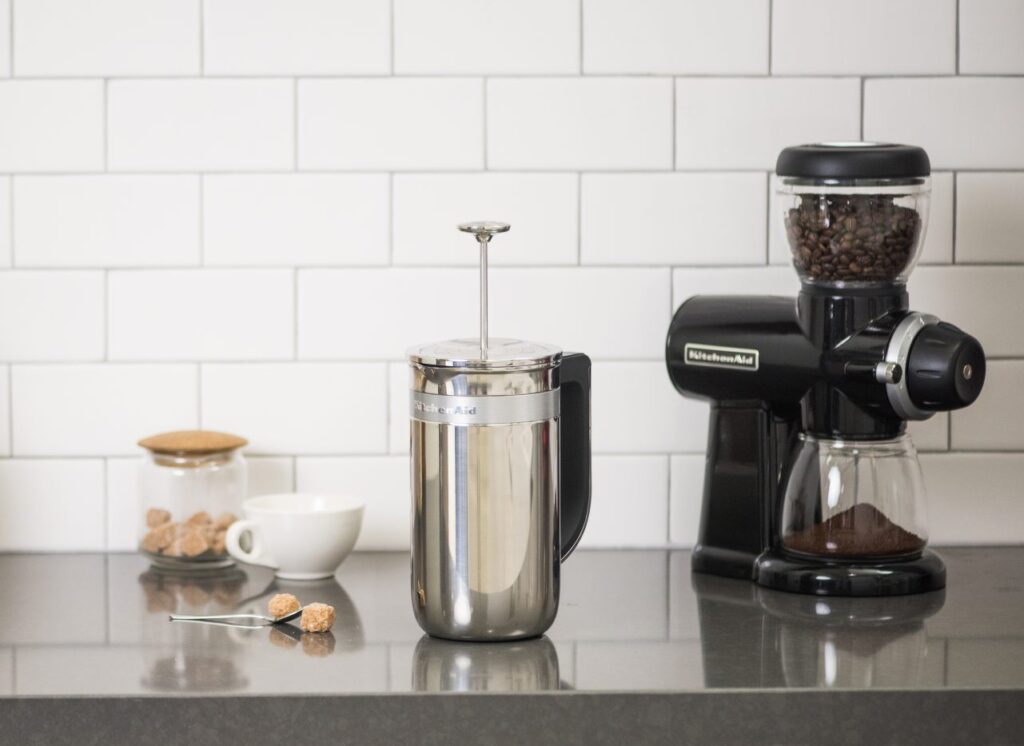
    KitchenAid burr grinder like mine. (Image from KitchenAid website)

    # 15 on my 99 Life Tips–A List is: Buy yourself a good burr coffee grinder when you can afford one. This is the one I’ve used for 20+ years. Use whole beans. You’re welcome.

    My first encounter with coffee

    I’ve been a coffee drinker since I was little—maybe 4 years old. I remember being at a family gathering at my maternal grandfather’s brother’s home in Podunk, SC. The name of the town is 96. Which has always seemed odd to me. It is nearby North, South Carolina, and even closer to Ware Shoals, which the locals pronounce as War Shoals, so I was scared to visit there as a youngster, not knowing when a battle might break out.

    Anyway, at this reunion of sorts, my grandfather’s brother, who I called Uncle James, and who was an old-school, handsaw carpenter with forearms like Popeye’s, was serving coffee. I don’t mean to give the impression he was carrying around a pot and refilling cups like a waitress at Waffle House. Just that coffee was available for self-serve all day. All. Day.

    At 4, I liked sugar, but my mom limited me to one piece of cake or pie. To my amazement, there was no limit on coffee. And there, right beside the coffeepot, sat a large cardboard tube of Dixie Crystals sugar with its own pour spout. All. Day. I probably had 8 or 10 cups of coffee-flavored syrup during the hours we spent listening to our relatives speak slow. (My mom was born in SC, near this gathering place, but she grew up and went to school in the Midwest where I was born, in Davenport, Iowa. So we spoke differently) By late afternoon, the combination of caffeine and sugar made me a nuisance, and my mom turned me outdoors to race and wrestle the dogs out back.

    But this is about burr coffee grinders isn’t it? It’s not about Southern Drawls.

    My love affair with coffee matures

    To the point. Coffee is ritualistic. It is good food. Sure. To my mind, it is the breakfast of champions. But there is something about making coffee, similar to making a cup of tea, that invites the coffee lover into the magic of ritual.

    When I was a younger man, I used to spoon Taster’s Choice or Folger’s into a cup, pour in boiling water, add milk (I stopped with the sugar), and think I was drinking coffee. That was fine on those mornings I when I’d gotten little to no sleep and the boss was in his pickup blowing the horn for me to come out and go to work. Speed was of the essence. A jar of pre-ground black dust in a jar was fast, if nothing else.

    Later, I discovered the finer things. First, I got a blade grinder and started buying whole beans. It was cheap and plastic, except for the thin metal blade that spun around to dice the beans. I learned somewhere, probably from my habitual reading and accumulation of unrelated facts, that coffee was better if you ground the beans just before brewing. I did this a while, but it wasn’t until I met a real coffee-man, a barista in a fancy coffee shop in the local mall, that I learned about burr grinders. His knowledge inspired me to buy a burr coffee grinder. I’m paying it forward.

    Burr beats blades

    Burr grinders use opposing, spinning pinwheels of ridges to crush and grind whole beans. Whereas a blade grinder will heat the beans, enough to change their composition—tainting their flavor, burr grinders don’t. Blade grinders also chop and dice uneven shapes. The grind is not consistent. Burr grinders are the slow and gentle approach to coffee bean perfection. There is a dial-in setting on burr grinders to match the grind to your coffee maker and taste preference. The grounds are uniform and perfectly alike.

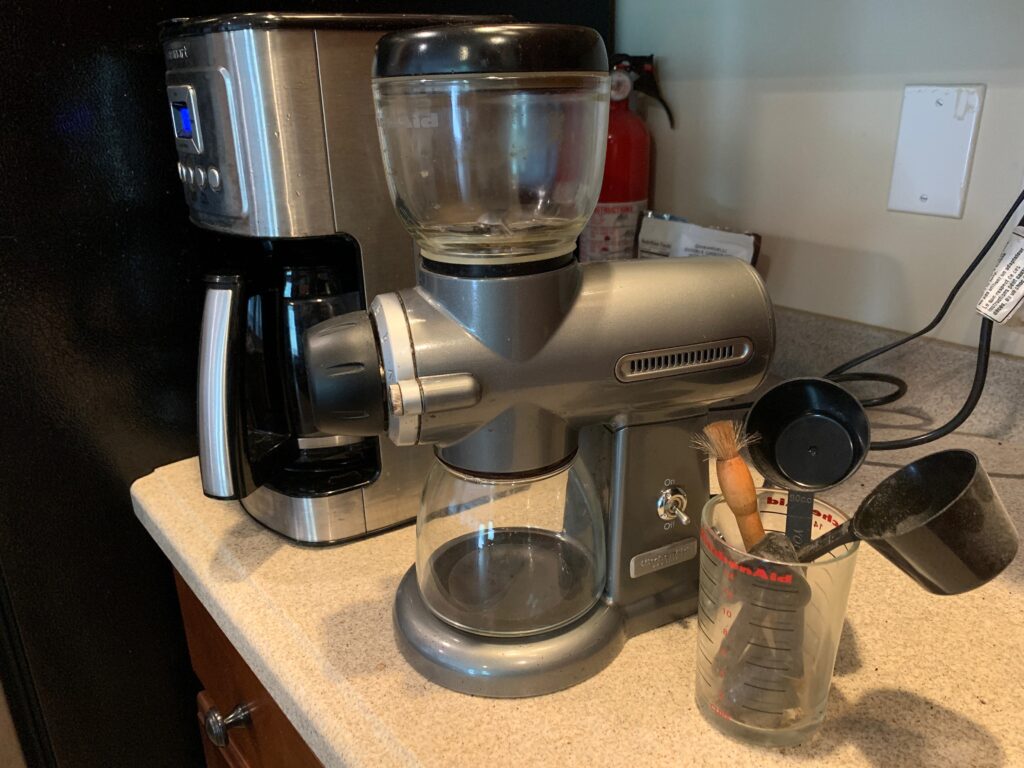
    I have had the same Kitchen Aid grinder for at least 30 years. A workhorse, it has outlived 5 computers and as many televisions. It sits on my counter beside my Cuisinart coffee maker. My grinder is integral to my morning ritual.

    The Magic of Ritual

    Each morning, I empty the prior days grounds from the Cuisinart into the trash (I’m not currently composting, though I have in the past). I fill the tank with water, then I reach down my tub of beans and one Melita bamboo, unbleached #4 filter from the box I’ve cut open to expose the filters in the cupboard. Using a scoop I keep in with the beans, I shovel 7 scoops into the top of my grinder. 

    My kids recently pointed out that I use a peculiar cadence when scooping—it’s quick scoop, slow pour… quick scoop, slow pour… If they’ve been awake, they’ve heard me do this every morning for their entire lives. My grinder is older than all but 1 of my kids. So they know the peculiar rhythm of my coffee ritual.

    After the 7 scoops, I flip the toggle switch and hear the satisfying churn of the grinder. It is deep and resonant, not like the high-speed whine of a blade grinder. Those sound more like a smoothie maker or blender. My grinder is more like a throaty wood chipper. I watch the heap of grounds slowly disappear into the grinder’s maw. I assist with a tiny pastry brush, sweeping the reluctant beans into the hopper to disappear. The aroma is fresh, instant, and intoxicating.

    buy a burr coffee grinder
    My burr grinder at the center of my morning ritual. (Photo by Author)

    The ritual is peaceful, serene, almost hypnotic. It is half-mindful-half-autonomic magic. I could do it asleep, but I remain aware of every step of the process. I know every quick-slow scoop matters to the outcome, so I pay attention with a much deeper part of me than normal thinking. Like I said, it’s magic. And my burr grinder is at the center of it all.

    So, buy a burr coffee grinder. It is a fantastic investment in excellent coffee, healthy ritual, and the beauty of single-purpose, well-engineered tools. Which means it is a fantastic investment in yourself. Win-Win-Win.

  • Take It From A Snob—You Should Drink Coffee Fresh

    Take It From A Snob—You Should Drink Coffee Fresh

    Drink Coffee Fresh
    Ocrakoke Coffee at Cape Hatteras. Yes, I bought a mug. (Photo by Author)

    # 14 on my 99 Life Tips–A List is: Drink coffee fresh. Preferably within 20 minutes after brewing. A brewmaster once told me that after 20 minutes, coffee’s chemistry changes, turning it into something else. As an addendum to this tip: don’t serve old coffee to a guest in your home. Make a fresh pot, or offer them something else.

    I suppose I should have started this tip with the simpler imperative, “Drink coffee.” But then I’d be forced to make an exception for my girlfriend who in all other ways seems remarkably well-balanced and stable, but who does not drink coffee, so I’m certain there is some latent problem yet to be revealed.

    I jest. But not about drinking coffee fresh. And not about making it fresh for company.

    My tip stands on its own with sufficient explanation. You can google the details if you doubt the veracity. Here is a good site with decent information for the home barista.

    One addendum: Buy whole beans, store them properly in an air-tight opaque container and grind them fresh with a burr grinder (not a blade grinder). I will be adding a story about this.

    Is it more trouble to drink coffee fresh? Yes. Is it worth it? Yes. Am I a coffee snob? Yes.

    Drink Coffee Fresh
    Beachie Bean’s Coffee Shop in NSB, FL (Photo by Author)

    To sample the local pace, support locally owned coffee shops

    While on the topic, allow me to plug the idea of finding good local coffee shops to support whenever you travel. I know the ubiquity of large chains like Starbucks make them easier to find for their numbers, but there is something uniquely satisfying about a cup of fresh coffee enjoyed just after dawn in a locally owned shop. 

    Part of the allure is that traveling well, and by that I mean getting the most of the experience, involves at least sampling the local pace of life, if not outright melding into it. Where better to sample the local pace than at a locally owned, locally supported coffee shop?

    Just remember to drink coffee fresh. You’re welcome. Oh, and never use non-dairy creamers and continue to call yourself a coffee drinker. I’m not sure what that chemically processed stuff is. So, that’s it. You’re doubly welcome.

    Drink Coffee Fresh
    This coffee shop on the NC Outer Banks even has a lending library. How cool is that? (Photo by Author)

    PS- I’m not a coffee shop owner, just an opinionated coffee lover who happens to be right about this. Enjoy! 😉

  • If You Want To Dance, You Have To Pay The Piper—And Other Sacred Verses Of My Youth

    If You Want To Dance, You Have To Pay The Piper—And Other Sacred Verses Of My Youth

    # 93 on my 99 Life Tips–A List is: If you want to dance, you have to pay the piper.

    This advice is from my Uncle. He said it so often that it is now enshrined in my life’s accepted canon. 

    This sacred tidbit is 1 Kurt 1:1.

    It stands beside other canonized wisdom I received as a kid from those more wise than I.

    My Granddaddy, Leo, used to say things like, “The faint heart never won the fair maiden.” 

    And, “Look before you leap.” 

    And “Nothing good ever happens after midnight.” 

    (Much later I would tell him he had never been out with me after midnight except to go flounder gigging).

    He said these things so-matter-of-factly and with such conviction he also has a book in the canon—First Leo.

    It is filled with priceless treasures, sometimes mixed with half-scriptures, like “the wages of sin is death.” Sometimes he elevated his extra-biblical quips to Divine status by asserting things like, “You know the Good Book says one in the hand is worth two in the bush.”

    A melting pot of wisdom

    I would shake my head and roll my eyes. But I didn’t dare try to dissuade him from mingling those aphorisms from Poor Richard’s Almanac and other dubious sources into a melting pot of wisdom. After all, I wasn’t “old enough for my wants to hurt me.”

    But, the one from my Uncle stands out, both for its succinct truth, and for its unfailing accuracy. 

    If you want to dance, you have to pay the piper.

    Other memorable verses from my Uncle include the timeless, “Let’s put her in the wind.” 

    He always said this at the end of a long workday when the power saws had screamed their last, the smell of fresh cut pine was hanging in the air, the tools were all gathered and put away, the job site was prepped for tomorrow, and power cords collected, coiled and looped like lassos. 

    That magical phrase signaled quitting time. It conjured sailing away towards a better shore, or riding off into the sunset, or exiting the stage into an evening of rest, relaxation, and recuperation, usually accompanied by a cold beer. Hearing it,  just as remembering it now, induces a Pavlovian response. Your face parts in an involuntary smile, and you’re ready to tap a reserve of strength to pack up and go—away from work and towards play.

    My Uncle and Granddad shared a common desire that propelled their energies. They wanted to play! So they worked hard to fully enjoy the play of not working in the interim. Neither one ever uttered something so mundane as “Work Hard, Play Hard.” But they lived it. And it rubbed off on me.

    I do want to dance. Both literally (sometimes), and figuratively (daily). To dance is to play. In my mind, I hear my uncle, and dance becomes representative of play. To do so, I work, cause you have to pay the piper, as it says in First Kurt chapter one. So, you too, remember this advice, if you want to dance, you have to pay the piper.

  • R-E-S-P-E-C-T: It’s Multi-Faceted Meanings & How Knowing The Variations Can Save Your Life

    R-E-S-P-E-C-T: It’s Multi-Faceted Meanings & How Knowing The Variations Can Save Your Life


    # 92 on my 99 Life Tips–A List is: You should, respect a person (or not) based on 1- who they show themselves to be. But, you should respect authorities based on 2- what they can do to you. None can require you to respect the person in the uniform or office, refer to “1” for that.


    I could not write this essay about respect without hearing Aretha belt out the spelling in that inimitable, soulful way of hers. I hope you’ll enjoy that earworm. If you belong to my generation, you will. If not, you’re already thinking, “huh?”

    This is an essay about respect; its various meanings, its contextual application, and how knowing how to show respect appropriately can save your life.

    Words are idea containers 

    We need to think for a minute about what respect is and what it isn’t. Like Aretha, we spell it only one way. But we use it to mean many things. I won’t bore you with definitions except to say this about words: Words are idea containers.

    When my firstborn was young — precocious, verbal child that she was — if she saw something she didn’t have the vocabulary for, she used a catch-all container, the word “pumen” (rhymes with lumen). Her word box contained everything from blackberries to motorcycles, from horses to Santa Claus. It was a large container. We grew used to her pointing at something and asking, “What’s that pumen?”

    “Respect” tries too hard to contain too much

    My story has a point. Which is that some words contain ideas so numerous and varied the containment stretches and tests the adequacy of the word to hold and convey them all.

    The word “love” is a prime example. We use it to describe our feeling for bananas, baseball, and best friends.

    With words such as love, like, hate, we come to understand that context plays a role helping the hearer or reader infer the speaker or writer’s intent. There is a broad range of meaning in these “over packed” words.

    Respect is such a word. It is an over-packed, “try-hard” of a word attempting to do overmuch. It is the “pumen” of social lubricants and niceties. This gives it a wide spectrum of meaning. But not all the meanings are apropos for every usage. 

    A variety of meanings to fit the contextual and cultural pendulum

    There is a contextual and cultural pendulum when selecting the applicable meaning of respect. In my lifetime, the meaning of respect has swung from — “to acknowledge the right of,” or, “to regard” — to the current meaning (as used by my kid’s generation) in which it reflects an amalgamation of “esteem, high regard, acceptance, and approbation” (though my kids never use that actual word). So, the meaning of respect is rapidly accelerating to its farthest and highest meaning which is “deep admiration” and “the highest regard”.

    And in some cultures respect has always meant “deep veneration” and “honor”, such as that respect shown to one’s elders, something we’ve never been good at in the U.S..

    We see then, that the single word respect conveys a variety of meanings. It doesn’t mean the same thing to all people, even to those who speak the same language and share the same cultural heritage.


    The Advice Reframed

    I laid that groundwork in an essay about respect to serve as a footing upon which to discuss the advice I offered at the outset. 

    When you read it again, notice how the meaning shifts. The ideas contained in the word respect change as the context changes.

    Below, for clarity’s sake, I’ve reframed the advice offered in my tip.

    Respect a person (or don’t respect them) based on:

    1- Who they are in words and deeds.

    2- The power they have (because of the office or job they fill) to mess with or take your life.

    As stated, Respect is an interesting idea-container of a word. It includes variations of meanings which have shifted in one generation. In my youth, showing respect was simply to act with the deference of courtesy and politeness. It was akin to good manners. Respect had little to do with agreement or acceptance or esteem, except at the very highest levels where only the most deserving received it. In such cases, we substituted a better, more specialized word, more descriptive of feelings of esteem, admiration, and acclaim.

    For example, I’ve never heard a fan say, “I really respect Jerry Garcia’s soloing.” Or, “I respect Mark Twain as a writer of short stories.” And no one would say, “I respect the way Mother Teresa cared for Calcutta’s poor.”

    Because Respect and Admiration are different

    To respect you is to offer you the opportunity to be heard, to voice your own opinion, to state your view and stake out a position. This fundamental level of respect comes with the territory inherent in the idea that we are equals. You are as entitled to your opinions as I am entitled to mine. I regard your right to speak for yourself and live the way you choose as valid rights. But… I am not required to admire the things you say or the lifestyle choices you make. I am not required to look to you as a role model. I may totally disrespect your choices, and you mine, while simultaneously respecting your right to make them.

    So, I can respect your right to your opinions without respecting your opinions. I can listen to you and still not agree with you. Respect doesn’t mean I shelve my discernment, logic, learning, or personal biases and views and adopt yours. Respect is not acquiescence, or agreement, or approbation.

    The Respect of 2 Ideological Opponents

    The story is told of the friendship of the late Supreme Court Justices Antonin Scalia and Ruth Bader Ginsburg. These two were figurehead iconoclasts of vastly different political and judicial ideologies, yet remained friends until Scalia’s death. Before his passing, someone once asked Scalia, the strict constructionist conservative, about his friendship with Ginsberg, the vaunted liberal feminist. The questioner expressed incredulity about the basis of such a cordial relationship when their political and judicial views were so diametrically opposed.

    Scalia quipped, “I attack ideas, not people.”

    If I could write that into my next thousand stories, I would.

    We do well to remember and practice those sage words. Respect for the other person is the contextual framework that allows that to happen. Scalia respected Ginsberg. She respected him. I respect them both, nay; I admire them both, for showing each other such deferential respect for the right to their own views and opinions, even when they didn’t share or admire the views expressed.

    How the meaning has shifted

    In my kid’s generation, the so called Gen X through Z, the meaning of respect has steadily swung towards the esteem side of the pendulum. If I disagree with the viewpoint of my youngest kids, they will often accuse me of being “disrespectful”, or worse, “rude” (which seems to be one of the worst character flaws you can display to members of the generations at the end of the alphabet).

    I’m sure the shift in meaning is because of mistaken ideas of Self-Esteem propagated in public educational environments. We commonly treat self-esteem as an entitlement to be granted to all as a participation trophy, rather than as the internal esteem one earns and holds for oneself because of one’s character (virtue). The word “self” in the phrase “self-esteem” is a dead giveaway that this esteem must come from within. No one can give it to you. Esteem conferred from without we should call by some other name.

    I can respect the right of a student to come to class, or to skip class. I can respect their right to learn up to their ability, or to shun the effort required to learn. But I do not esteem anyone who skips class or who does not better themselves when granted a free opportunity to do so. What is estimable about that?

    Thus, respect is not esteem, though the highest end of the respect-definition-spectrum does include the concept.

    Numbers 1 and 2 unpacked — This could save your life

    My advice in #1 above relates to this higher end of the spectrum. Admirable character, words, and deeds must earn the highest meaning of the word respect. To none but the worthy do we entitle this usage. We reserve it for the deserving because it conveys the sense of appreciation, approval, acknowledgement of worthiness, etc.. We don’t grant it lightly, denigrating and trivializing it into a meaningless entitlement to all comers, regardless of character, expertise, or worthiness.

    The admonition in number 2 of my advice, if heeded, can save you a lot of needless heartache, and possibly even save your life.

    I have in mind here those persons acting in an official capacity who have both authority and power to interfere with your personal freedom or life, in extremis. They can take either, or both. In an essay about respect, I would be remiss not to warn you to respect that power. Together we can pray and work to see the end of that power being abused and mis-used. Regrettably, that day remains in the future.

    We have all seen the horrifying and gut-wrenching examples of unscrupulous, even murderous, thugs (for there is no better idea container for them), dressed in uniforms and armed with badges, batons, billy clubs, and guns, who deserve no more esteem, admiration, acclaim, approval, or acceptance than a sociopathic criminal deserves. Their lack of character, lack of ethical behavior, lack of morality, lack of humanity all stand as accusers at the bar of justice, and we all want them to receive the just recompense of the crimes they’ve committed while clothed in the uniform and trappings of state authority.

    When in doubt, focus on the uniform, not the person

    Still, if a uniformed authority figure accosts you, you do well to respect the uniform for the power the wearer has to alter forever, or even to end, your life. It is shamefully true that some have shown this basic deference and respect for the uniform, if not for the person wearing it, and still had their lives taken away by a uniform wearing murderer. But it is wise to respect the power behind that uniform. It is wise to acknowledge the authority that created that position. It is important to remember that the authority that created the position also armed them with a weapon that if used, whether in righteousness or murder, can make you just as dead either way.

    So while, because of unworthiness of moral character, we may feel utter contempt, disdain, and disgust for the politician, or judge, or cop, or soldier who wields social or political or judicial power, we’d best respect the power. We can reach in the container of respect and at least come up with the sense of acknowledgement, understanding, and regard for what the uniform or office represents, even if we wouldn’t waste saliva to spit on the person occupying it. For the person wearing the uniform or occupying the office to receive more than base level respect, they will have to do so by earning it.

    The Takeaway — A Respectable Purpose

    But let’s turn away from uniformed persons, or officeholders, and other authority figures and end this essay about respect thinking about ourselves. If you want my respect, I stand ready to give it to you. I want nothing more than to have a role model to admire, a mind I can glean from, an example to be inspired by. Go for it. I will respect you to the fullest meaning. But I won’t hand you that just for sitting there breathing. Nor do I expect it from you. I aim to earn your respect. I want to earn it first as a person. No rotten tree can bear good fruit

    So, first I strive to be a person whose life and character are respectable. From that kind of life, I hope will flow opinions and ideas that will induce more respect. Do I hope to win your admiration and acclaim? Yes, yes I do. I hope that my presence on this planet enriches you and creates good things in your life. And I hope that your life will create good things for me. There’s no more respectable purpose, is there?

  • Gentlemen Hold Doors For Women — And Other Relics of a Bygone Era

    Gentlemen Hold Doors For Women — And Other Relics of a Bygone Era

    Gentlemen hold doors for women
    Shutterstock photo by Olena Yakobchuck (licensed to Author)

    # 7 on my, 99 Life Tips – A List is: If you’re a guy, hold doors open for women. For that matter, if you arrive at door first, hold doors open for anyone. This way, if you meet the rare woman offended by your offering, you can explain, ”Hey, I hold doors open for anyone when I get to the door first.”

    This is, or at least used to be, self-explanatory. I’m not talking about sexist chivalry, here. This is just good manners. This is what gentlemen do. Gentlemen hold doors for women.

    I would stop holding a door for a woman who asked me not to, out of respect for her wishes, but it would feel odd to me.

    For that matter, hold doors for everyone

    In daily practice, I hold doors for anyone and everyone if I get to the door first. Sometimes this turns me into the doorman for a few minutes. Those few seconds lost have never cost me anything of importance. Usually, I get a small sip of feeling good about myself for performing a small act of considerate kindness. I don’t view this as a grand gesture. It is not a statement about the comparative strengths of the sexes. Gimme a break. 

    Gentlemen hold doors for women and others just to be good people. There are plenty of good people in the world, but not enough of us consistently act like it. This is one hell of an easy way to act like it.

    Feels weird to make a blog post about something so self-evident. Almost as strange as writing one about wearing a mask during a pandemic, or getting vaccinated to stop its spread. 

    But times are different now. Politeness and consideration are at a premium. Human decency is rare as gold bullion. Being nice without a selfie stick or camera crew is apparently passé. Set yourself apart. Go old school. Hold a door.

  • Try Not To Learn Anything New Today — It’s Harder Than It Looks

    Try Not To Learn Anything New Today — It’s Harder Than It Looks

    Try Not To Learn Anything Today - hoarded books
    How I imagine my mind. (How’d that girl with the vinyl backpack get in here?) Photo by Darwin Vegher on Unsplash

    # 18  on my 99 Life Tips–A List is: ”Try to learn something new every day,” is often included on lists like this. Instead, try not to. By trying not to, you’ll become aware of how much you learn everyday without even trying, you just have to be awake enough to catch it.

    I enjoy “life-tips” lists. Invariably, they advise us to try to learn something new each day. I read those words and hear Yoda in my head, “There is no Try! There is only Do or Do Not!”

    Still, my tip condenses to this: Try not to learn anything new today. I’m a professional non-conformist. I’m not plagiarizing that usual worn-out tip. Instead, we’ll try the opposite.

    I’m sure I must have let some days pass without learning anything new. The likelihood of that seems like a reasonable assumption given a span of some 15K days. But I’d be stunned if I’ve failed to learn something in more than 1% of them. The other 99% of the time, new facts and information falls on me, follows me home, and piles up.

    If you’re awake, you learn without trying. If. You’re. Awake.

    I’m not going all woo-woo metaphysical here. You don’t have to be the Dalai Lama, or Buddha himself. You’ll learn stuff if you remain just reasonably alert and half sober.

    But, I’m contradicting my tip, which is to dis-courage your attempts to learn. Here, I’ll put it in bold letters. 

    You’re supposed to try NOT to learn

    A confession. This is the only rhetorically facetious tip of the entire 99 on my list. How’s that for some purple adjectives? (ProWritingAid and Grammarly are gonna love that). And it is the only one I don’t practice regularly. In fact, I’ve never practiced this one at all. I’ve never made the active effort not to learn something for even one day. 

    And see, I just proved the point of my tip. You just learned several things in that one paragraph without trying. You learned some things about me. And you gained the bonus knowledge that even pro writing software doesn’t have a sarcasm or satire mode. See?

    Comic Relief

    I’m curious about all kinds of things. One of my favorite comics of all times is a scene in a doctor’s office. In the office, we  see a serious looking doctor wearing a lab coat, stethoscope draped around his neck. He is peering intently at a chart and and standing beside his patient, who is seated on the exam table. The patient is a worried looking cat, brow knit with anxiety. Tension is etched on both faces. The doctor speaks, “I’m afraid it’s curiosity.”

    Cute, huh? I’m curious to know. I’ve got a motor to learn. I’ve got more questions than answers  and the more answers I get the more questions they breed.

    As a writer, I’ve heard of an affliction called writer’s block in which the writer is stuck and has nothing to write about. It’s hard to imagine. That must be the same feeling as having nothing to live about. I have way more ideas than time. Way more time than talent. 

    Most likely, I’ll just keep on learning and letting ideas and information pile up in my mind where all the rooms look like an episode of Hoarders. See, my advice is not for everybody. It just won’t work for me. 

    But your mileage may vary. So, you go ahead and try not to learn anything new today. Feel free to return and comment below with all the ways your efforts failed. Other readers may learn something. Oh, shoot!

  • People Fall In Love Everyday—None Fall Into Intimacy

    People Fall In Love Everyday—None Fall Into Intimacy

    # 90 on my 99 Life Tips–A List is: A good relationship is a good fit. The broken pieces and whole pieces interlock

    You may have heard that good relationships are a good fit. 

    I remember first hearing the concept from a post-Ph.D psychologist (a former college friend) when I told her about the demise of my 22 year marriage. She wisely told me relationships aren’t like going to the grocery store and picking the perfect item off the shelf, they have to be a good fit, comfortable for each partner.

    The mental image was suitable and thankfully soon thereafter, I reconnected with the best fit of my life, and for the past twelve years we’ve been constant companions. We built our relationship on mutual respect, but there’s a lot more to it than that. We take care of each other’s broken pieces, sometimes filling in missing portions, other times strengthening and protecting the ruins. 

    What makes a good fit?

    A good fit is indispensable to a good relationship, but I want to explore what makes a fit good?

    A good fit is when the broken pieces of each life fit together, not the whole ones.

    That’s something not everyone sees. Think of Tom Cruise and Kelly Preston in Jerry Maguire. Those two were too perfect. Sure, the sex was hot, but there was no room for intimacy in the midst of all that stifling, demanding perfection. Check the linked scene. Who could live up to that?

    If you want a good fit, one filled with deep intimacy, you have to embrace brokenness.

    And let me add this caveat; everyone’s broken. Even the people who think they’re perfect.

    Intimacy in a relationship comes from excavation of the buried, broken pieces, and carefully exploring how they fit together.

    Broken pieces fitting together creates intimacy
    Photo by CHUTTERSNAP on Unsplash

    What plays on dating app profiles, won’t create intimacy

    When someone starts a relationship telling all about their successes, achievements, and accolades, you may feel happy for the teller, even excited, but not intimate. There’s neither room, nor need for you in those stories other than as their personal admirer, cheerleader or fan. 

    They may be a wonderful influencer, but those stories don’t admit intimacy.

    When you share only your carefully curated best moments, you’re signaling how rich your life already is and how little your listener can do to make it any better except as your captive audience. It is nice to have affirmation, even admiration. But intimacy is better.

    Sounds a lot like typical dating profiles, doesn’t it?

    But within the broken places… lies a world humility, vulnerability, trust, and protection—intimacy.

    There may be such a thing as love at first sight, I don’t know. Sight to me is a very untrustworthy barometer of most anything real.

    I know this. There is no such thing as intimacy at first sight.

    Intimacy takes time. It takes trust. Being built on shared brokenness, it requires the discovery of where your broken places, ownership of the pieces, acknowledgement that there may be whole chunks missing now, and the willingness and the wisdom to know when to share those details with a new potential partner. 

    That last piece is key. Not everyone deserves your broken pieces. And no one deserves them too soon. Freely share your whole ones, let everyone see those. Fling those whole bits like you’re riding on a Mardi gras float. 

    But for your own sake, save the best of you, the broken places, for someone worthy.

    When two people build a friendship from mutual initial commonality and attraction, then patiently let each other venture in to the back rooms, the intimate rooms, ones furnished with painful memories and the pictures on the walls are of unforgotten wounds, something magical can happen. The magic of intimacy. 

    That shared brokenness is the best. Tenderness, lovingkindness, and protective shielding awakens between the partners. Each knows the other’s vulnerabilities and rather than exploiting them for selfish gain, cherishes and caresses them, partners carefully, lovingly tracing each other’s scars, and holding each other in fierce determination not to create new ones.


    You cannot fall into intimacy

    The Beatles, in With A Little Help From My Friends asked, 

    “Do you believe in love at first sight?

    Yes, I’m certain that it happens all the time

    What do you feel when you turn out the light?

    I can’t tell you but I know it’s mine.”

    Beatles: With A Little Help From My Friends

    I prefer the Joe Cocker, Woodstock version as seen here.

    Whether or not at first sight, people fall in love every day.

    No one falls into intimacy.

    That’s reserved for those willing to be vulnerable, patient, and fit each other’s broken pieces together into the puzzle of Intimate Love. That is a good fit.

  • Hate Is Emotional Attachment—How To Be Free From Its Vicious Grasp

    Hate Is Emotional Attachment—How To Be Free From Its Vicious Grasp

    Hate attaches you to the object of hatred
    Hatred poisons the hater more than the hated. (Shutterstock Image licensed to Author)

    # 86 on my 99 Life Tips–A List is: Hate is way too powerful an emotion to give to the people deserving of it. It attaches you to them the way love does. This is not a good thing.

    Hate attaches you to the object of your hatred. Both hatred and love define us in terms of a relationship, whether or not the relationship still exists. Hatred persisted in is not without this expensive surcharge to the hater. And even knowing this—damn if it isn’t nearly impossible to let it go.


    Hatred is murder in the heart

    As recorded in Matthew 5:28, Jesus said that if a man looks on a woman to lust after her, he has committed adultery in his heart.

    By this same reasoning, using the same application of moral principle, in my heart I’m a murderer. You probably are, too.

    Hatred is to murder what lust is to adultery. It is the emotional principle behind it. It may be hot, rage-fueled hatred, or vengeance served cold, but hatred is a symptom on the murder spectrum.

    That’s too damaging an emotion to keep, and too powerful to give to those most deserving of it.

    Your object of hatred is someone who has marred your world, and has marred your enjoyment of it. To where the mere existence of your object taints the world with a putrid stench. And face it, if you’ve known the depths of hate, given the ability, and with no repercussions, you’d blink and have your nemesis vanish or die a thousand deaths.

    [Stop grinning in imagined contemplation. Really. This is not a good thing.]


    Ain’t no time to hate

    Why you ask? You don’t know they did to me. Don’t I? I’ve struggled with my hatred for years. Finally, I’m realizing the truth in one of my favorite songs:

    “Ain’t no time to hate, barely time to wait.”

    ~ Grateful Dead: Uncle John’s Band

    Regardless, and I mean, literally, regard it no longer, look no longer at what was done to you. Focus instead at what still lies in front of you to do. Don’t let another day go by being emotionally attached to someone undeserving of a second thought. That’s what hate is, fundamentally—emotional attachment. Do you have time for that? I don’t!

    You are still here. Still standing. That person you hate didn’t destroy you, though they tried. They didn’t vanquish your spirit. Your soul remains intact. They just aren’t all that!

    The conditions for forgiveness may not be possible

    Am I suggesting you kiss and make-up? Oh, hell no!

    There are some wounds irrecoverable, irreconcilable, irredeemable by you or me. There are things that require recompense and repentance for forgiveness to even be thought of, much less have any meaning beyond the mouthing of empty words. And ofttimes, there is no way to exact recompense, and the opportunity no longer exists for the change of heart and mind repentance encompasses. If the forgiveness that yields reconciliation and restoration is impossible, we must leave the offender in the hands of God for judgement, or Karma, or whatever you call sowing and reaping in your tradition.


    Move forward as a different person

    What to do then if hatred is to be laid aside? What to do if forgiveness is an impossibility?

    You move ahead as a different person. The version of you the despised object sought to hurt and destroy survives (!) and yet exists no more in that form or that relation. The new you has escaped the orbit; thus free to be defined by what you move toward, not by what you leave behind. 

    You are as free from being defined by that former relation and the hatred it provoked, keeping the bond in place, as a slave is free upon learning of his emancipation, or an inmate upon learning of his release from prison.

    The Takeaway

    If you must look back, cast a backward glance in scorn, in pity, in disgust. Better to despise than to hate. Hatred is too powerful. Hate attaches you to the object of your hatred. It gives that object power over you by allowing that object to define the terms of your emotional and psychological health. You drag it behind you everywhere you go. That’s way more power than you should give to any deserving of those feelings we call hate. The burden is on the hater, much more than on the hated.

    Better to think of them as insignificant, impotent to do you further harm. While seeing yourself as free. Abandoning the hatred is loosing the last linking shackle. Go!

  • What Do You Like & Why Do You Like It?

    What Do You Like & Why Do You Like It?

    # 85 on my 99 Life Tips–A List is: Know why you like what you like. Learn to identify the feeling of liking something before you have the words to tell yourself you like it. That resonance, that connection, that is your home.


    This one has been staring at me for a couple of days. I know what I mean by the tip I offered months ago when I created my list and posted it, but this one captures so much.

    What you like defines you

    Why do you like that? Why don’t you like this? Can your likes change—become weaker (?), or stronger? If they can change, did the thing formerly liked change? Or did the former “Like-er” change? Important stuff.

    We all start in infancy as blank slates. Yes, I know, the argument of nature vs. nurture. Sure, sure. Still… I have no Grateful Dead genes that make me resonate to that frequency, nor any Russian genes I’m aware of that make the slow, deliberated, painstakingly detailed accounts of Dostoevsky so appealing and full of life and truth to me.

    So, as for the accumulation of culture—which is really a fancy word for group or social liking of a thing—I’m on the nurture side of that debate. We like what we like because we get exposed to it by someone who convinces us that people like us like stuff like this. There’s a kind of peer pressure to like most of the things we choose. 

    [That, and the size of the menu in proportion to the size of our appetites, and whether we find good entrements (palate cleansers) between samplings.] 

    There are also degrees of liking a thing. You may wear the tee-shirt, but not kill bats on stage and drink their blood. (You can look up the old Ozzy Osbourne legend somewhere… Google it.)

    So, Greg, you’re 300 words in and haven’t told me a damn thing about why I like some stuff and not other stuff.

    True, dear reader, we are halfway down a proper electronic page and I cannot tell you what to like. I can, however, urge this—Don’t let anyone else tell you either!

    We all got our first likes because someone pushed sweet mashed pears into our baby mouths before they spooned in disgusting pureed lima beans. Someone played Mozart, or Miles Davis or Metallica before Beethoven, Benny Goodman, or Bad Company.

    We first gain likes and tastes from the people around us who expose us to them and usually because they like them too. (Maybe not with babyhood pears, but you catch my drift).

    Here’s the rub

    At some point, earlier or later, I don’t know, you will want to pay attention to whether or not you’d like Led Zeppelin at all if that delectable girl in the yellow overalls didn’t look so good wearing that logo emblazoned across her beautiful… t-shirt (what did you think I was going to type?)

    My mom was a member of the Columbia Records club. This was back when dinosaurs roamed North America and people still had turntables on which to extract sound from round plastic platters. She got several albums a month, and she used to sit dreamily and play one album called Go To Heaven by a band of long-haired men, standing in a cloud on the cover, wearing cheesy looking, white, polyester-velveteen Lawrence Welk suits. 

    Alabama Getaway and Don’t Ease Me In off that record sounded like countrified crapola to my 13-year-old ears. Hearing it made me gag and flee the premises, long before I got to hear Lost Sailor and Saint of Circumstance

    I couldn’t stand it! Yuck! 13-year-olds ought not be judged too harshly for underdeveloped anything. Puberty makes for a cloudy filter.

    But I did like her Fleetwood Mac, and Rickie Lee Jones, and Little Feat albums. I even liked Jimmy Buffett, and I wanted to like Crosby, Stills, Nash, and Young because they had the coolest album cover. (You know the antique looking, sepia-toned album where they’re posed with a dog, and Crosby cradles a shotgun, and Neil is draped with bandoleers and a pistol, and a guitar is lying on the ground — Deja Vu—and it looks like Matthew Brady took the photograph right after the battle of Antietam or something). 

    God, I loved the look of that album cover because I was crazy for all kinds of Civil War stuff. That picture was so cool! Who cared about hippies floating in white John Travolta suits in a cloud!?

    But the music, Jeez! My misanthropic mom would get drunk, put on Teach Your Children and slur, “Hunnneee, jusss lishen to theesh wordzz. Thish iss evertheeen I wanna  shay to you kidzz.”


    OMG!! Please No!Likes can change

    I hated C,S,N,Y then. Association, ya know?

    Though, I LOVE their music now. Different association… ya know?

    The same reason I now love all things Grateful Dead. I had to grow into it. Then it grew into me.

    So, sometimes early exposure doesn’t take root. Germination takes longer. Circumstances change, and then, bam! You hear something, or see something, or taste it, and it’s like tasting and seeing and hearing home. Like gathering up fragments of self that complete you. I know, weird.

    But, they say there’s no accounting for taste. And truly there isn’t. If you will put on your Indiana Jones hat and do some personal archeology to dig up the reasons you’ve buried and kept your own personal treasures, you’ll learn a hella lot about yourself.

    Fact is, your likes and loves will tell you more about yourself than your dislikes.

    Shove over, I’ve invited God in

    Probably shouldn’t drag God into a story already crowded with Jimmy Buffett, my drunk mom, Rickie Lee Jones, and bandoleers, but I see [Him] as defined (bad word, I don’t think [He] can be defined adequately, else the whole God idea shrinks, but it’s the best word we’ve got) by what [He] likes, immeasurably more than by what [He] dislikes. Just like you and me are defined more by what we like and allow in than by what we hate and keep out.

    It’s the opposite of the way evangelical Christians think of God and themselves. These define themselves by what they oppose, what they’re against, what they resist and are afraid of. They never crack open Song of Songs, the most beautiful ode to physical, sexual love ever written (“kisses sweeter than wine”). It just sits there unread and unappreciated in their bibles. They conveniently forget Noah got drunk (after preserving humanity), David committed adultery—and murder (and was still called a man after God’s own heart), Jesus turned water into about a hundred gallons of wine at a wedding, and Peter denied Jesus (but Jesus restored him again over fish tacos on the beach).

    They forget God loved everybody, EVERYBODY so much, [He] paid the ultimate price to win us back. I don’t imagine [He’s] trying to keep anyone out on technicalities like who they love. [He’d] prefer to outfit us all in white suits, invite us to stand in a cloud, and Go To Heaven. Or maybe my God is just bigger and more full of Grace and Mercy than yours. I dunno. Or maybe I’m wrong. But I’d rather be wrong believing in God as revealed Love. Maybe you’re unflawed, and you’re loved for your perfection. That doesn’t apply to me. But because God loves flawed me as much as [He] does, my only response is to trust [Him.] That is what faith is all about, after all. The heart’s response to a God showing and proving [His] Love.

    If you’re curious about my brackets around masculine pronouns in reference to God, it’s because of my uncertainty of how to think of God and gender. I think of God as Father, the only real Father I’ve ever known. But God is called El Shaddai in the Hebrew scriptures, too, which means “the Breasted One”, or nurse. I love that image—of God being the source of life and growth and sustenance, of comfort, and warmth, and security, the way a nursing mother is to her infant child. You are welcome to your own images. I am convinced in my heart that my brackets aren’t offensive to [Him], or Him. End of disclaimer.

    Back to the topic at hand—Here’s an unlimited credit card

    Learn to identify what you like, on your own terms. Evaluate your preferences to see if you picked them up as the price of admission to some tribe or other, or thinking they’d be the key to some girl’s heart. 

    What do you like, the real you? Imagine you have an unlimited credit card. Your preferences and tastes are the only ones you need consult. You start with an empty iPod, empty media shelves, and an unfurnished home—no pictures on the walls, nothing in the pantry, fridge, wine cellar, or liquor cabinet. What’s parked in the driveway? What do you get? What do you like? Not—what does your wife, husband, lover like? No. What do you like?

    Go ahead, you have my full permission to fill your life with as many of those things you can. On the way, you’ll answer the question: Why do you like that? It may be this simple. You just do! It resonates. And it scratches the persistent itch, uncovers the empty spot, and fills up the void. Because it caresses your heart; and sings you, rocks you, swaddles you, envelops you, whispers you—home.

    It may as simple as the idea enshrined by Mick Jagger—

    “I know it’s only Rock n’ Roll, but I like it… yes I do!”

    ~ Rolling Stones: It’s Only Rock n’ Roll

    Mick likes Rock n’ Roll, and that like defines Mick. What defines you? What do you like?

    One day, I’ll invite you over to my own imaginary bare-floored, yoga-pillowed pad where we can have church listening for the whisper of God, blasting my collection of studio and live Dead performances on my megawatt stereo system, while we drink Napa Valley wine and Russel’’s Reserve and Grok out on all my Van Gogh and Monet and Mondrian paintings. Or maybe we’ll “ooh and aahhh” over my library of thousands of volumes of curated literature, housing everything from Brené Brown to Zane Grey.

    You’ll like it. Or at least I will.

    What did you ask? Oh, yeah, that Aerosmith you hear coming from the other room? Oh, that’s just my girlfriend rocking out on the sounds she likes. She calls mine alternately “Grandpa” or “Sleepy” music. If you prefer the Demon of Screamin’ to my sleepy tunes, you are welcome to plug in your headphones. To each his own. I can’t tell you what to like, I can only ask you to tell me, why do you like it?