
Category: Life Hacks

  • Invest In Yourself Without Apology – 4 Simple Ways

    Invest In Yourself Without Apology – 4 Simple Ways

    Return On InvestmenI- iPad with ROI graph - Invest in Yourself
    Invest in Yourself and get the greatest possible ROI (Adobe Stock image licensed to author)

    # 52 on my, 99 Life Tips – A List is: Invest in yourself without apology by reading, exploring, learning, exercising.

    True wealth does not consist in possessions that can be listed on a will or a homeowner’s insurance policy. True wealth is not a medium of exchange in the typical sense, the way mere money is. Nevertheless, to acquire riches that don’t tarnish, that aren’t subject to the vagaries of ”market forces”, and that keep supplying a return, you must invest in yourself without apology. Here are four simple, yet effective, ways to do that.

    1- Read

    I count this as life’s most important skill. Unless you read, you only get to try on and live one life. By reading even mediocre writing, you can use your vast imagination to inhabit another world. By reading you meld your mind, with its limited, finite table of contents, with the minds of every writer you sample. You become multi-perspectived. 

    This is of incalculable worth. For if a person can never see beyond themselves; that is, if they can never see the world from another’s viewpoint and ”put themselves in another’s shoes”, how can they ever see other people as anything but objects to be used?

    2- Explore

    Reading is a type of exploration, but by this head, I mean that a person should explore their surroundings in a state of awareness that allows for the possibility of unexpected discovery. One aspect of exploration is to see or to experience a common thing in a new way. I try, as much as possible, to go through each day, and even to move about my house, or walk the streets of my neighborhood, as if I’ve never seen them before.

    Here’a a tip to help with this mindset. You have never lived this particular day before. And you never will again. Explore it. Mine it. Extract all of the beauty and pleasure and knowledge and appreciation out of it you possibly can. Become an explorer of this day, and find all there is to be found.

    3- Learn

    If you read and explore you will gain knowledge. The accumulation of knowledge is like a person who, by reading and exploring, notices and collects puzzle pieces. Eventually, the learner accumulates enough pieces to see patterns emerge. Some of the pieces fit together exactly. In some places there are gaps. By arranging and linking and connecting the tidbits of stored knowledge, one begins to see recurring themes.

    At some point you will have pieced together enough related knowledge to be Competent in that area. Continue adding pieces on the way to Mastery.

    The other benefit is the humility and even the mild melancholia that comes to the one who realizes that his puzzle may never be finished. There is no clear, absolute picture to go by. There will be sections with no pieces that seem to match. The yearning sadness is the unavoidable flip side of gratitude for having learned so much, yet the recognition that there is so much left to know, that may never be known. 

    Nevertheless, the Learner would never trade what he knows for a trifle like a car, or a house, or another of life’s accessories. If knowledge suddenly became the medium of exchange, he would not give away a single piece of his puzzle.

    4- Exercise

    I used to believe the most valuable commodity in life was Time. We’re all on the clock, after all. But a shift in my perspective makes me believe that the most valuable commodity is actually health. I would not want to live an innumerable number of days, sick. You may feel differently but consider, if health became the basis of your paycheck, and not hours, how much health would you trade for your pay?

    To this end, exercise is the single most important thing I can do to help. Well, that and consuming only as many calories of the highest quality I can afford to sustain life with the energy requirements of my body and lifestyle. 

    Start by walking. Healthy humans are ambulatory. We walk upright on two legs. I’ve made the incalculably rich discovery that walking is both means and end. It is perhaps the most spiritual physical practice a person can undertake. 

    In Summary

    Invest in yourself without apology. We need you at your absolute best. I’ll try to be at my best for you, too.

  • Your Will Cannot Control Your Emotions – Truth To Live By

    Your Will Cannot Control Your Emotions – Truth To Live By

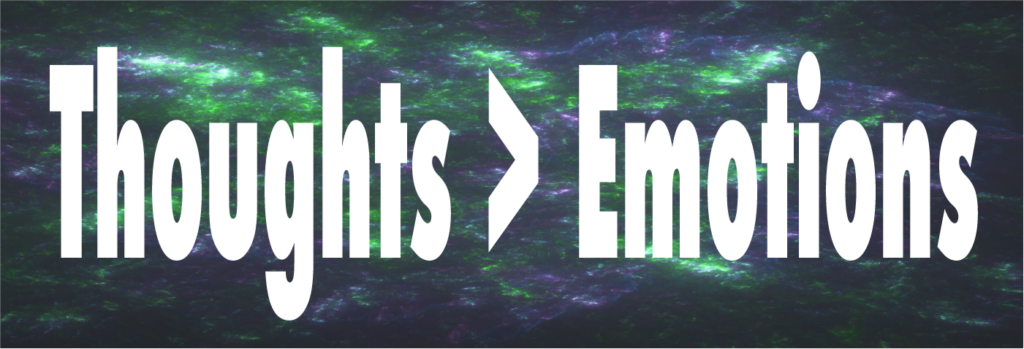
    Your will cannot control your emotions. Image show Thoughts>Emotions on tie-dyed fractal background.
    Thoughts yield Emotions, Emotions come from Thoughts. However you think of it, you cannot will emotions into, or out of, existence (Image by author)

    # 48 on my, 99 Life Tips – A List is: Emotions cannot be directly controlled by the will. Try to be scared now. You have to first think of something scary, right? All emotions are this way. They are the fruit of your thoughts.


    You Will Never Un-See This Truth

    There are some truths that, once presented to the mind, become irrefutable. The truth that emotion cannot be directly controlled by the will belongs to this class. Try it. As demonstrated in the example above, feelings don’t respond to your will. Your mind and thoughts must play an intermediate role. This role is indispensable. Your will cannot control your emotions. It cannot produce fear on its own initiative.

    If you try now to be joyful, say, as an act of will, you will encounter the same obstacle. You must think of something joyous first. Once you do, the emotion is easy to produce. In fact, it is impossible to feel any other way for as long as you keep the joyous thought in your mind.

    Likewise, unfortunately, this quote is also true:

    My life has been full of terrible misfortunes, most of which never happened.

    ~Michel de Montaigne

    If you cannot make yourself feel a certain way by willing the feeling into existence, neither can you will the feeling out of existence, once you’re feeling it. 

    While I am a staunch advocate of controlling everything you can. The linked discoveries that my will cannot control my emotions, rather, that my emotions come from my thinking (which I can control), has proved of incalculable worth to me. I hope you will find the same benefit.

    Exactly How Does This Help You?

    Knowing the general rule of where your emotions come from, allows you to know how to change them. And it will keep you from wasting time and energy listening to bad advice like, ”Don’t be (angry, afraid, anxious,)” 

    Your will doesn’t control your feelings. So you can safely stop trying.

    Sometimes, knowing what not to do is an important step in discovering what to do.

    Now, you realize the following:

    1. Your will does not produce your emotions, instead;
    2. Emotions are the products of your thoughts, and;
    3. Thoughts can be controlled by a conscious, willful choice (in the absence of mental illness of neurological pathology), therefore;
    4. You can change how you feel by changing how you’re thinking (or what you’re thinking about).

    Your will cannot control your emotions, but if you change your mind, you can change your world.

  • Go Granular When You Feel Bad

    Go Granular When You Feel Bad

    This woman feels bad. Is she lonely, stressed, tired, overwhelmed, or depressed? We would have to go granular to find out.
    Saying this woman feels “bad” doesn’t reveal much about what she’s really feeling. We would have to go granular to find out. (Adobe Stock Image: licensed by author)

    # 45 on my, 99 Life Tips – A List is: In the face of negative emotions, go as granular as you can to analyze and identify exactly what it is you’re feeling. Generalities like, ”I’m just sad,” won’t work.

    No matter your optimism, positive-mindedness, or mental toughness, there will be times when you feel bad. Unfortunately, this fact besieges and ensnares us all. Even those whose practice is to deny negative emotions, for a moment feel bad enough to trigger their denial response. It is neither a crime, nor a sin, to feel bad. In the physical world, pain is a signal that something is damaged or injured and needs protective care. Ignoring physical pain can lead to permanent damage. 

    This is also true of emotional pain. Ignoring or denying mental and emotional pain is not an effective strategy if mental and emotional health is the goal. Neither are generalizations a good remedy. Telling yourself, or others, ”I’m just down today,” or, ”I just feel bad,” doesn’t give any clues either to what it is you’re really feeling, or to the cause. Think of the last time someone mouthed this to you. Did their, ”I just feel bad,” provide enough useful information to offer a solution or ease their suffering?

    Sometimes, we guard our privacy by deflecting unwanted attention away from our down times. Uttering a generic, ”I’m just a little down,” can be a defensive, avoidance technique. However, it’s not healthy to do this to yourself. One practice that is helpful is to probe deeper than these surface generalities to unmask exactly, precisely what you’re feeling. 

    Emotional Nuance Is More Than Semantics

    There is a difference between ”sadness,” and depression, and between depression, and anxiety. Likewise, are you ”upset,” or frustrated? ”Angry,” or just annoyed? Do you feel ”hurt,” or ashamed? Are you simply ”bothered,” or do you feel overlooked and invisible? These nuances of emotional intensity and precision are more than mere semantics.

    Going ”granular” yields analysis of your feelings with specificity. And the process of ferreting out precisely what you’re feeling, will often reveal why you’re feeling it. Oftentimes, this discovery is the insight you need to change the way you feel. Sometimes this happens instantly. Other times, you’ll come away with a hard-won lesson that can bring beauty and wisdom from the pain. At minimum, you will have a diagnostic tool revealing the root causes of the matter. 

    The next time you feel bad, go as granular as you can. Dive deeply to discover exactly what you’re feeling. You’ll likely also uncover the ”why” of your negative emotions, and this awareness will equip you to address the roots, and not just the bad, surface fruits, represented by those generic ”bad” feelings.

  • Now, Gratitude Is

    Now, Gratitude Is

    Gratitude is slowing down to savor and enjoy a cup of coffee like the woman pictured here.
    Slow down, savor, appreciate, enjoy. Now, Gratitude is. (Adobe Stock Image licensed to Author)

    # 12 on my, 99 Life Tips – A List is: Gratitude works its magic in the moment you become aware of something for which to be thankful. The more aware you become, the more the magic of gratitude will follow you throughout your day. It doesn’t work the same when practiced as a generalized, “I’m thankful for my life.” No, gratitude works best and strongest within the context of contemporaneous specificity. 

    By word count, this is my longest tip. Still, if I was limited to only one tip, this would be it. This one has the most potential to produce positive, repeatable results. As stated, gratitude works best and strongest within the context of contemporaneous specificity. While correct, the gist can be summed up with: Now, Gratitude is.

    But allow me to try for more clarity. Gratitude works most deeply, and its effects are experienced most fully, in specific, definable, instantaneous and momentary awarenesses of appreciation. Hmmm…that’s worse. Try this: Gratitude is the sense of appreciation, wonder, and thankfulness for a single, specific thing, at a single specific moment in time. Yes, that’s closer to it. Now, Gratitude is.

    Many believe they are grateful who ”count their blessings”, and can recite instances of good fortune for which they undoubtedly feel thankful as they remember them. But this type of gratitude is a lame imposter compared to the practice of gratitude I’m trying to capture with feeble words. Now, Gratitude is.

    When Does Gratitude Happen? Now

    The first words of Hebrews 11:1 say, ”Now, Faith Is…”. I could meditate, write, and preach on this segment of a verse forever. Briefly, it declares the season in which faith can be exercised. That season is ”Now”. I submit, true gratitude is the same. Now, Gratitude is. Either Gratitude happens right now, this moment, at the exact instant when the pleasure for which gratitude is the deepest and only appropriate response, or it doesn’t happen at all.

    True gratitude is the antithesis, and therefore the antidote, to depression and anxiety. It is not a backward looking remembrance. Nor, is it a journal chronicling pleasant things past. Rather, It is the present tense inhalation of appreciation for the present tense experience of the simplest pleasure. It is the pause to savor that stops time and transforms a right now moment of pleasure into an eternity. Gratitude is the observant mind grasping what makes pleasure pleasurable. And it is the satisfied inner accountant who says, “this is enough.” This awareness is one of profound appreciation and thanksgiving for the experience. And it is a sense of incredible awe at being capable of enjoying such an experience. No, true gratitude and depression cannot coexist. Now, Gratitude is.

    Thus, gratitude is to be found in the first savored sip of freshly brewed, creamy coffee. Likewise, it is present at the first light of dawn. Similarly, for the grateful observer, it is the glimpse of Orion in the night sky, or the faintest outline of the crescent moon against a pale blue morning. Gratitude feels the smile on a baby’s face. And, it also invests the good-morning kiss of your love with all the the courage and fortitude you need to face the entire day. Gratitude is the warm coat you pull on against a chill wind. And can also be the childlike glee of a soft spring rain against your upturned face. Are you beginning to see? Now, Gratitude is.

    Practiced this way, as a sort of “appreciation radar,” gratitude becomes a bulwark against almost every mental ailment, while enriching and elevating everything in its scope. And friends, there are as many different opportunities to practice it as moments in a day. For,…Now Gratitude is.

    Be grateful therefore, and live. Now, Gratitude is.

  • Know Your Imperfections – You’ll Be Dragging Them With You Through Life

    Know Your Imperfections – You’ll Be Dragging Them With You Through Life

    dog on a leash with barred teeth ready to fight another dog over a ball
    This scene shows context, situation, and negative emotion…a recipe for disaster

    # 6 on my, 99 Life Tips – A List is: Know your imperfections – You won’t get over them or get past them, you’ll drag them with you through life. You must learn where they live and what brings them out of the dark.

    TF does this mean, you may be asking yourself? Lemme explain. I often hear people struggling to overcome some negative trait or other, say they are hoping, ”to get over it”. There exists a belief, or maybe a wish, that it is possible to outgrow or forever overcome character flaws. Yet, the contrary is true. We rarely, if ever, get over, or get past, our imperfections. The imperfections are ours. They lurk beneath the surface (hopefully), but provided the right (wrong) context and a trigger, the imperfection(s) will bust out. This makes it imperative to know your imperfections, and also to be able to identify the conditions for their display, before they erupt.

    To me, it is helpful to think of my most egregious character deficiencies as susceptibilities. It is helpful to me to realize that I am capable of all the acts and words that live in my life’s junk drawer of shame. I’ve already proven my ability to do each of them, after all. Thus, I have stopped making promises about whether or not one of them may fall out of the drawer into a life scene, ready for public consumption. I believe in the reality of toxic behavioral patterns. To short circuit the behavior, I have to spot the pattern that triggers it.

    Think with me. Humans are capable of committing personal atrocities on an almost unimaginably vast scale, from drunkenness to adultery to drug abuse to 9-11. You and I may have never committed the most gruesome or detrimental deeds, but whatever disgraceful and disturbing commissions you have personally produced could come back at any time the conditions are ripe and your inner awareness and security system is lax. 

    Because We All Have A Past…And We Want To Leave It There

    I have done a lot of bad stuff in earlier chapters of my life. And I live with the knowledge that the context and the opportunity I found myself in at those earlier times created the perfect recipe for their manifestations. Should the same conditions and opportunities arise, I would be foolish to think I couldn’t do the same things again, or worse. Of course I could.

    And so could you. Especially so in the face of negative emotions. Each of us develops patterned responses to negative emotions. We build defense mechanisms. Some will have a pattern of attack, others a pattern of run away. The attackers group may become angry, abusive, hateful, and aggressive, The runners may drink, drug, or distract themselves with other potentially harmful efforts to feel something other than the negative feelings they are dealing with. The runners may end up in someone else’s arms for instance, or overdraft their checking accounts. The attackers may end up in jail on assault charges. 

    These examples illustrate extremes to a purpose. Which is, your patterns of response are unique to you. They are deeply ingrained. You will likely never, ”get past them”. The important thing is to know your imperfections, realize and know you won’t get over them, and become acutely aware of the first sign of the emotional signals that if unattended, might provide a trigger for your worst self to burst forth. 

    This form of internal situational awareness will be far more effective and therefore more beneficial to you than any efforts spent deluding yourself that you can overcome those deeply ingrained patterns. Better to realize that there is a ferocious attack dog lurking inside you. Be ready with the leash at the first sign of stirring.

    We’re all capable of every bad thing you can think of given the opportunity and the context. Be watchful therefore, and aware of the particular context (both emotional and situational) that wakes up your inner demons. This is what it means to know your imperfections.

  • Focus On Your Strengths – Don’t Take Them For Granted

    ESPN Illustration: Stephen Curry jumpshot . The best in history

    #5 on my, 99 Life Tips – A Listis: Practice Your Strengths. 

    The idea here is primarily a matter of focus. Time spent patching up weaknesses and repairing deficiencies doesn’t pay off as well as effort spent when you simply practice your strengths. 

    The second part of the equation is the old adage, ”practice makes perfect”. Therefore, think not only of deploying your strengths, but of working on (practicing) them.

    This one likely seems counter-intuitive for several underlying psychological reasons. This article from Zapier, by Jessica Greene has this to say:

    various studies have shown that when we focus on developing our strengths, we grow faster than when trying to improve our weaknesses. Plus, people who use their strengths are happier, less stressed, and more confident.”

    Jessica Greene, Zapier

    The same article cites a 2016 study showing that people believe two simultaneous things about themselves (their personalities):

    1- Strengths are permanent features that are here to stay and will persist into the future.

    2- Weaknesses (in the form of undesirable traits) are more easy to change than they really are.

    It turns out neither of these is true. These implicit personality beliefs fool us. We think that we can easily change undesirable character flaws, while taking our personal assets for granted. The reality is those who identify their strengths and work to hone and perfect them achieve better results than those who think they can easily change their less desirable characteristics.

    As anecdotal evidence, one can look at the performance of Stephen Curry. Already the most prolific and successful 3-point shooter in NBA history, Curry worked hard to make himself an even more potent 3-point scoring threat. He increased his range. He decreased the time it takes him to get a shot away. And he honed his passing skills. These were already MVP caliber strengths for Curry, but his renewed focus on those strengths are resulting in personal records for him during the current season. He is on pace to win the NBA scoring title despite being the focus of his opponent’s defenses game after game. Take a look at this article from the San Jose Mercury News for more on Curry practicing his strengths.

    Whether you are an MVP in your job or your various roles in life, hopefully Curry’s example will inspire you that you can be even better. Take those strengths you already have and make them stronger. Don’t take them for granted. Polish them, hone them, and deploy them with even more confidence and accompanying success.

    If you’re wondering what your strengths are, the Zapier article, linked above, also offers several resources to help you identify them, several of which are free online.

  • Form Follows Function

    Form follows Function in Nature…almost as if it were designed that way, right?

    ”Whether it be the sweeping eagle in his flight, or the open apple-blossom, the toiling work-horse, the blithe swan, the branching oak, the winding stream at its base, the drifting clouds, over all the coursing sun, form ever follows function, and this is the law. Where function does not change, form does not change. The granite rocks, the ever-brooding hills, remain for ages; the lightning lives, comes into shape, and dies, in a twinkling.

    It is the pervading law of all things organic and inorganic, of all things physical and metaphysical, of all things human and all things superhuman, of all true manifestations of the head, of the heart, of the soul, that the life is recognizable in its expression, that form ever follows function. This is the law.”

    The above quote is from Louis Sullivan, an American architect of the late 19th-century, best known for his protegé, Frank Lloyd Wright, and for developing the shape of the tall steel skyscraper in 19th-century Chicago.

    His quote above, taken from an article about the artistic design of tall office buildings, has been condensed to one perhaps more familiar to most readers which is:

    Form follows function

    How something looks, its form, should reflect what it does, its function

    I really like the 21st-century rise of ”Lifestyle Design”. Tim Ferris, author of books including The 4-Hour Workweek, The 4-Hour Body, and Tribe of Mentors, would be one of the leading proponents of this school.

    I find that most of the people I’ve met don’t think much about designing their lives. Their lives are designed to serve a function created by someone else.

    Perhaps this is inherent in what Thoreau meant when he said,

    The mass of men lead lives of quiet desperation…

    Does the form of your life follow a function you chose? Or did someone else choose it for you?

    If you’re living a life that looks the way it does out of necessity to fulfill a function that is more useful for someone else than it is for you, stop and think what you can do to re-design it so that it functions first for you. 

    If there is anything essential and exceptional about American Freedom, it’s to be found in the answer to that question.

  • Is Feeling Good A Choice?

    Rise and Shine…or something like that.

    Do you wake up in the morning and decide to feel bad? Ever?

    And, to be specific, I’m talking about emotions here, not physical ailments. Though, no one wakes up wanting to feel sick, either. It’s certainly true that our emotional selves live at the mercy of our physical selves. There’s no denying the physical constitution dictates a measure of mental and emotional well-being.

    But emotionally speaking, in general terms, and in the absence of pathology, bad feelings show up because you’ve invited them. You don’t have to explicitly ask them in for coffee, they just barge in as the plus-one of your thoughts. 

    No, most of us don’t choose to feel bad. At least not in a way we’re consciously aware of.

    But, without a doubt, there are things you can do to guarantee you’ll feel bad, right? Try to go through your day noticing every single thing that is wrong with the world. Think about everything in your life that isn’t how you want it to be. If that doesn’t do the trick, think of the things that are okay and see what you can do today to spoil them rather than nurture them.

    What about feeling good? Can you decide to feel good? I think you can. You probably can’t guarantee good feelings the same way you can guarantee bad ones, but you can certainly choose what to focus on. You can direct your attention. 

    Here’s a way to give yourself a chance to feel good about things today.

    First, think of how you can guarantee feeling bad. 

    Now, do the opposite.

  • Reality Can Be Limited By Perspective

    One of my favorite lines in a Grateful Dead song comes from the tune, Scarlet Begonias.

    “Once in a while you can get shown the light,

    In the strangest of places if you look at it right.”

    This has been true for me. All that it sometimes takes to see a previously hidden truth is my own willingness to look at the subject a different way. 

    This act of taking another look at something is what is colloquially referred to as ”open-mindedness”. I find a lot of people are afraid of this term. I find they are afraid of it because they misunderstand it. Being ”open-minded” doesn’t mean abandoning anchors of belief, or intellectual boundaries, putting you in danger that your brain will fall out. It means accepting the possibility that there may be more than one valid viewpoint to a particular issue.

    Ideally, this would be a universally applied truth. But, before any truth can be applied, it must first be known. Here then, is my attempt to say, 

    ”Hey, here’s something cool. There’s more than one way to see a lot of issues. Have you tried looking at it from another perspective? Have you tried putting yourself in the other guy’s shoes, for instance?”

    A few months ago, I was sitting on the front porch with my seventeen year old. We were discussing a problem he was facing. His ability to solve the problem was limited by two things. One, he had only seventeen years of experience to draw from. Two, this lack of experience forced him in to a very narrow perspective, which blew the problem out of all proportion.

    I was sitting in my normal spot on the front porch. It is wide enough to accommodate my frame. He was sitting in a chair to my left. A cloud moved in the sky, the sun peered from behind it, illuminating a perfectly crafted and quite large spider web just as I glanced up to notice it. The web had been there the whole time we had been talking, but I couldn’t see it against the gray overcast. It took the light hitting it just right for it to come into view. What had been real the whole morning, was now real to me.

    I asked my son, sitting to my left at the end of the porch and at an acute angle to the web, if he could see it. He shook his head. Interesting, I thought. Nature has provided the perfect metaphor. 

    ”Come look at this,” I said.

    He got up, came over a few steps and looked up at the intricate web. 

    ”Wow!” he said. He was amazed by both the intricacy of the web, and that something so large had been completely hidden from view.

    All he had to do was look at it right.

  • Happiness Equations

    Someone once said this about goals,

    ”Aim at nothing and you will be sure to hit it.”

    That’s a paraphrase from my memory. I did not look it up for attribution. 

    The quote makes a good point. If you don’t have a goal in mind, a destination to reach, then any result will do. All outcomes are equally good if you haven’t bothered to select a specific outcome.

    In practice, satisfaction in life is measured by how well we are doing at meeting implicit expectations. There is a mathematical formula that is descriptive of this phenomenon:

    Happiness = Reality – Expectations

    If true (and my experience has proven to me at least that it is), a  thoughtful look reveals that the only part of that equation in your direct control is the Expectations part. The more accepting you are of however Reality unfolds, without imposing any particular expectations on its unfolding, other than the expectation that it will unfold, the happier you will be.

    Can we reconfigure the equation to get any different outcome? Let’s try. By the magic of algebra, solving for Reality, we have:

    Reality = – Expectations – Happiness

    This equation posits that Reality unfolds regardless of either your expectations or feelings about it.

    And then we can also solve for Expectations, and we get:

    Expectations = Reality – Happiness

    This final look shows that Expectations are True (in the sense of accurate) when you accept what Is ( how Reality unfolds) and disregard how it makes you feel.

    So, no matter how we slice it, you can guarantee un-Happiness by expecting to be Happy.

    Happiness then, is a poor goal for one who expects it. The rejection of the expectation of Happiness as irrational is the surest way to experience it in Reality. You’re welcome.