Category: Life

  • Do Not Borrow Problems Not Yours To Solve

    Do Not Borrow Problems Not Yours To Solve

    # 97 on my 99 Life Tips–A List is: Do not borrow problems not yours to solve. Life will give you enough to do.

    Do you know what the biggest problem facing most people is? Their biggest problem is that they don’t know what their biggest problem is. Maybe this is you.

    We all know people who make it their life’s work to stick their nose into other people’s business. We’ve all got friends and family and co-workers coming out our ying-yangs telling us how to do this or that, or how to fix something or other we know good and well they have neither experience nor expertise we can rely on.

    Don’t do that. Don’t borrow problems that aren’t yours to solve. You just make yourself a royal pain-in-the-ass. Life will give you enough to do just focusing on your own shit.

    When you receive unsolicited advice from someone telling you what you should do about whatever, and you can see they are drowning in a cesspool of their own unsolved problems, how does that feel? Do you consider them a trusted source? Do you appreciate their concern and rush to incorporate their advice?

    No Poseurs Allowed!

    Hell no! You don’t want to be that guy/girl/non-binary poseur either.

    Leave other people’s problems alone. Leave them alone until they ask you. The invitation to pitch in with help and advice in someone else’s affairs is a sacred trust. Don’t neglect it and don’t abuse it. Be the person who gets asked your opinion, not the kind who never gets asked yet can’t stop giving it.

    One day soon, I will write a story titled, How To Know If You Are A Good Parent. The story will comprise one question and two follow up comments.

    The question: Do your kids ask for your advice?

    The comments: If yes, you are a good parent. If not, you need some improvement.

    Now, like chord positions on a guitar neck, this story can be transposed to play in different keys. We can change it from the key of Parenting to the key of Friendship, say. We can then change the title substituting Friend for Parent and keep the content of the story exactly the same. See how nice that works?

    Is this too simplified? Maybe. But then, I’m a simple guy. Let’s keep things real, shall we?

    Don’t borrow problems not yours to solve. Go to work on your biggest problem. Start by figuring out exactly what that is.

    We good?

  • Why You Should Be Motivated By Hope

    Why You Should Be Motivated By Hope

    be motivated by hope more than by fear
    Photo by Don Pinnock on Unsplash

    # 94 on my 99 Life Tips–A List is: As much as lies within you, be motivated by hope more than by fear. 

    For your entire life, two great underlying motivators have debated and fought over all your decisions — hope of gain and fear of loss. These two combatants, working in opposition, have driven you to do, or not do, to opt for, or against, every choice having meaningful results from the time you were old enough to exercise free agency (self-direction in your preferences).

    Scan through a listing of headlines and sub-titles on Medium, or any platform like it. Nearly all seek clicks and readers by triggering hopes or fears. I recently read an interesting article on Medium by Ashley Broadwater that admits playing upon reader’s fears hoping to make headlines go viral. Similarly, look at a news media website. It’s nearly all fear… with a sprinkling of hope. This isn’t a judgement—merely an observation you may not have noticed or framed in these terms. 

    Can you guess which of these is the strongest, most predominant? Do people prove to be motivated by hope more than by fear? Sadly, no. The dominant motivator is fear, as shown in this research paper

    Fear has Instagram

    Quicker to act on the brain, fear stimulates a more primal region, causing autonomic physical responses in a way that hope does not. Fear is the Tony Robbins of motivational speakers shouting at your brain. (Not that Tony himself motivates by fear, he’s just bigger and louder—look at his website).

    Hope is meek, mild-mannered Seth Godin. (Compare Seth’s website). Like Seth, Hope relies on an understated, minimalist style and aesthetic. It is an emotional motivator that comes from higher, cortical levels of passive brain activity and more rational and active reasoning. Yes, hope is there, but seems a little unsure of itself, almost apologetic, as if it would be too much of an imposition or interruption if it were suddenly to speak up and assert itself. 

    Not Fear. Like a lie, Fear is halfway around the world before Hope can put on its pants. Except in our case, fear has taken over the brain before you can arouse hope to compete. Hope won’t cause an adrenaline dump. It won’t make your heart climb into your throat. Fear will do both those things then post it on Instagram. 

    These two, one larger and louder, the other more suppressed and quiet, are so ingrained, and one in particular, fear, so deeply rooted into both your physiology and psyche, you may not be aware of either. You cannot see them anymore, you’ve grown so used to them. Which is exactly why I’m writing this. I want you to be aware. You NEED to be aware. You’re making all of your decisions at their behest.

    Fear wins on points

    Fear wins on points as the dominant motivator. But it has an unfair advantage gained by being first to the market, so to speak.

    Neurophysiologists and psychologists agree that fear appeared very early in evolutionary brain development. It is the proverbial lizard-brain. This makes sense. Responding to saber-tooth tigers quickly can save your life more than contemplating Sartre and metaphysics hoping to create more inspirational cave art. Fear is why the art is in caves — and hope is why, even in caves, there is art.

    Think of the fear that would drive humans to live in caves, and the hope that would inspire them to create art on their walls. Beautiful and inspiring isn’t it?

    Fears and hopes and dreams of our own

    And that’s you and me. We have fears that drive us into our own caves. Both you and I seek protection and security. We hate the idea of loss. We are afraid to fail. These fears make us tolerate conditions we would never encourage a loved one to accept. Some fears paralyze our most precious dreams. Until the hope of their realization whispers in our ear, and we take up the pen, or the brush. Other fears cripple our resolve and erode our self-esteem—until we confront our demeaning and demanding boss, break free from an abusive relationship, and go for our hopes.

    Hope, meek, mild-mannered hope is all we have to nudge us forward out of comfort, and safety, and certainty. Hope encourages us with promise, prospect, potential, and possibility in our struggle to overcome fear. We overcome fear, all of it, by reaching for the hope of something better, something more than, even though we put everything at risk to arrive there.

    So, dear friends, as often as you can, be motivated by hope more than by fear. At the very least I hope by reading this you’re stirred to a new cognizance of what motivates you on a day-to-day basis and especially what drives the most impactful, big-picture decisions you make.

    More to say and the takeaway for now

    There is more to say on this subject than can I can address in one article. I’ll be working on related stories on this topic, having only scratched the surface in my background research. The relation of hope and fear to behavioral economics, politics, labor markets, relationships, and social justice movements are all topics I hope to write about. I’m excited to discover more, and I hope my findings will assist in your life’s journey.

    As a writer, I know the mind-crippling fear you must overcome (repeatedly) hoping your work can be meaningful to others—not just scoffed at and cast aside. Kudos to all of you who face down that elemental fear to paint, to sculpt, and to write on the walls of your own caves — and who invite us to take a peak. I see your art, and I see you. I think that’s what you, me, and all creators are hoping for.

    Just take this away; these two principle motivators impact all of your decisions. Scan your history to determine which has prevailed to this point. Motivated by hope, I equipped you with a fresh awareness to help you determine which will prevail as you go forward. It is my earnest hope that you will be motivated by hope more than by fear.

  • There Is A Grand Canyon Between You and Jesus

    There Is A Grand Canyon Between You and Jesus

    There is a Grand Canyon between you and Jesus
    Photo by Christine Roy on Unsplash

    # 35 on my 99 Life Tips–A List is: There is a Grand Canyon between you on your best day and Jesus on his worst. Being “Christlike” is a fallacy. Genuine Christianity has never been about imitation or method acting.

    A Grand Canyon of Difference

    Take honest inventory of your spiritual life, and you’ll realize there is a Grand Canyon between you and Jesus. Even on your best day, when you’ve dressed up, said your prayers, had a devotional time, listened to Christian music, and meditated on God—you cannot produce the Spiritual resource needed to live the Christian life. That resource is Christ Himself, through the person and power of the Holy Spirit.

    Yes, dear friend, even dear brethren, there is a Grand Canyon between you and Jesus, the gulf formed by the differing sources of power relied upon for life.

    Allow me to introduce Watchman Nee (cover your toes)

    Watchman Nee, a Chinese National and Christian author, in his book Not I, but Christ, stirred controversy when he wrote this:

    “If you can teach a dog to be a Christian, then you can teach a man to be a Christian. There is none who can live the Christian life but Christ.”

    This quote, also from Nee, is like it:

    God is not seeking a display of my Christ-likeness, but a manifestation of His Christ.

    ~ Watchman Nee

    and finally this:

    We think of the Christian life as a ‘changed life’ but it is not that. What God offers us is an ‘exchanged life,’ a ‘substituted life,’ and Christ is our Substitute within.

    ~ Watchman Nee

    Follow the links provided to learn more. His writing will change your view of the Christian life.

    Christianity as strength training

    In my 35 years as a believer, I’ve seen many good-hearted people and many well-meaning preachers speak and act as if being a good Christian is like going to the gym. Through your disciplined efforts; you get stronger and stronger. Soon, you can do more and more reps. Gradually, you get fit; you lose weight. You keep working at it, persevering to put in the effort to get the results, feeling the smile of God, and being congratulated by your fellow-believers for all your dedicated, inspiring work. Work hard enough and your life gets better. But, it’s hard, relentless work. Friend, I’ve been you.

    The gym for Christians is church attendance and prayer and bible study and meetings and maybe tithing or doing some good works. It’s stopping drinking and smoking and cussing and listening to bad music and hanging out with bad people (any non-Christians). It is voting the right way and saying the right things and replacing the magnets on your refrigerator with bible verses.

    Is this as good as it gets until we die and go to Heaven

    But it is also mingled with failure and discouragement. It is struggling with habitual sin, and backsliding and repenting, and keeping up appearances and attending services—but still being defeated. So you grit your teeth and say, “God is Good.” But you can’t escape the gnawing, empty feeling that there has to be more to the Christian life than what you’re experiencing. And all the while, you blame yourself for your lack of “progress”, and feel guilty for letting God down. But you hang in there knowing that Heaven will be worth all the hard work and effort.

    The typical idea suggests that one can become a “strong Christian”. In some circles, you’ll actually hear that term applied to particularly zealous and serious examples. The truth is—when we are weak, then we are strong, for then Christ’s power can rest upon us. God will let us be as strong as we want to be, but God is attracted to weakness.

    That’s why He likes me so much. 😉

    (And will be attracted to you the same way; as soon as you embrace your weakness as I have my own.)


    The Canyon separates Jesus from self-empowered fiasco

    I say, there’s a Grand Canyon between us and Jesus if that’s the extent of it.

    It is either Christ manifesting Himself in and through us, or it is a human fiasco dressed up in church clothes saying churchy things. Many of the things we try to do for God are performed, not by the Spirit, but by self conjured effort, relying on our own “wisdom” and willpower, not on the power of God. Perhaps that’s why we see little of it in our day.

    What God wants done by us, He will do in and through us. Let’s not confuse that into thinking that anything we say or do in the Name of Jesus is done by Jesus. It’s just not.

    Please don’t take offense. If you understand me correctly, and accept my motivation for writing this, you’ll embrace the living Christ to manifest Himself in and through you. The true Christian life has always been about who Jesus is and what He is in us, not about you or me. He’s the only one who can live the life He’s called us to live, let’s trust Him to do just that, shall we? Because there is a Grand Canyon between you and Jesus.

  • Don’t Let The Love Of God Hit You In The Back

    Don’t Let The Love Of God Hit You In The Back

    don't let the love of God hit you in the back
    Photo by Eleni Bellou on Unsplash

    # 34 on my 99 Life Tips–A List is: The love of God is like light from the Sun. If you turn your back on the Sun, the light will hit you in the back.

    I’m writing so you don’t let the Love of God hit you in the back. In the Bible, or Christian scriptures, there are many references to the love of God. Here is a listing of some of the more well know of them. Leaving aside very thorny, legitimate questions about the existence of evil and pain in the world for now, I will focus on one verse:

    Whoever does not love does not know God, because God is love.

    ~ 1 John 4:8, NKJV

    This verse, pregnant with meaning, tells the reader all they need to know about the essential nature of God. God is love. Love is not an attribute, feature, or property God has or sometimes flexes. Love is God’s essence.

    Does the Sun HAVE light and heat or IS it light and heat?

    We could say, speaking about the star at the center of our solar system, the sun has light, or the sun has heat. But when we think about the sun, it is most accurate to think about what the sun IS than what it has or what it does. For us, the sun is light and heat, therefore energy and life. It is the energy source of all living things on the planet. Every calorie consumed (a measure of thermal units) is stored, portable energy from the sun.

    Now we may imagine a person living in isolation, closed off in a room with heavy light blocking shades drawn, pulled closed against the intrusion of all sunlight. We may imagine duct tape at the edges to create an atmosphere devoid of even the leakage of light. But we know that all those efforts to avoid sunlight won’t make the sun itself stop shining. It will shine on the exterior of that building. It will shine on the back of those shades. Yes, those inside can ignore that and shut themselves off from it, but the sun will shine on undeterred.

    The Love of God is the same

    I see the God who is Love the same way. Since God is Love, there is nothing any of us can do to create love in God. And since God is Love, there is nothing any can do to shut it off, either. For God to stop loving would be to cease being God. The ode to Love and the God who is Love in the fourth chapter of 1 John in the New Testament is so compelling, one might almost invert the words to Love is God and still be just as true.

    Beloved, let us love one another, for love is of God; 

    and everyone who loves is born of God and knows God.

    ~ 1 John 4:7, NKJV

    Love needs a recipient

    I decided a long time ago. If God is love, then the one thing an essential Love of that magnitude needs is a recipient, a “beloved” if you will. I decided God doesn’t have to look past me. I will absorb all the Love God wants to shine my way. For over 35 years, I have kept my face turned in the posture of recipient, the beloved. You can do the same. Turn towards that love. Don’t let the love of God hit you in the back. If you wake each day to the simple truth that God is Love, and you are still here, therefore you are loved, it will change your life.

    I recognize that I’m not loved for my perfections, nor unloved for my sins. Nor am I loved for anything other than existence. I’m loved in spite of myself. I am loved because I’m here, and just like light from the sun, God’s love is shining upon me whether I face it or turn my back on it. Best to throw my arms and heart wide and give that God who is Love, what that Love is after… a home.

    “And we have known and believed the love that God has for us.

    God is love, and he who abides in love abides in God, and God in him.”

    ~ 1 John 4:16, NKJV

    Yes, perplexing questions remain. They are above my pay-grade. Most are beyond my capacity to understand at all. Doubtless you and I both have unanswered, bothersome, and painful questions, but they don’t negate the answers I have. And the single greatest answer is God is Love… not has, or shows, or gives Love, but IS Love. Don’t let the Love of God hit you in the back.

  • Just Because You’ve Read About It Doesn’t Mean You Know About It

    Just Because You’ve Read About It Doesn’t Mean You Know About It

    you've read about it
    Photo by Kelcy Gatson on Unsplash

    # 24 on my 99 Life Tips–A List is: Reading about something is not the same as doing something. Reading a story about Paris is not the same as actually visiting Paris. This applies to every aspect of reading. As valuable as it is, it is no substitute for experience.

    The intended audience for this tip is the ardent, imaginative reader. Your mind can trick you into believing you’ve done and experienced something because you’ve read about it. You may convince yourself you’ve learned all there is to know because you’ve read about it. I don’t mean to imply your reading will cause a psychotic break with reality. But the emotional and intellectual engagement stirred by reading good writing creates a world. A real one. And sometimes it’s difficult for the most intelligent to realize that all the things they’ve read about, and therefore felt as if they were present seeing, hearing, feeling, fighting, loving, longing in the scenes and characters is real only in their mind. Perhaps this has happened to you.

    I am not being disparaging. Real in the mind is real. There is nothing more “real”. But no one is a trout fisherman because they read a story about trout fishing outside Pamplona. Even if you recall details like the crisp newspapers to wrap the day’s catch in. And regardless whether you can almost taste the dust from the bus ride back to town. Dust you’ll quench with Sangria in the bar in time for the day’s bull running. No, dear reader, reading about drinking red wine won’t stain your teeth or make you drunk. Even when Hemingway is writing the tale.

    I always think of two things in relation to this tip:

    The first is the scene in Good Will Hunting in which Robin Williams’ psychiatrist character chastises Matt Damon’s ne’er do well savant character. Damon’s Will Hunting receives a dressing down for being so smug. He’s never actually done the things he’s read about. He’s never been out of Boston. Although he could recite all kinds of facts about Michelangelo, gleaned from the books he’s read, he doesn’t know what it smells like inside the Sistine Chapel. Because he’s never been. “You’re Just A Kid”. Williams’ character tells him. He’s never really been in love. He’s merely read about a lot of things. Though he can provide brilliant analysis with his near perfect recall, reading is no substitute for the actual streets of Rome. It’s a fantastic scene.

    The second is on a cross-country car trip when I was 20. I had picked up a Frenchman named Dominic hitchhiking from Binghamton, NY, on his way to see a girl in Sterling, CO. After a side-trip to New York City we started west. On the second day, Dominic grew critical of the countryside in his fatigue at seeing the farms and cornfields along the interstate. 

    As night fell on a long day of driving, my passenger got impatient. He pleaded with me to get out of the cornfields. After seemingly endless miles of nothing but corn, we saw an exit towards a town. Maybe it would be a more suburban, less pastoral view. I could drive forever at that age, but the corn was like a green ocean. I was suffering sensory deprivation. Plus, we were forced to limit our expenditures to fuel and food. We would not waste precious money on a hotel for the few hours of sleep we’d need before heading out again. I either needed to drive on to a rest stop, or find a suitable place.

    This is the West

    We came off the interstate and I turned off the service road onto a long, wide 2-lane in western Ohio. Mailboxes dispersed on either side marked the corners of front yards as big as baseball fields. Dark, wood-framed farmhouses sat well back from the road. Only occasionally did we see a light in a window. Still, Dom suggested I pull off into one of the front yards where we could sleep. He insisted we could set up my tent beside my Toyota, or sleep under the stars in our sleeping bags. 

    “What? Right in their front yard?” I said, “Have you lost your mind?”

    “Oh, not at all,” he replied in good but broken English, “This is the West, I have read all about it.”

    “Oh,” says I, “you’ve read about it. Good. Then you’ve no doubt read about shotguns, too.”

    I kept right on driving, headed back nearer the interstate, away from Dom’s temptation to get us shot at or dog bit, and eventually found a dirt farm road leading back into a cornfield where we would be safe and could get a few hours shut eye.

    “I have read about it.” I’ll never forget that. Don’t you forget it either.

  • How Music Affects Your Emotions Directly

    How Music Affects Your Emotions Directly

    # 23 on my 99 Life Tips–A List is: Music bypasses your thoughts to affect your emotions directly. It is unique among art forms for this quality as far as I’ve discovered. Take care then, what you are inviting to stir your emotions.


    Music affects emotions and brain responses in emotional centers regardless of lyrical content, or whether the pieces are solely instrumental. There is a body of brain imaging and clinical proof that music bypasses your thoughts to affect your emotions directly.

    This topic is worthy of a book or a doctoral thesis on its own. I will limit my commentary to calling your attention to the facts stated. Of note is that one study linked above showed that hearing sad music provoked some people to deeper levels of sadness.

    “… the study found that for some people, sad music can cause negative feelings of profound grief.”

     ~ Memorable Experiences with Sad Music—Reasons, Reactions and Mechanisms of Three Types of Experiences published in Plos One

    Emotions usually spring from thoughts

    Emotions usually arise as the products of thoughts, and independent of willing them into existence. A person can choose to be happy, but cannot by willing it, make it so directly. One cannot will happiness. One must first think happy thoughts… or listen to happy music. Music affects your emotions directly, not needing the mind to act as conduit.

    I am listening to jazz by Art Pepper as I write this. This is the first time I’ve immersed myself in an hour of his playing. I am familiar with him as a jazz musician only because I’ve read references to him in some Barry Eisler books, and I’ve heard snippets of tunes while watching the Bosch detective series derived from Michael Connelly’s novels. (You can stream Bosch on Amazon Prime Video).

    Having no familiarity with Pepper’s music, I am enjoying his fluid, sensual, upbeat, even cheerful jazz clarinet and saxophone as the perfect accompaniment to writing. There is nothing melancholy or depressing about it. It is urgent and energetic—sometimes staccato, phrased like well punctuated sentences. He plays woodwinds the way a hummingbird flies, darting here and there—never still for long. There is nothing angry, and certainly no rage. I find myself carried along, fully engaged with the virtuosity of expression, the coolness of style that draws me in like a whisper rather than repelling me like a shout.

    Ray Bradbury said the best jazz musicians play as if they don’t believe in death. An hour or so in and I know Pepper is an unbeliever, too. Listening to him I don’t believe in death, either. Rather, I feel smarter, more sophisticated and cosmopolitan—more vibrant and alive. It would be the perfect soundtrack for a dinner party, or an art crawl. Perhaps to serenade a gathering of happy, comfortable friends as they sample wines, cheeses, and chocolates. I like it. It makes me feel good and I will add Pepper’s jazz to my rotation.

    You have your favorite music. Ask yourself what it does for you. How does it make you feel? Do you have a “go to” band or song?

    Music as mental health medicine

    I have a life-rule not included on my 99 Life Tips list, but it would easily be the hundredth tip. Never, ever drink when you’re down. That, too, is a story in its own right. You should, however, have some healthy alternatives for self-medicating your mental health. I find there is nothing better than music. The studies linked above cite the therapeutic value of music as well. Music affects your emotions. Just take care to recognize which emotions you’re inviting yourself to feel when you make your choice of music to listen to.

    “Dear Mr. Fantasy, play us a tune

    Something to make us all happy

    Do anything, take us out of this gloom

    Sing a song, play guitar, make it snappy

    You are the one who can make us all laugh

    But doing that you break out in tears

    Please don’t be sad, if it was a straight mind you had,

    We wouldn’t have known you all these years”

    ~Traffic: Dear Mr. Fantasy
  • The Magic of Ritual & Why You Should Buy A Burr Coffee Grinder—With a Childhood Story Added to Boot

    The Magic of Ritual & Why You Should Buy A Burr Coffee Grinder—With a Childhood Story Added to Boot

    buy a burr coffee grinder
    KitchenAid burr grinder like mine. (Image from KitchenAid website)

    # 15 on my 99 Life Tips–A List is: Buy yourself a good burr coffee grinder when you can afford one. This is the one I’ve used for 20+ years. Use whole beans. You’re welcome.

    My first encounter with coffee

    I’ve been a coffee drinker since I was little—maybe 4 years old. I remember being at a family gathering at my maternal grandfather’s brother’s home in Podunk, SC. The name of the town is 96. Which has always seemed odd to me. It is nearby North, South Carolina, and even closer to Ware Shoals, which the locals pronounce as War Shoals, so I was scared to visit there as a youngster, not knowing when a battle might break out.

    Anyway, at this reunion of sorts, my grandfather’s brother, who I called Uncle James, and who was an old-school, handsaw carpenter with forearms like Popeye’s, was serving coffee. I don’t mean to give the impression he was carrying around a pot and refilling cups like a waitress at Waffle House. Just that coffee was available for self-serve all day. All. Day.

    At 4, I liked sugar, but my mom limited me to one piece of cake or pie. To my amazement, there was no limit on coffee. And there, right beside the coffeepot, sat a large cardboard tube of Dixie Crystals sugar with its own pour spout. All. Day. I probably had 8 or 10 cups of coffee-flavored syrup during the hours we spent listening to our relatives speak slow. (My mom was born in SC, near this gathering place, but she grew up and went to school in the Midwest where I was born, in Davenport, Iowa. So we spoke differently) By late afternoon, the combination of caffeine and sugar made me a nuisance, and my mom turned me outdoors to race and wrestle the dogs out back.

    But this is about burr coffee grinders isn’t it? It’s not about Southern Drawls.

    My love affair with coffee matures

    To the point. Coffee is ritualistic. It is good food. Sure. To my mind, it is the breakfast of champions. But there is something about making coffee, similar to making a cup of tea, that invites the coffee lover into the magic of ritual.

    When I was a younger man, I used to spoon Taster’s Choice or Folger’s into a cup, pour in boiling water, add milk (I stopped with the sugar), and think I was drinking coffee. That was fine on those mornings I when I’d gotten little to no sleep and the boss was in his pickup blowing the horn for me to come out and go to work. Speed was of the essence. A jar of pre-ground black dust in a jar was fast, if nothing else.

    Later, I discovered the finer things. First, I got a blade grinder and started buying whole beans. It was cheap and plastic, except for the thin metal blade that spun around to dice the beans. I learned somewhere, probably from my habitual reading and accumulation of unrelated facts, that coffee was better if you ground the beans just before brewing. I did this a while, but it wasn’t until I met a real coffee-man, a barista in a fancy coffee shop in the local mall, that I learned about burr grinders. His knowledge inspired me to buy a burr coffee grinder. I’m paying it forward.

    Burr beats blades

    Burr grinders use opposing, spinning pinwheels of ridges to crush and grind whole beans. Whereas a blade grinder will heat the beans, enough to change their composition—tainting their flavor, burr grinders don’t. Blade grinders also chop and dice uneven shapes. The grind is not consistent. Burr grinders are the slow and gentle approach to coffee bean perfection. There is a dial-in setting on burr grinders to match the grind to your coffee maker and taste preference. The grounds are uniform and perfectly alike.

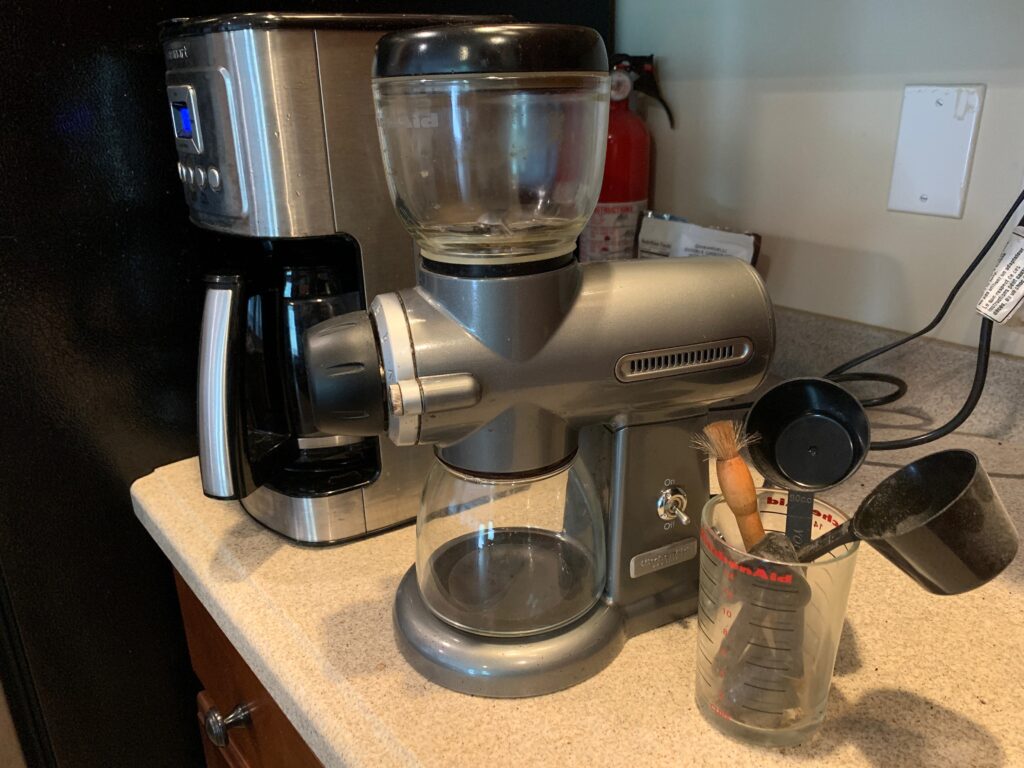
    I have had the same Kitchen Aid grinder for at least 30 years. A workhorse, it has outlived 5 computers and as many televisions. It sits on my counter beside my Cuisinart coffee maker. My grinder is integral to my morning ritual.

    The Magic of Ritual

    Each morning, I empty the prior days grounds from the Cuisinart into the trash (I’m not currently composting, though I have in the past). I fill the tank with water, then I reach down my tub of beans and one Melita bamboo, unbleached #4 filter from the box I’ve cut open to expose the filters in the cupboard. Using a scoop I keep in with the beans, I shovel 7 scoops into the top of my grinder. 

    My kids recently pointed out that I use a peculiar cadence when scooping—it’s quick scoop, slow pour… quick scoop, slow pour… If they’ve been awake, they’ve heard me do this every morning for their entire lives. My grinder is older than all but 1 of my kids. So they know the peculiar rhythm of my coffee ritual.

    After the 7 scoops, I flip the toggle switch and hear the satisfying churn of the grinder. It is deep and resonant, not like the high-speed whine of a blade grinder. Those sound more like a smoothie maker or blender. My grinder is more like a throaty wood chipper. I watch the heap of grounds slowly disappear into the grinder’s maw. I assist with a tiny pastry brush, sweeping the reluctant beans into the hopper to disappear. The aroma is fresh, instant, and intoxicating.

    buy a burr coffee grinder
    My burr grinder at the center of my morning ritual. (Photo by Author)

    The ritual is peaceful, serene, almost hypnotic. It is half-mindful-half-autonomic magic. I could do it asleep, but I remain aware of every step of the process. I know every quick-slow scoop matters to the outcome, so I pay attention with a much deeper part of me than normal thinking. Like I said, it’s magic. And my burr grinder is at the center of it all.

    So, buy a burr coffee grinder. It is a fantastic investment in excellent coffee, healthy ritual, and the beauty of single-purpose, well-engineered tools. Which means it is a fantastic investment in yourself. Win-Win-Win.

  • Take It From A Snob—You Should Drink Coffee Fresh

    Take It From A Snob—You Should Drink Coffee Fresh

    Drink Coffee Fresh
    Ocrakoke Coffee at Cape Hatteras. Yes, I bought a mug. (Photo by Author)

    # 14 on my 99 Life Tips–A List is: Drink coffee fresh. Preferably within 20 minutes after brewing. A brewmaster once told me that after 20 minutes, coffee’s chemistry changes, turning it into something else. As an addendum to this tip: don’t serve old coffee to a guest in your home. Make a fresh pot, or offer them something else.

    I suppose I should have started this tip with the simpler imperative, “Drink coffee.” But then I’d be forced to make an exception for my girlfriend who in all other ways seems remarkably well-balanced and stable, but who does not drink coffee, so I’m certain there is some latent problem yet to be revealed.

    I jest. But not about drinking coffee fresh. And not about making it fresh for company.

    My tip stands on its own with sufficient explanation. You can google the details if you doubt the veracity. Here is a good site with decent information for the home barista.

    One addendum: Buy whole beans, store them properly in an air-tight opaque container and grind them fresh with a burr grinder (not a blade grinder). I will be adding a story about this.

    Is it more trouble to drink coffee fresh? Yes. Is it worth it? Yes. Am I a coffee snob? Yes.

    Drink Coffee Fresh
    Beachie Bean’s Coffee Shop in NSB, FL (Photo by Author)

    To sample the local pace, support locally owned coffee shops

    While on the topic, allow me to plug the idea of finding good local coffee shops to support whenever you travel. I know the ubiquity of large chains like Starbucks make them easier to find for their numbers, but there is something uniquely satisfying about a cup of fresh coffee enjoyed just after dawn in a locally owned shop. 

    Part of the allure is that traveling well, and by that I mean getting the most of the experience, involves at least sampling the local pace of life, if not outright melding into it. Where better to sample the local pace than at a locally owned, locally supported coffee shop?

    Just remember to drink coffee fresh. You’re welcome. Oh, and never use non-dairy creamers and continue to call yourself a coffee drinker. I’m not sure what that chemically processed stuff is. So, that’s it. You’re doubly welcome.

    Drink Coffee Fresh
    This coffee shop on the NC Outer Banks even has a lending library. How cool is that? (Photo by Author)

    PS- I’m not a coffee shop owner, just an opinionated coffee lover who happens to be right about this. Enjoy! 😉

  • If You Want To Dance, You Have To Pay The Piper—And Other Sacred Verses Of My Youth

    If You Want To Dance, You Have To Pay The Piper—And Other Sacred Verses Of My Youth

    # 93 on my 99 Life Tips–A List is: If you want to dance, you have to pay the piper.

    This advice is from my Uncle. He said it so often that it is now enshrined in my life’s accepted canon. 

    This sacred tidbit is 1 Kurt 1:1.

    It stands beside other canonized wisdom I received as a kid from those more wise than I.

    My Granddaddy, Leo, used to say things like, “The faint heart never won the fair maiden.” 

    And, “Look before you leap.” 

    And “Nothing good ever happens after midnight.” 

    (Much later I would tell him he had never been out with me after midnight except to go flounder gigging).

    He said these things so-matter-of-factly and with such conviction he also has a book in the canon—First Leo.

    It is filled with priceless treasures, sometimes mixed with half-scriptures, like “the wages of sin is death.” Sometimes he elevated his extra-biblical quips to Divine status by asserting things like, “You know the Good Book says one in the hand is worth two in the bush.”

    A melting pot of wisdom

    I would shake my head and roll my eyes. But I didn’t dare try to dissuade him from mingling those aphorisms from Poor Richard’s Almanac and other dubious sources into a melting pot of wisdom. After all, I wasn’t “old enough for my wants to hurt me.”

    But, the one from my Uncle stands out, both for its succinct truth, and for its unfailing accuracy. 

    If you want to dance, you have to pay the piper.

    Other memorable verses from my Uncle include the timeless, “Let’s put her in the wind.” 

    He always said this at the end of a long workday when the power saws had screamed their last, the smell of fresh cut pine was hanging in the air, the tools were all gathered and put away, the job site was prepped for tomorrow, and power cords collected, coiled and looped like lassos. 

    That magical phrase signaled quitting time. It conjured sailing away towards a better shore, or riding off into the sunset, or exiting the stage into an evening of rest, relaxation, and recuperation, usually accompanied by a cold beer. Hearing it,  just as remembering it now, induces a Pavlovian response. Your face parts in an involuntary smile, and you’re ready to tap a reserve of strength to pack up and go—away from work and towards play.

    My Uncle and Granddad shared a common desire that propelled their energies. They wanted to play! So they worked hard to fully enjoy the play of not working in the interim. Neither one ever uttered something so mundane as “Work Hard, Play Hard.” But they lived it. And it rubbed off on me.

    I do want to dance. Both literally (sometimes), and figuratively (daily). To dance is to play. In my mind, I hear my uncle, and dance becomes representative of play. To do so, I work, cause you have to pay the piper, as it says in First Kurt chapter one. So, you too, remember this advice, if you want to dance, you have to pay the piper.

  • R-E-S-P-E-C-T: It’s Multi-Faceted Meanings & How Knowing The Variations Can Save Your Life

    R-E-S-P-E-C-T: It’s Multi-Faceted Meanings & How Knowing The Variations Can Save Your Life


    # 92 on my 99 Life Tips–A List is: You should, respect a person (or not) based on 1- who they show themselves to be. But, you should respect authorities based on 2- what they can do to you. None can require you to respect the person in the uniform or office, refer to “1” for that.


    I could not write this essay about respect without hearing Aretha belt out the spelling in that inimitable, soulful way of hers. I hope you’ll enjoy that earworm. If you belong to my generation, you will. If not, you’re already thinking, “huh?”

    This is an essay about respect; its various meanings, its contextual application, and how knowing how to show respect appropriately can save your life.

    Words are idea containers 

    We need to think for a minute about what respect is and what it isn’t. Like Aretha, we spell it only one way. But we use it to mean many things. I won’t bore you with definitions except to say this about words: Words are idea containers.

    When my firstborn was young — precocious, verbal child that she was — if she saw something she didn’t have the vocabulary for, she used a catch-all container, the word “pumen” (rhymes with lumen). Her word box contained everything from blackberries to motorcycles, from horses to Santa Claus. It was a large container. We grew used to her pointing at something and asking, “What’s that pumen?”

    “Respect” tries too hard to contain too much

    My story has a point. Which is that some words contain ideas so numerous and varied the containment stretches and tests the adequacy of the word to hold and convey them all.

    The word “love” is a prime example. We use it to describe our feeling for bananas, baseball, and best friends.

    With words such as love, like, hate, we come to understand that context plays a role helping the hearer or reader infer the speaker or writer’s intent. There is a broad range of meaning in these “over packed” words.

    Respect is such a word. It is an over-packed, “try-hard” of a word attempting to do overmuch. It is the “pumen” of social lubricants and niceties. This gives it a wide spectrum of meaning. But not all the meanings are apropos for every usage. 

    A variety of meanings to fit the contextual and cultural pendulum

    There is a contextual and cultural pendulum when selecting the applicable meaning of respect. In my lifetime, the meaning of respect has swung from — “to acknowledge the right of,” or, “to regard” — to the current meaning (as used by my kid’s generation) in which it reflects an amalgamation of “esteem, high regard, acceptance, and approbation” (though my kids never use that actual word). So, the meaning of respect is rapidly accelerating to its farthest and highest meaning which is “deep admiration” and “the highest regard”.

    And in some cultures respect has always meant “deep veneration” and “honor”, such as that respect shown to one’s elders, something we’ve never been good at in the U.S..

    We see then, that the single word respect conveys a variety of meanings. It doesn’t mean the same thing to all people, even to those who speak the same language and share the same cultural heritage.


    The Advice Reframed

    I laid that groundwork in an essay about respect to serve as a footing upon which to discuss the advice I offered at the outset. 

    When you read it again, notice how the meaning shifts. The ideas contained in the word respect change as the context changes.

    Below, for clarity’s sake, I’ve reframed the advice offered in my tip.

    Respect a person (or don’t respect them) based on:

    1- Who they are in words and deeds.

    2- The power they have (because of the office or job they fill) to mess with or take your life.

    As stated, Respect is an interesting idea-container of a word. It includes variations of meanings which have shifted in one generation. In my youth, showing respect was simply to act with the deference of courtesy and politeness. It was akin to good manners. Respect had little to do with agreement or acceptance or esteem, except at the very highest levels where only the most deserving received it. In such cases, we substituted a better, more specialized word, more descriptive of feelings of esteem, admiration, and acclaim.

    For example, I’ve never heard a fan say, “I really respect Jerry Garcia’s soloing.” Or, “I respect Mark Twain as a writer of short stories.” And no one would say, “I respect the way Mother Teresa cared for Calcutta’s poor.”

    Because Respect and Admiration are different

    To respect you is to offer you the opportunity to be heard, to voice your own opinion, to state your view and stake out a position. This fundamental level of respect comes with the territory inherent in the idea that we are equals. You are as entitled to your opinions as I am entitled to mine. I regard your right to speak for yourself and live the way you choose as valid rights. But… I am not required to admire the things you say or the lifestyle choices you make. I am not required to look to you as a role model. I may totally disrespect your choices, and you mine, while simultaneously respecting your right to make them.

    So, I can respect your right to your opinions without respecting your opinions. I can listen to you and still not agree with you. Respect doesn’t mean I shelve my discernment, logic, learning, or personal biases and views and adopt yours. Respect is not acquiescence, or agreement, or approbation.

    The Respect of 2 Ideological Opponents

    The story is told of the friendship of the late Supreme Court Justices Antonin Scalia and Ruth Bader Ginsburg. These two were figurehead iconoclasts of vastly different political and judicial ideologies, yet remained friends until Scalia’s death. Before his passing, someone once asked Scalia, the strict constructionist conservative, about his friendship with Ginsberg, the vaunted liberal feminist. The questioner expressed incredulity about the basis of such a cordial relationship when their political and judicial views were so diametrically opposed.

    Scalia quipped, “I attack ideas, not people.”

    If I could write that into my next thousand stories, I would.

    We do well to remember and practice those sage words. Respect for the other person is the contextual framework that allows that to happen. Scalia respected Ginsberg. She respected him. I respect them both, nay; I admire them both, for showing each other such deferential respect for the right to their own views and opinions, even when they didn’t share or admire the views expressed.

    How the meaning has shifted

    In my kid’s generation, the so called Gen X through Z, the meaning of respect has steadily swung towards the esteem side of the pendulum. If I disagree with the viewpoint of my youngest kids, they will often accuse me of being “disrespectful”, or worse, “rude” (which seems to be one of the worst character flaws you can display to members of the generations at the end of the alphabet).

    I’m sure the shift in meaning is because of mistaken ideas of Self-Esteem propagated in public educational environments. We commonly treat self-esteem as an entitlement to be granted to all as a participation trophy, rather than as the internal esteem one earns and holds for oneself because of one’s character (virtue). The word “self” in the phrase “self-esteem” is a dead giveaway that this esteem must come from within. No one can give it to you. Esteem conferred from without we should call by some other name.

    I can respect the right of a student to come to class, or to skip class. I can respect their right to learn up to their ability, or to shun the effort required to learn. But I do not esteem anyone who skips class or who does not better themselves when granted a free opportunity to do so. What is estimable about that?

    Thus, respect is not esteem, though the highest end of the respect-definition-spectrum does include the concept.

    Numbers 1 and 2 unpacked — This could save your life

    My advice in #1 above relates to this higher end of the spectrum. Admirable character, words, and deeds must earn the highest meaning of the word respect. To none but the worthy do we entitle this usage. We reserve it for the deserving because it conveys the sense of appreciation, approval, acknowledgement of worthiness, etc.. We don’t grant it lightly, denigrating and trivializing it into a meaningless entitlement to all comers, regardless of character, expertise, or worthiness.

    The admonition in number 2 of my advice, if heeded, can save you a lot of needless heartache, and possibly even save your life.

    I have in mind here those persons acting in an official capacity who have both authority and power to interfere with your personal freedom or life, in extremis. They can take either, or both. In an essay about respect, I would be remiss not to warn you to respect that power. Together we can pray and work to see the end of that power being abused and mis-used. Regrettably, that day remains in the future.

    We have all seen the horrifying and gut-wrenching examples of unscrupulous, even murderous, thugs (for there is no better idea container for them), dressed in uniforms and armed with badges, batons, billy clubs, and guns, who deserve no more esteem, admiration, acclaim, approval, or acceptance than a sociopathic criminal deserves. Their lack of character, lack of ethical behavior, lack of morality, lack of humanity all stand as accusers at the bar of justice, and we all want them to receive the just recompense of the crimes they’ve committed while clothed in the uniform and trappings of state authority.

    When in doubt, focus on the uniform, not the person

    Still, if a uniformed authority figure accosts you, you do well to respect the uniform for the power the wearer has to alter forever, or even to end, your life. It is shamefully true that some have shown this basic deference and respect for the uniform, if not for the person wearing it, and still had their lives taken away by a uniform wearing murderer. But it is wise to respect the power behind that uniform. It is wise to acknowledge the authority that created that position. It is important to remember that the authority that created the position also armed them with a weapon that if used, whether in righteousness or murder, can make you just as dead either way.

    So while, because of unworthiness of moral character, we may feel utter contempt, disdain, and disgust for the politician, or judge, or cop, or soldier who wields social or political or judicial power, we’d best respect the power. We can reach in the container of respect and at least come up with the sense of acknowledgement, understanding, and regard for what the uniform or office represents, even if we wouldn’t waste saliva to spit on the person occupying it. For the person wearing the uniform or occupying the office to receive more than base level respect, they will have to do so by earning it.

    The Takeaway — A Respectable Purpose

    But let’s turn away from uniformed persons, or officeholders, and other authority figures and end this essay about respect thinking about ourselves. If you want my respect, I stand ready to give it to you. I want nothing more than to have a role model to admire, a mind I can glean from, an example to be inspired by. Go for it. I will respect you to the fullest meaning. But I won’t hand you that just for sitting there breathing. Nor do I expect it from you. I aim to earn your respect. I want to earn it first as a person. No rotten tree can bear good fruit

    So, first I strive to be a person whose life and character are respectable. From that kind of life, I hope will flow opinions and ideas that will induce more respect. Do I hope to win your admiration and acclaim? Yes, yes I do. I hope that my presence on this planet enriches you and creates good things in your life. And I hope that your life will create good things for me. There’s no more respectable purpose, is there?