Tag: creativity

  • Why You Should Be Motivated By Hope

    Why You Should Be Motivated By Hope

    be motivated by hope more than by fear
    Photo by Don Pinnock on Unsplash

    # 94 on my 99 Life Tips–A List is: As much as lies within you, be motivated by hope more than by fear. 

    For your entire life, two great underlying motivators have debated and fought over all your decisions — hope of gain and fear of loss. These two combatants, working in opposition, have driven you to do, or not do, to opt for, or against, every choice having meaningful results from the time you were old enough to exercise free agency (self-direction in your preferences).

    Scan through a listing of headlines and sub-titles on Medium, or any platform like it. Nearly all seek clicks and readers by triggering hopes or fears. I recently read an interesting article on Medium by Ashley Broadwater that admits playing upon reader’s fears hoping to make headlines go viral. Similarly, look at a news media website. It’s nearly all fear… with a sprinkling of hope. This isn’t a judgement—merely an observation you may not have noticed or framed in these terms. 

    Can you guess which of these is the strongest, most predominant? Do people prove to be motivated by hope more than by fear? Sadly, no. The dominant motivator is fear, as shown in this research paper

    Fear has Instagram

    Quicker to act on the brain, fear stimulates a more primal region, causing autonomic physical responses in a way that hope does not. Fear is the Tony Robbins of motivational speakers shouting at your brain. (Not that Tony himself motivates by fear, he’s just bigger and louder—look at his website).

    Hope is meek, mild-mannered Seth Godin. (Compare Seth’s website). Like Seth, Hope relies on an understated, minimalist style and aesthetic. It is an emotional motivator that comes from higher, cortical levels of passive brain activity and more rational and active reasoning. Yes, hope is there, but seems a little unsure of itself, almost apologetic, as if it would be too much of an imposition or interruption if it were suddenly to speak up and assert itself. 

    Not Fear. Like a lie, Fear is halfway around the world before Hope can put on its pants. Except in our case, fear has taken over the brain before you can arouse hope to compete. Hope won’t cause an adrenaline dump. It won’t make your heart climb into your throat. Fear will do both those things then post it on Instagram. 

    These two, one larger and louder, the other more suppressed and quiet, are so ingrained, and one in particular, fear, so deeply rooted into both your physiology and psyche, you may not be aware of either. You cannot see them anymore, you’ve grown so used to them. Which is exactly why I’m writing this. I want you to be aware. You NEED to be aware. You’re making all of your decisions at their behest.

    Fear wins on points

    Fear wins on points as the dominant motivator. But it has an unfair advantage gained by being first to the market, so to speak.

    Neurophysiologists and psychologists agree that fear appeared very early in evolutionary brain development. It is the proverbial lizard-brain. This makes sense. Responding to saber-tooth tigers quickly can save your life more than contemplating Sartre and metaphysics hoping to create more inspirational cave art. Fear is why the art is in caves — and hope is why, even in caves, there is art.

    Think of the fear that would drive humans to live in caves, and the hope that would inspire them to create art on their walls. Beautiful and inspiring isn’t it?

    Fears and hopes and dreams of our own

    And that’s you and me. We have fears that drive us into our own caves. Both you and I seek protection and security. We hate the idea of loss. We are afraid to fail. These fears make us tolerate conditions we would never encourage a loved one to accept. Some fears paralyze our most precious dreams. Until the hope of their realization whispers in our ear, and we take up the pen, or the brush. Other fears cripple our resolve and erode our self-esteem—until we confront our demeaning and demanding boss, break free from an abusive relationship, and go for our hopes.

    Hope, meek, mild-mannered hope is all we have to nudge us forward out of comfort, and safety, and certainty. Hope encourages us with promise, prospect, potential, and possibility in our struggle to overcome fear. We overcome fear, all of it, by reaching for the hope of something better, something more than, even though we put everything at risk to arrive there.

    So, dear friends, as often as you can, be motivated by hope more than by fear. At the very least I hope by reading this you’re stirred to a new cognizance of what motivates you on a day-to-day basis and especially what drives the most impactful, big-picture decisions you make.

    More to say and the takeaway for now

    There is more to say on this subject than can I can address in one article. I’ll be working on related stories on this topic, having only scratched the surface in my background research. The relation of hope and fear to behavioral economics, politics, labor markets, relationships, and social justice movements are all topics I hope to write about. I’m excited to discover more, and I hope my findings will assist in your life’s journey.

    As a writer, I know the mind-crippling fear you must overcome (repeatedly) hoping your work can be meaningful to others—not just scoffed at and cast aside. Kudos to all of you who face down that elemental fear to paint, to sculpt, and to write on the walls of your own caves — and who invite us to take a peak. I see your art, and I see you. I think that’s what you, me, and all creators are hoping for.

    Just take this away; these two principle motivators impact all of your decisions. Scan your history to determine which has prevailed to this point. Motivated by hope, I equipped you with a fresh awareness to help you determine which will prevail as you go forward. It is my earnest hope that you will be motivated by hope more than by fear.

  • The Public Art/Private Artist Dilemma: Which Does The Audience Own?

    The Public Art/Private Artist Dilemma: Which Does The Audience Own?

    This is a story about the Public Art-Private Artist dilemma–defined as the struggle between what an artist creates for public consumption and the private artist who does the creating. The relationship between creative people (famous or not) and their audience raises an observation, and begs a question. The audience consumes the art produced by an artist, but can it claim ownership of either?

    The issue occurred to me a couple days ago when this tweet captured my attention.

    “Will you ever listen to Eric Clapton’s music again, now that you know he’s a Trump supporter?”

    Come Again?

    The tweet stopped me cold. And it’s had me thinking.

    First, I love Eric Clapton’s music. I have many of his albums, listen to them with joy, and I can even play a serviceable Layla on acoustic guitar. 

    Second, prior to the tweet, I knew as much about Clapton’s political views as he knows about mine. 

    Third, I don’t give a damn about his politics. What I care about is the way the music makes me feel. Who he votes for or thinks I should vote for has no bearing.

    When you write, or sing, or paint, or dance, or act, or play your instrument, I am moved by what you create–exclusively. If you move me so much I internalize what you created, it’s mine now. You made it part of me; the greatest success an artist can achieve. You still own the copyright, but you don’t own the effects.

    The best artists speak to us, move us, and shape us despite themselves. Only an artist knows the inner demons they wrestle to create something worth giving away; and the courage it takes to summon the vulnerability to give it. Creating art is an act of faith performed despite fear of failure and struggles with imperfection.

    So I don’t really care about your non-PC views, neuroses, or other hang-ups. I don’t feel compelled to cancel all your unpopular opinions. I promise to stress about your politics only if you write a political piece. Even then, I’m going to evaluate what you’ve created for me by how it makes me feel, and whether I incorporate it into my life, not by who you vote for, and regardless of whether you hold all the right opinions…mine.

    The shared bond between artist and audience is the art. When you make your art public, I own how it makes me feel. But I don’t own you. That’s private. 

  • What Would It Look Like Fixed? A Life-Changing Question

    What Would It Look Like Fixed? A Life-Changing Question

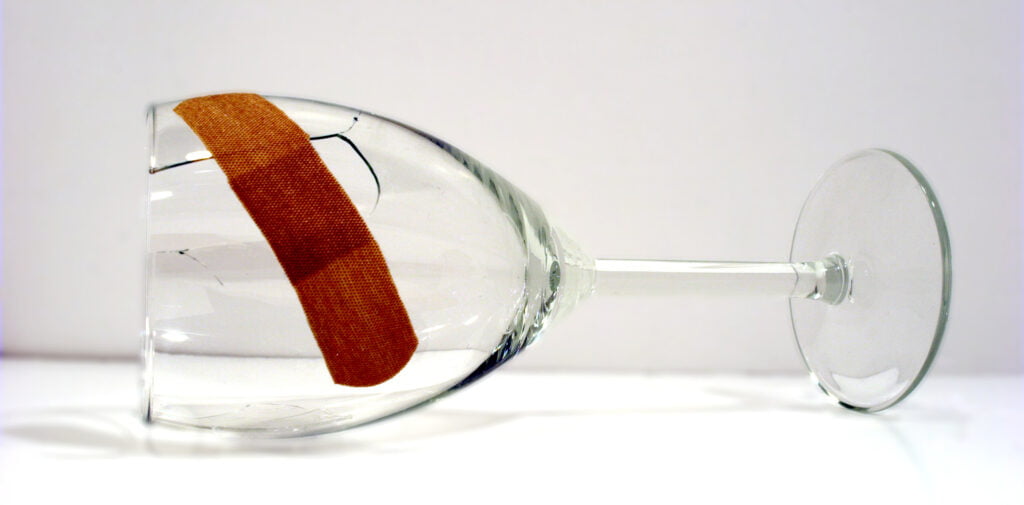
    What would it look like fixed? Probably not like this broken glass with a band-aid stuck on it.
    What would it look like fixed? Probably not like this…(Dreamstime Image: licensed to the author)

    # 60 on my, 99 Life Tips – A List is: You cannot solve any problem without having a clear picture of the solution in mind. Ask, ”what would it look like fixed?” borrowed from David Allen.

    Because this is one of my favorite questions, and has been so life-changing for me, I secured the domain whatwoulditlooklikefixed.com a few years ago, where I will eventually build out a self-help site based around this idea. I’m happy to share it here with you.  

    I was introduced to the concept in David Allen’s book: Getting Things Done: The Art of Stress-Free Productivity. I highly recommend the book if you want to dive deeper into the whole system of personal productivity and time management Allen espouses.

    Answering what would it look like fixed has become the starting point of my entire problem-solving heuristic.

    The premise is simple. A problem arises. You want to fix it. So far, so good…

    But fixing problems requires answers to two questions:

    1- What is the true problem? (This is a book in its own right)

    2- What would absence of the problem look like, or conversely, what would it look like fixed?

    Until you answer these two questions problems manifest will remain problems unsolved

    How often have you set out to fix a problem without first discovering what was really bothering you, or having a definite, clear idea of what needed to happen to not feel bothered by it anymore? If you’ve done this, you know how frustrating it can be to multiply effort using the wrong means for the wrong ends with no clear plan. (Which probably describes the typical workday of millions of people). And maybe this too accurately describes normal life for a lot of people as well.

    So, since you certainly want to avoid adding frustration to the feelings you already have about your issue. Do the hard work, the meaningful work, up front. The hard work is actually mental, involving thinking and imagination. You’re creating a world where your problem doesn’t exist. In this world, you vanquished the burden. It’s gone. Exterminated. Kaput.

    This picture gives you both a target state to achieve and the inspiration to achieve it. Don’t worry yet on what will have to happen to make this vision come to pass. That’s another part of the problem-solving process. Without a clearly defined destination, further steps in the process are tantamount to walking in circles.

    From Concept to Concrete

    This is how, precisely how, all the man-made reality that you look around you and see, gets from concept to concrete. Things go from abstract idea to tangible reality by answering some variation of this one question.

    What would it look like fixed?

    If you want to solve a problem and don’t have this idea clearly in mind, how will you know when you’re done? How will you gauge success at eliminating the problem. Do you see the dilemma? Unless you can clearly state, in specific language, ”This problem will be fixed when ______________.” happens, all efforts will amount to pushing in the clutch on a car, stomping the accelerator, and redlining the engine in a screaming cloud of smoke and fury, but the car goes nowhere.

    Instead, do the hard work up front. Get a clear picture of exactly what fixed would look like, then use the appropriate means to reach that desired end. (A subject for another day).

  • Words Mean Things

    Words Mean Things

    My mind was blown and my soul touched by Amanda Gorman’s recitation of her poem, The Hill We Climb during yesterday’s inauguration of Joe Biden as the 46th President of The United States. Her words were inspired and inspiring. Her tone, honest and hopeful. 

    The text of Miss Gorman’s poem can be found at a number of places online, here is one:

    https://www.baltimoresun.com/opinion/editorial/bs-ed-0121-gorman-transcript-20210120-5ojxffrfb5cybjabhgiffgiyhi-story.html

    I encourage everyone to read it. I encourage everyone to soak it in and to soak in it.

    I happened to hear an interview last night with Miss Gorman during which she was asked if she visualized images as she created her poem. Her response, paraphrased, was that she is a poet working with words and text, not images. She went on to explain how she had wanted to re-elevate the simple power of the word after an era when words have been both misused and used to mistreat, and to mislead.

    This resonated with me. Words mean things. Words can build up or tear down. They can bind up invisible wounds or they can cut deeper than a sword to create jagged, pain-filled new ones. 

    Words are containers of meaning. Speakers and readers of the same language use abstract sounds or squiggles and marks on a page to transmit an invisible part of themselves to their hearers and readers. This transmission of oneself into another by the means of communication is an invitation to a shared world (or the casting out from one); a window to a shared reality (or a slammed door); a link that bridges the gap between two souls (or a wall of impediment). 

    Miss Gorman’s carefully chosen words, some of which I have excerpted below, are a blueprint of an America that I believe in. 

    I want to live in and be part of creating an America where:

    ”…we lift our gazes not to what stands between us, but what stands before us. We close the divide because we know, to put our future first, we must first put our differences aside.”

    ”Because being American is more than a pride we inherit; it’s the past we step into and how we repair it.”

    We each have a chance to step away from the brink and into a new way of speaking to and listening to one another. Though we are not all poets; we can, and we must, choose our words carefully, the ones we speak and the ones we listen to. After all, words mean things.

  • Creation v. Distribution

    If you want to share the things you create; art, music, writing, crafts; you will reach a dilemma that involves dividing your time between creating, and learning how to effectively share what you’ve created. 

    You will have to think about, research, compare, decide upon, engage with, manipulate, conduct trials, learn from errors, and finally, implement channels of distribution. Then, you will have to analyze the results, make adjustments, and maybe even go a different direction to reach your target audience.

    You will be forced to divide your energy and your precious fleeting time between the creative and the administrative, between the producer and the distributor, the manufacturer and the salesman. 

    All the links in the chain are important, but not equally so. All have their place, but must be ordered properly. All are useful, but only a few are necessary. The effort to create does not occupy the same mental space or attention as that required to promote and market and distribute, because creation and distribution utilize different skillsets. Do not lose sight of what is truly valuable in the chain. 

    There is no need of a market without a product. 

    Be careful to get the best return on your investment of time, attention, and energy. Maximize your strengths at all times. This is more valuable than improving your weaknesses. 

    Selling one’s wares can take on a life of its own with an insatiable appetite that eats the maker of the wares.