If you ever get a chance to lift up your eyes to the Grand Tetons I hope you’re as blown away as I was (Unsplash image by Toan Chu)
# 13 on my, 99 Life Tips – A List is: In keeping with the above, lift your eyes throughout the day to change your focal point, especially when outdoors. Americans, especially, are ”head hangers” habitually looking a yard or two in front of our feet. We even do this indoors, looking at the flooring. Look up. You’ll thank me.
My uncle taught me this. He pointed it out to me when I was working for him and learning carpentry. Doing a job for a client that wanted us to install 7-pc crown molding in a 20 foot foyer, he remarked that they were wasting their money. When I asked why he said, ”Americans are head hangers.”
He had been raised in Great Britain, and had traveled extensively overseas, including a stint in Vietnam. I figured he knew was he was talking about though it didn’t keep us from taking the job.
I began observing people. My observations confirmed my uncle’s assertion. It was especially obvious, when I watched people enter a new space. And this was apparent whether people walked into a residence, or into a commercial or religious building. Americans gaze downwards more than upwards.
Maybe it’s our colonial, puritanical beginnings. There are no real castles or cathedrals marking our national architectural aesthetic.
Maybe it’s purely evolutionary. Man has never faced too many predators from above. Who knows?
Now, that’s fine if you’re hiking, making sure not to twist an ankle, but it could cause you to miss out on a lot of unexpected Beauty that is above eye level. And that would be a shame because unexpected Beauty is one of the greatest sources of Gratitude and the resultant increase in happiness and overall mental health. So, do yourself a favor and make the effort to look up.
Now, if you prefer your life tips with a moral. Consider Psalm 121:1-2
”I lift my eyes up, to the mountains, where does my help come from? (some translations are affirmative, and render the last clause, ”from whence comes my help.”)
My help comes from You. Maker of Heaven. Creator of the Earth.”
Notice: The Psalmist does not look down in helpless despair. Neither does he look around for help, knowing assistance from peers on his plane won’t suffice. For help, he looks up. He looks to the Mountains, to the Heavens, and to their and his Maker.
Eye vision test with sight chart – the chart is what it is
# 21 on my, 99 Life Tips – A List is: Accept life as it shows you it is, not as you wish it was, or as you want it to be. The same goes for people.
It’s possible some will read that tip, shrug, and think, ”No duh!” While others, myself included, will see that we resemble the remark, and try to act on it. While it is undoubtedly normal to put the best spin on life, some of us invest too much in the spin. If this is you, then let this be a reminder to accept life as it shows you it is. And also, accept people the way they show you they are, not as you want them to be.
Rather than try to enumerate all of the psychological reasons some people have difficulty with this, let’s stipulate that some simply do. You may be among that number. Assuming that’s the case, consider the following questions:
Is your experience of life the result of how you think life is; or do you think about life based on how life has shown itself to be to you?
Perception Is Reality
Few would admit they belong in the first camp. And yet, to some degree, we cannot experience anything differently than how we think prior to the actual experience. You bring your way of thinking about life to every life experience. This is commonly referred to as paradigm, which is nearly synonymous with perspective. The difference being that paradigm refers to the big picture ”model” of reality we mentally construct, while perspective refers to the small picture, individual, subjective point of view from which we observe the model and form beliefs about it. Together, these influence our perception of the world. And our perception is our functional reality. How could it be otherwise?
In this way we experience life like a person who perpetually wears sunglasses. The sunglasses filter everything. The filter modifies the reality of what is being looked at. Remove the sunglasses, and everything looks a little different. Change the filter and change the world.
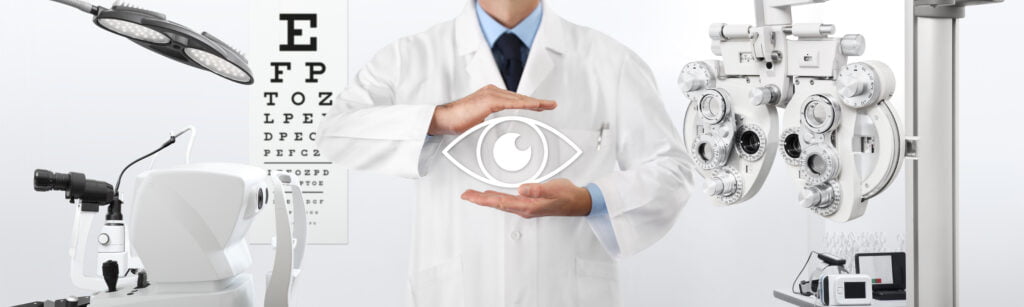
This optician, with his charts and machines can help you see things in the physical world the way they are. You’ll have to do that for yourself in your mental world.
A patient in need of eyeglasses looks at a chart, or at images though a machine. The images are blurred. An adjustment is made. The images get worse. Another adjustment, and the images get better. They appear sharp, crisp, and in focus. In this scenario, do the actual images change at all? No…they are what they are. The patient would be foolish to see blurred images, wish they were clear, and declare them to be so because he wants them to be.
Reality Cataracts
A few years ago, I had cataract surgery for both eyes. Prior to the surgery, vision in my right eye had become so occluded that if I tilted my head a certain way, objects would disappear. I could make street signs, cars, and people disappear just by closing my left eye and tilting my head. Some people try to live this way. They try to make problems disappear by an inner tilting of their mind. But guess what? Just because you cannot or will not see something doesn’t mean it’s not there.
If your own paradigm, perspective, personality, perception, or personal hang-ups make it difficult to accept life as it shows you it is, then, like a person in need of an optometrist for corrective lenses, you probably need a new prescription. Or, like me you need an ophthalmologist for your eyes and your life. Tilting your head and pretending is not a long term solution.
And friends, not to be too heavy handed with the analogy, that’s us. Life and people are images on a chart. The chart does not change. The way you see the chart changes. Better to see the chart, and life as it shows you it is, not the way you wish it was.
Awareness Of The Susceptibility Helps You Look Twice
I wish there was a magic cure. If there is one, I haven’t found it. Knowing that I’m wearing my own sunglasses of perception, and that I cannot take them off, helps me to realize that I could be wrong. Knowing that I’ve had a past history of mistaking my glossed over version of reality from what was really on the chart, makes me wary. It makes me look twice. I don’t tilt my mind and hope the evidence will change. This healthy skepticism at least gives me the awareness that my own uncorrected filter tends to skew life towards the way I prefer it to be, not necessarily the way it is. This is an imperfection that I will likely always carry with me. So, my tip to accept life as it shows you it is…definitely applies to me. If it applies to you, get those eyes checked.
You have made it to today. Congratulations! No, I’m definitely not being facetious. If you are reading this you’ve proven that you have what it takes to marshal your resources, persevere in the daily grind, overcome obstacles, and succeed in life. Have you ever stopped to realize the truth of what you just read? It has taken a series of daily miracles to make it here! Have you considered that? If not, the appropriate response to that recognition should be gratitude.
The simple, undeniable fact of being alive…again..today…this day, is enough evidence to prove you know how to do this life thing. With all that you’ve been through, it is a remarkable achievement to keep showing up!
If you don’t feel like the reminder is a big deal – no, a ReallyBigDeal, then you probably take a lot of unpleasant rides on the emotional roller coaster. Am I right? I can make that guess with confidence, knowing that a consistently positive emotional state is sustained by an accurate accounting and valuation of what you have. It is impossible to be happy while anxious and focused on what you don’t have.
Simply re-aligning your focus can change your life.
”I can tell your future
just look what’s in your hand.
But I can’t stop for nothing
I’m just playin’ in the band.”
~Grateful Dead: Playin’ In The Band
The focus of this site
This post and site is devoted to helping you look at what’s already in your hand. Once you see that you’ve had everything you’ve needed, really needed, to get to today; you will gain a confidence that will see you through every storm to arrive at whatever port tomorrow brings your way. Remind yourself, that if you’ve made it to today, the appropriate response is gratitude.
So, stop for a moment and allow yourself to feel grateful that you’ve made it this far, that you’re still here, that you’ve been perfectly equipped to get to this point in your life. We’ll learn how to focus that appreciation onto the smallest things, the simplest occurrences, the thousand and one simple pleasures that enrich your life every day.
You’re going to learn how to see what you have, simply by looking for it, and looking at it. And that’s going to spark a new way of seeing everything else about this world. Gratitude for the smallest of blessings can turn this entire world into a museum of amazement for you.
One of my favorite lines in a Grateful Dead song comes from the tune, Scarlet Begonias.
“Once in a while you can get shown the light,
In the strangest of places if you look at it right.”
This has been true for me. All that it sometimes takes to see a previously hidden truth is my own willingness to look at the subject a different way.
This act of taking another look at something is what is colloquially referred to as ”open-mindedness”. I find a lot of people are afraid of this term. I find they are afraid of it because they misunderstand it. Being ”open-minded” doesn’t mean abandoning anchors of belief, or intellectual boundaries, putting you in danger that your brain will fall out. It means accepting the possibility that there may be more than one valid viewpoint to a particular issue.
Ideally, this would be a universally applied truth. But, before any truth can be applied, it must first be known. Here then, is my attempt to say,
”Hey, here’s something cool. There’s more than one way to see a lot of issues. Have you tried looking at it from another perspective? Have you tried putting yourself in the other guy’s shoes, for instance?”
A few months ago, I was sitting on the front porch with my seventeen year old. We were discussing a problem he was facing. His ability to solve the problem was limited by two things. One, he had only seventeen years of experience to draw from. Two, this lack of experience forced him in to a very narrow perspective, which blew the problem out of all proportion.
I was sitting in my normal spot on the front porch. It is wide enough to accommodate my frame. He was sitting in a chair to my left. A cloud moved in the sky, the sun peered from behind it, illuminating a perfectly crafted and quite large spider web just as I glanced up to notice it. The web had been there the whole time we had been talking, but I couldn’t see it against the gray overcast. It took the light hitting it just right for it to come into view. What had been real the whole morning, was now real to me.
I asked my son, sitting to my left at the end of the porch and at an acute angle to the web, if he could see it. He shook his head. Interesting, I thought. Nature has provided the perfect metaphor.
”Come look at this,” I said.
He got up, came over a few steps and looked up at the intricate web.
”Wow!” he said. He was amazed by both the intricacy of the web, and that something so large had been completely hidden from view.
Years ago, on vacation in New Smyrna Beach, Florida, I awoke at dawn to go for a walk on the beach, and I saw a curious sight. A guy on a bike was pedaling across the parking lot from the street, pumping away with one hand on the handlebars and the other gripping a surfboard perched precariously on his shoulder. The board was at least twelve feet long.
I glanced seaward and saw six or so surfers out in the cold, gray, early morning waters. NSB is known for two things: surfing and shark bites.
The cyclist chained his bike to a post and carried his board over to where I was staring out at the early-bird surfers. Some were prone on their boards paddling out into the breakers, some were sitting straddle-legged, bobbing in the swell, just beyond the whitecaps, looking out to sea over their shoulders towards the rising sun.
I stood there for a few minutes watching, when I noticed the guy with the ultra-long board hadn’t budged. I said, ”Aren’t you gonna join them?”
He kicked at some sand, kept peering intently at the sea, and said, ”Nah man, there’s no set.”
I realized I hadn’t actually seen anyone up on their board riding a wave yet. Waves were breaking but the kids in the water kept re-positioning themselves, occasionally paddling furiously to try to catch a whitecap and giving up.
”That’d just be a lot of wasted time,” the leather-tanned surfer said, squinting into the morning sun, ”Maybe later.” And with that he turned and padded barefoot back to his bike.
That morning has stuck with me as a metaphor for wasted effort. The people in the water weren’t ”surfing”. They were wet, they had surf boards, they were cresting whitecaps, but they weren’t surfing. Surfing happens when you match your timing, positioning, and skill with energy that the wave provides. And when the waves are broken and irregular and without a ”set”, you spend more energy than the ocean does.
Mr. Longboard had come to surf, not just to get wet. Since the conditions weren’t cooperative, he wasn’t wasting his time and effort. He was experienced enough to know it would have been a lost cause.
Similar events happen in our lives. Times when we are maxing out effort but there is no flow, and few results. We’re busy, but not productive. Sometimes, it’s a conversation where the other person just isn’t hearing, no matter how many different ways you try to say it. Sometimes, it’s adverse market conditions. Or when the environment makes it impossible to concentrate and do your best work. And sometimes we give it our all, but things beyond our control prevent the results we’re hoping for. It’s important to recognize that it isn’t always about you.
We can learn to maximize the return on our efforts. We can be aware of opportunities to meld effort, skill, and timing to get the best results. And we can learn to spot when there is a ”set” and be ready to ride.